
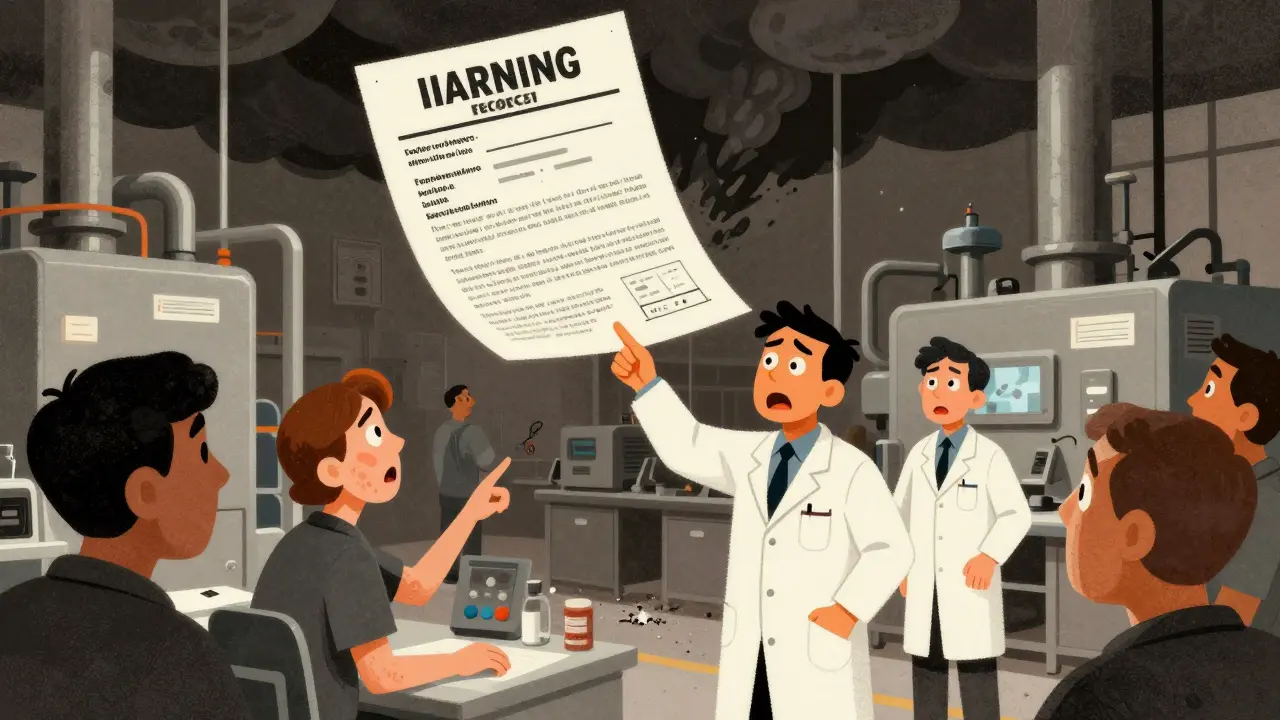
When the FDA issues a warning letter to a drug manufacturer, it’s not just a notice-it’s a red flag that can shut down production, delay product launches, and cost millions. These aren’t casual reminders. They’re formal, legally significant documents that spell out exactly how a company broke the rules and what it must do to fix it. If you work in pharmaceutical manufacturing, understanding these letters isn’t optional. It’s survival.
What Exactly Is an FDA Warning Letter?
An FDA warning letter is the agency’s official way of telling a manufacturer it has violated the Federal Food, Drug, and Cosmetic Act, especially when it comes to Current Good Manufacturing Practices (CGMP). These rules aren’t suggestions. They’re the minimum standards for making sure drugs are safe, pure, and effective. The FDA doesn’t issue these letters lightly. According to their own data, warning letters are only sent when violations are serious enough to risk patient safety or product quality.
Between 2022 and 2023, the number of warning letters jumped from 289 to 327. That’s a 12.7% increase in just one year. And it’s not random. The FDA has been ramping up inspections, especially at foreign facilities. In 2023, Indian manufacturers received nearly 39% of all warning letters, while U.S.-based companies got about 31%. The trend is clear: enforcement is getting stricter, and the net is widening.
What Do These Letters Actually Say?
Every warning letter follows the same structure. It starts with a list of specific violations-no vague language here. For example, one letter sent to Daewoo Pharmaceutical in July 2025 pointed out that workers had exposed skin, including foreheads, in an ISO 5 cleanroom. Another cited the use of non-sterile tape on a filling line. These aren’t hypotheticals. They’re real, documented observations from inspectors on the ground.
The letter then cites the exact regulation broken. Most often, it’s 21 CFR Parts 210 and 211, which cover the basics of manufacturing, testing, and quality control. But it’s not enough to just name the rule. The FDA expects you to show you understand why it matters. For instance, if you failed to test incoming ingredients for contamination, the letter will specify which components were affected-like glycerin or propylene glycol-and why that’s dangerous.
Finally, the letter tells you what to do. No vague promises. You must submit a detailed corrective action plan within 15 working days. That means identifying the root cause, proving you’ve fixed it, and showing how you’ll prevent it from happening again. The FDA doesn’t accept excuses like "we didn’t know" or "it was a one-time mistake." They want data, documentation, and proof.
Common Violations You Can’t Afford to Ignore
Not all violations are created equal. Some show up again and again. Here are the top three that land companies in hot water:
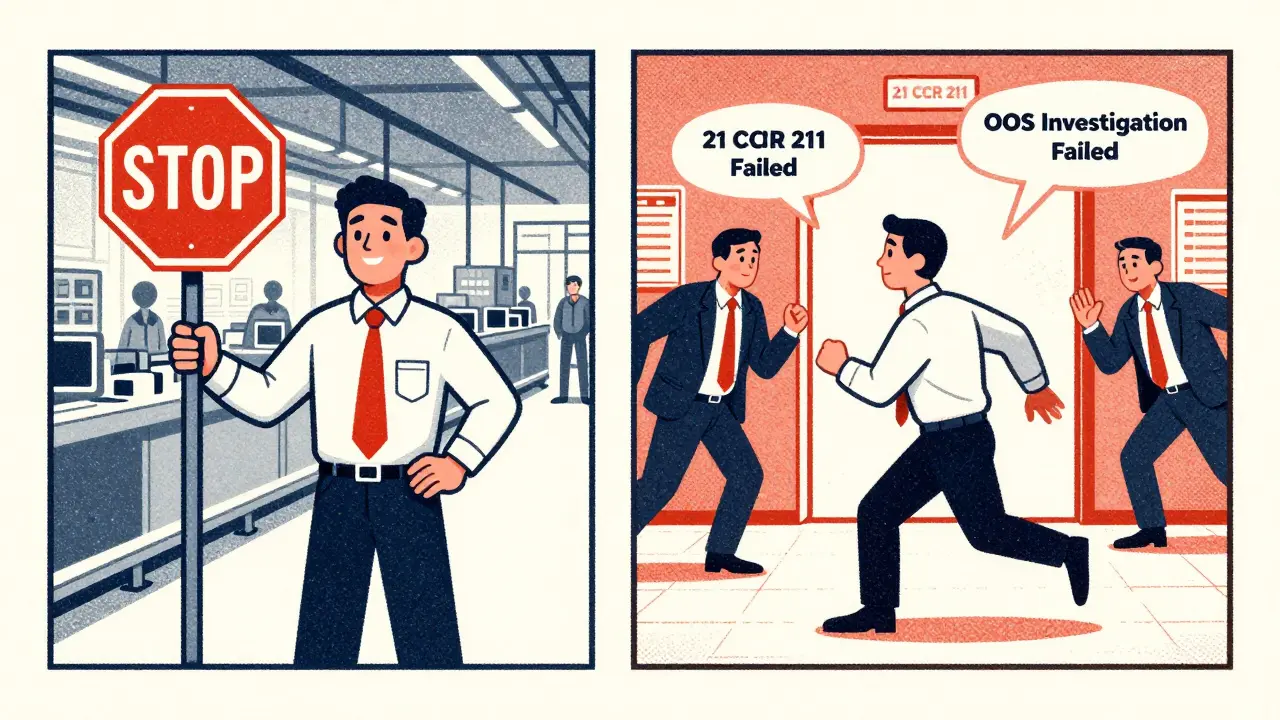
- Inadequate investigation of out-of-specification (OOS) results: If a batch fails testing, you can’t just throw it out and move on. The FDA requires a full investigation to find out why it failed. In 63.4% of warning letters, this was the root issue. One company got cited because they never checked whether a failed sterility test was due to lab error or actual contamination. That’s a red flag.
- Poor quality unit oversight: The quality unit must be independent and empowered to stop production if something’s wrong. In 57.8% of letters, this was flagged. One manufacturer kept shipping products even after the quality team raised concerns. The FDA saw that as a culture problem-not a one-off mistake.
- Aseptic processing failures: For sterile drugs, like injectables, contamination risks are deadly. A 2022 study of 512 warning letters found 78.3% involved aseptic issues. One common problem? Inadequate media fill tests. These simulate production to catch contamination before it hits patients. Skipping or botching them is a fast track to a warning letter.
And don’t forget data integrity. In 2019, only 42% of warning letters mentioned data issues. By 2023, that number jumped to 67%. The FDA is now watching electronic records like a hawk. If your system allows edits without audit trails, or if logs are deleted, you’re on their radar.
What Happens After You Get a Letter?
Getting a warning letter doesn’t mean the end. But how you respond makes all the difference.
Most companies take 45 to 90 days just to write a proper response. Why? Because you need more than a letter. You need:
- A full root cause analysis backed by data
- Proof that your corrective actions actually worked
- A plan to prevent recurrence
- Documentation for every step
One mid-sized generic drug maker spent $4.2 million and lost 14 months on a product launch because their visual inspection system was flawed. The cost? $28 million in lost revenue. But it doesn’t have to be that way. Teva Pharmaceuticals fixed a similar issue in 11 months and cut product defects by 30%. Their secret? They didn’t just patch the problem-they rebuilt their quality culture.
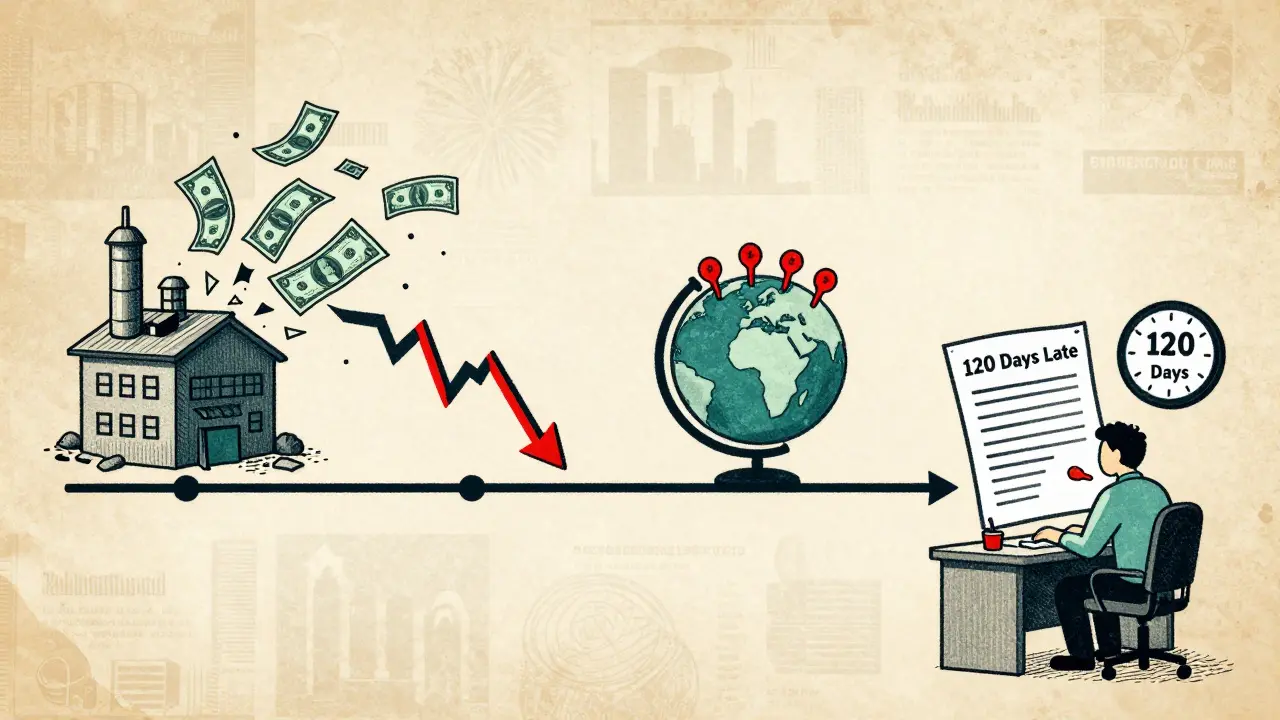
But here’s the catch: the FDA doesn’t always respond on time. Their target is 45 days to review your plan. In reality, 54% of companies wait over 120 days. That kind of delay can kill a product pipeline.
The Hidden Costs: More Than Just Money
Financial impact is obvious. EY’s 2023 survey found the average cost to fix a warning letter is $1.8 million for U.S. facilities and $2.7 million for foreign ones. But the hidden costs hurt more.
Companies that get warning letters often freeze new product submissions. That means no new revenue, no pipeline growth. Stock prices drop-firms with active warning letters saw 18.4% lower performance over 12 months, according to IQVIA.
Small manufacturers suffer the most. One 15-person facility spent $250/hour on three consultants just to write the response. They nearly went bankrupt. The system isn’t designed for them. The FDA expects enterprise-level documentation from a team of five.
And reputation? Once a warning letter is public-usually within 15 business days-it’s online forever. Buyers, partners, and investors check the FDA’s website before signing contracts. One letter can cost you customers you never even knew you had.
How to Avoid a Warning Letter Before It Hits
You can’t wait for an inspection to find your weaknesses. Here’s how to stay ahead:
- Run internal audits like the FDA is watching. Don’t wait for a Form 483. Find your own gaps before they do.
- Train staff on real-world examples. Show them actual warning letters. Don’t just teach the regulation-show them what breaking it looks like.
- Fix OOS results immediately. Every failed test needs a full investigation. No exceptions.
- Protect your data. Audit trails must be locked. No manual overrides. No deleted logs.
- Test your aseptic processes. If you make sterile products, your media fill program must be flawless. Run it quarterly, not annually.
And remember: the FDA looks at your entire company. If one facility got a warning letter two years ago, they’ll check if the same issue exists elsewhere. Glenmark Pharmaceuticals got cited in 2025 because they had the same problem at a different plant as they did in 2019. The FDA doesn’t forget.
What Comes Next? The Future of Enforcement
The FDA isn’t slowing down. Their 2023-2027 Strategic Plan says they’ll focus on facilities with past violations. Their goal? Cut repeat violations by 25% by 2027. That means more inspections, more scrutiny, and more letters.
They’re also expanding their use of the Risk-Based Certificate of Pharmaceutical Product Pilot Program, which means international suppliers will face even tighter checks. And with $112.7 million now dedicated to foreign inspections-a 28.5% increase since 2020-they’re serious about global oversight.
But there’s a risk. A 2023 FDA inspector report found 31% of follow-up inspections were delayed due to staffing shortages. That means some companies get away with slow fixes. But don’t count on it. The trend is clear: if you cut corners, you’ll be caught.
94.7% of companies eventually come into compliance after a warning letter. But that doesn’t mean it’s easy. It takes time, money, and real change. The companies that survive don’t just fix the problem-they fix the system that let it happen.
What happens if I don’t respond to an FDA warning letter?
If you don’t respond within 15 working days-or if your response is inadequate-the FDA can escalate. This includes placing your products on import alert, seizing inventory, issuing injunctions, or even pursuing criminal charges. Non-response is treated as a refusal to comply, which removes any chance of negotiation. The agency will act to protect public health, and that often means blocking your products from entering the U.S. market.
Can a warning letter be removed from the FDA website?
No. Once issued, a warning letter remains publicly available on the FDA’s website indefinitely. Even if you fully resolve the issue and the FDA closes the case, the original letter stays posted. This is intentional-it serves as a public record of compliance history. Companies should treat every letter as a permanent part of their regulatory footprint.
How long does it take to recover from a warning letter?
Most companies need 6 to 12 months of intensive work to fully resolve a warning letter. The timeline depends on the complexity of the violations. Simple documentation issues may be fixed in 4 months. Deep-rooted cultural or systemic failures-like poor quality unit authority or repeated aseptic breaches-can take over a year. The FDA doesn’t rush approvals. They want proof that changes are lasting, not temporary fixes.
Are warning letters only for pharmaceutical companies?
No. While most warning letters go to pharmaceutical manufacturers, they’re also issued to makers of medical devices, biologics, and even dietary supplements. Any facility regulated under the FD&C Act can receive one. The rules vary slightly by product type, but the core requirement-compliance with CGMP or equivalent standards-is consistent across categories.
Why do foreign facilities get more warning letters than U.S. ones?
Foreign facilities receive 22% more warning letters than U.S. facilities for equivalent violations, according to regulatory experts. This isn’t because foreign manufacturers are worse-they’re not. It’s because inspections abroad are more frequent and often less predictable. U.S. facilities have more regular oversight and better access to FDA guidance. Foreign sites may also face language barriers or cultural differences in compliance practices. The FDA is working to reduce this gap, but the imbalance remains a major point of industry concern.


14 comments
Nicholas Gama
This isn't about compliance. It's about control. The FDA doesn't care if you make safe drugs-they care if you follow their script. Every warning letter is a power play. They want you begging for permission to exist. And don't think they're blind to the fact that 78% of violations come from underfunded labs. They just don't care.
They're not protecting patients. They're protecting their budget. You think they'd let a foreign plant slip if it wasn't for the political optics? Don't be naive.
Mary Beth Brook
CGMP isn't a suggestion-it's the baseline. If your facility can't maintain ISO 5 integrity with exposed skin in the cleanroom, you shouldn't be manufacturing injectables. Period. The FDA isn't being punitive. They're being rational. And anyone who calls this overreach hasn't seen what happens when sterility fails. I've seen babies in NICU with fungal sepsis from contaminated IV bags. This isn't bureaucracy. It's triage.
Ray Foret Jr.
Man I read this whole thing and I'm just like… wow. Like seriously? We're talking about people who make medicine and they're getting nailed for using non-sterile tape?? 😅
But also… I get it. I work in a lab and one time we had a glove tear and we didn't report it. Next thing you know, the whole batch got flagged. Took 3 months to fix. So yeah. It's wild but it's real.
Just… maybe give small shops a break? We ain't Teva. 🙏
rafeq khlo
The data is clear Indian facilities are 39 of all warning letters this reflects systemic failure in quality culture not bias or oversight disparity US facilities have institutionalized QA systems while many foreign operators treat compliance as transactional not cultural this is not an indictment of people but of process design and leadership failure
Morgan Dodgen
Let’s be real-the FDA doesn’t want you to fix things. They want you to fail. Why? Because if you fail, they get more funding. More audits. More power. They’re not here to help. They’re here to expand. Look at the budget increases. 28.5% more for foreign inspections? That’s not about safety. That’s about empire-building.
And don’t get me started on data integrity. They’re scanning every keystroke like we’re all hackers. If you edit a log? You’re a criminal. If you fix a process? You’re still guilty until proven innocent. Welcome to the surveillance state.
Philip Mattawashish
You think this is about safety? No. This is about control. The FDA doesn’t want you to make medicine. They want you to beg them for permission to make medicine. Every warning letter is a psychological trap. They know you’ll panic. They know you’ll spend $2 million on consultants. They know you’ll cut corners just to get back in their good graces.
And then? They do it again. Next year. Next facility. Same script. It’s not regulation. It’s ritual. And you’re the sacrifice.
Tom Sanders
Yeah ok but like… how many of these letters are just because someone forgot to sign a form? I mean come on. I’ve worked in pharma. Half the time it’s paperwork drama. The FDA’s got 10,000 pages of rules and half of them don’t even make sense. They’re not catching killers. They’re catching typos.
Jazminn Jones
The assertion that foreign manufacturers are disproportionately targeted is statistically misleading. The disparity in warning letters correlates directly with the volume of inspections conducted. U.S. facilities benefit from routine, scheduled audits and established communication channels. Foreign facilities operate under unpredictable, high-risk inspection regimes. This is not bias-it is operational asymmetry. The FDA’s methodology is consistent with risk-based prioritization. To claim otherwise is to misunderstand regulatory science.
Stephen Rudd
Everyone here is acting like the FDA is some infallible guardian of health. Newsflash: they’ve approved opioids that killed half a million people. They’ve ignored contamination in vaccines. They’ve let companies use outdated software because it’s "grandfathered."
Now they’re screaming about tape on a filling line? That’s not oversight. That’s theater. You want to protect patients? Fix the real problems. Not the ones that look bad on a PowerPoint.
Erica Santos
Oh wow. A 12.7% increase in warning letters? That’s progress? No. That’s a system that’s broken. You don’t fix quality by scaring people into compliance. You fix it by empowering them. By trusting them. By paying them enough to care.
Instead, we have a culture where the QA guy gets fired for reporting a problem. And the FDA? They just write another letter. Brilliant. Let’s keep punishing the people who are trying to do the right thing.
George Vou
they said 39% of warning letters went to indian companies but what about the fact that most of the generic drugs in the us come from india? like duh. if you make 40% of the product you’re gonna get 40% of the letters. its math not malice.
also the whole "exposed skin" thing? yeah i get it but like… did they really have to make a whole letter about a guy with a forehead? lol
Scott Easterling
And let’s not forget: 67% of warning letters now mention data integrity. That’s insane. We’re not in 1998 anymore. You can’t just write on a clipboard and call it good. But also… why are we still using systems that let people delete logs? That’s not a compliance issue-that’s a design failure. Someone’s making money off this mess. And it ain’t the workers.
Mantooth Lehto
I worked at a small facility that got a letter over a failed media fill. We spent $180k on consultants. We lost our biggest client. We had to lay off 3 people.
And the FDA? They didn’t even reply for 6 months. Meanwhile, my boss cried every night. I’m not mad. I’m just… tired.
Why does it have to be this hard? 😭
Melba Miller
I read this and all I could think was: who’s really paying for this? The workers? The patients? Or the consultants who charge $300/hour to write the same 10-page response for every company?
There’s a whole industry built on FDA panic. And it’s not helping anyone. It’s just making a few rich.
Maybe the real violation isn’t the tape on the line. Maybe it’s the system that profits from the fear.