
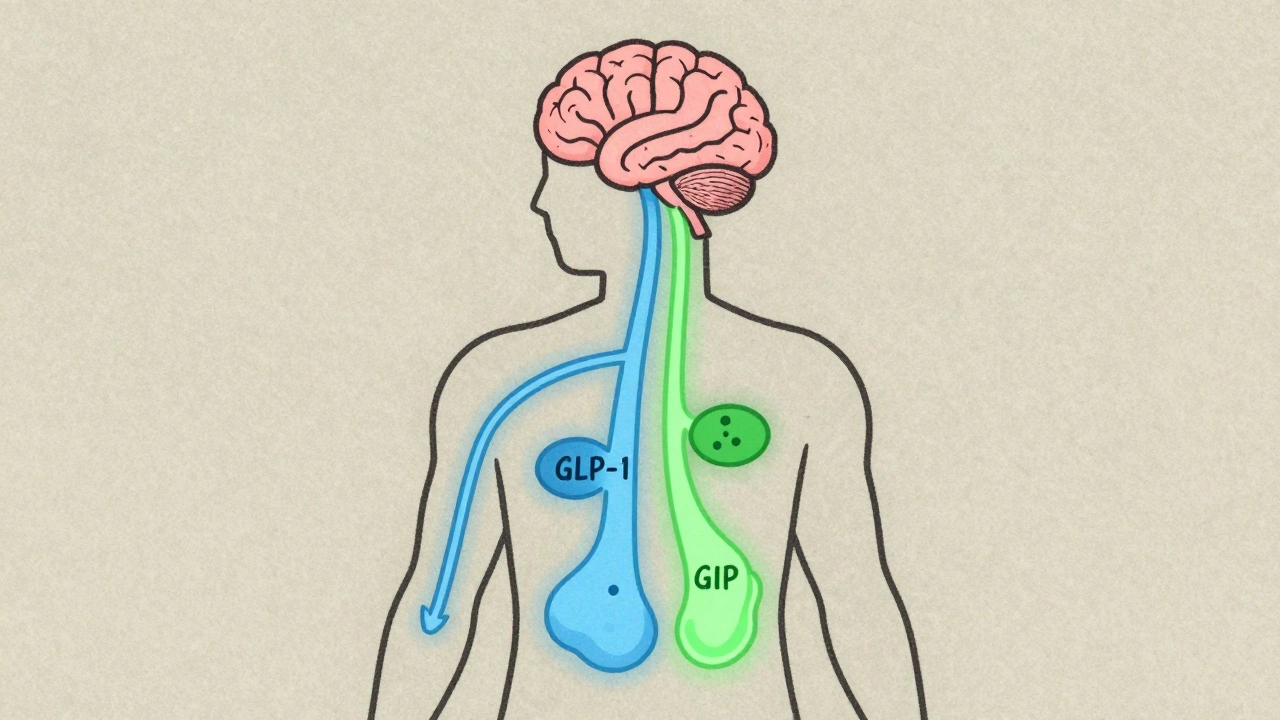
When it comes to weight loss medications, tirzepatide isn’t just another option-it’s a game changer. Approved by the FDA for chronic weight management in November 2023 under the brand name Zepbound, this drug works differently than anything before it. Unlike older weight-loss drugs that target just one hormone, tirzepatide hits two at once: GLP-1 and GIP. These are naturally occurring hormones in your body that help control blood sugar and appetite. By activating both receptors, tirzepatide doesn’t just make you feel less hungry-it changes how your body stores fat, burns energy, and responds to food. The result? People in clinical trials lost an average of 16.5% to 22.4% of their body weight over 72 weeks. That’s not a small number. For someone weighing 250 pounds, that’s over 40 pounds gone-not through extreme diets or endless gym sessions, but through a once-weekly injection that works with your body’s own biology.
How Tirzepatide Actually Works
Tirzepatide is a synthetic molecule designed to mimic two incretin hormones: GLP-1 and GIP. GLP-1 has been the focus of weight-loss drugs like semaglutide (Wegovy) for years. It slows digestion, reduces appetite, and tells your pancreas to release insulin only when blood sugar is high. GIP, on the other hand, was long thought to just help with insulin release after meals. But newer research shows GIP also plays a key role in fat metabolism and energy use. Tirzepatide combines both actions into one drug, creating what experts call a “twincretin.”
This dual action triggers multiple effects:
- It reduces hunger signals in the brain, especially in areas that drive cravings for high-calorie foods.
- It slows how fast food leaves your stomach, so you feel full longer.
- It improves insulin sensitivity, meaning your body uses glucose more efficiently instead of storing it as fat.
- It increases adiponectin, a hormone that helps break down fat and reduces inflammation in fat tissue.
- It boosts energy expenditure-your body burns more calories even at rest.
Studies from Duke University found that the combination of GLP-1 and GIP activation produces effects greater than either one alone. In fact, tirzepatide’s weight loss results are 51% higher than semaglutide’s in head-to-head trials. That’s not a minor edge-it’s a major leap forward in how we treat obesity.
Real Results from Real People
Numbers from clinical trials are impressive, but what do people actually experience? On Reddit’s r/Mounjaro community, with over 38,000 members, users report dramatic changes. One person shared they lost 58 pounds in six months on the 15 mg dose of Zepbound, saying the hunger suppression was “night and day” compared to other drugs they’d tried. Drugs.com reviews show an average rating of 8.2 out of 10, with 76% of users saying they lost more than 10% of their body weight.
But it’s not all smooth sailing. About one in three people stop taking tirzepatide because of side effects. The most common? Nausea, vomiting, and diarrhea. These aren’t rare-they happen in 20-25% of users for nausea alone. What most people don’t realize is that these side effects are often tied to how fast the dose is increased. The FDA-approved schedule starts at 2.5 mg weekly and slowly climbs over 20 weeks to 5 mg, then 10 mg, then 15 mg. Rushing this process makes side effects worse. Many who struggled early on found relief by extending the time between dose increases. One user wrote: “I stayed at 5 mg for 10 weeks instead of 4. The nausea disappeared. I didn’t lose as fast, but I kept going.”
Why It’s Better Than Other Weight Loss Drugs
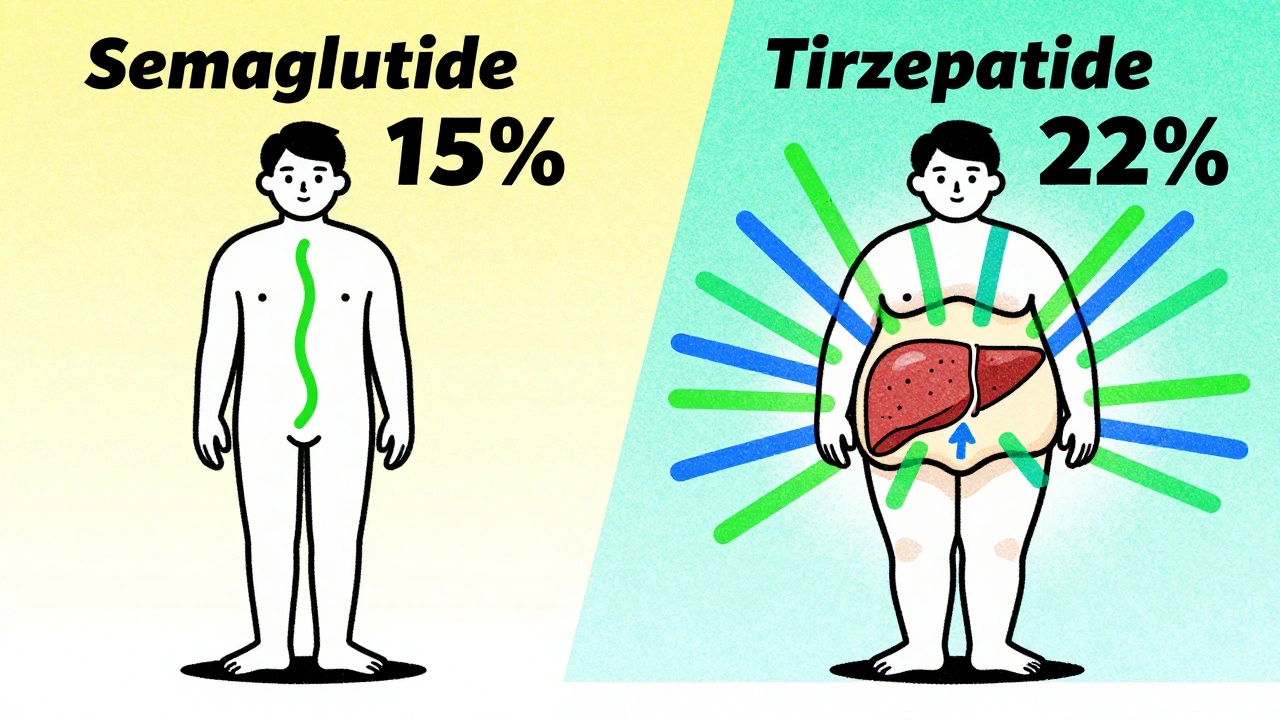
Before tirzepatide, semaglutide (Wegovy) was the gold standard for weight loss medications. It works well-people typically lose 10-15% of their weight. But tirzepatide doesn’t just match it; it beats it. In the SURMOUNT-1 trial, those on the highest dose of tirzepatide (15 mg) lost 22.5% of their body weight on average. The semaglutide group lost 14.9%. That’s a difference of over 7 percentage points. And it’s not just about appetite. People on tirzepatide lost more fat mass than those on semaglutide, even when their appetite scores were similar. That suggests tirzepatide does more than just reduce food intake-it changes how the body uses and stores energy.
Another advantage is durability. While both drugs improve insulin sensitivity, tirzepatide’s dual action also helps repair damaged fat cells and reduces inflammation in adipose tissue. This isn’t just about losing weight-it’s about improving metabolic health at a cellular level. Experts like Dr. Robert Kushner from Northwestern call it a “paradigm shift.” For the first time, a drug isn’t just masking hunger-it’s fixing underlying metabolic dysfunction.
Side Effects and Risks
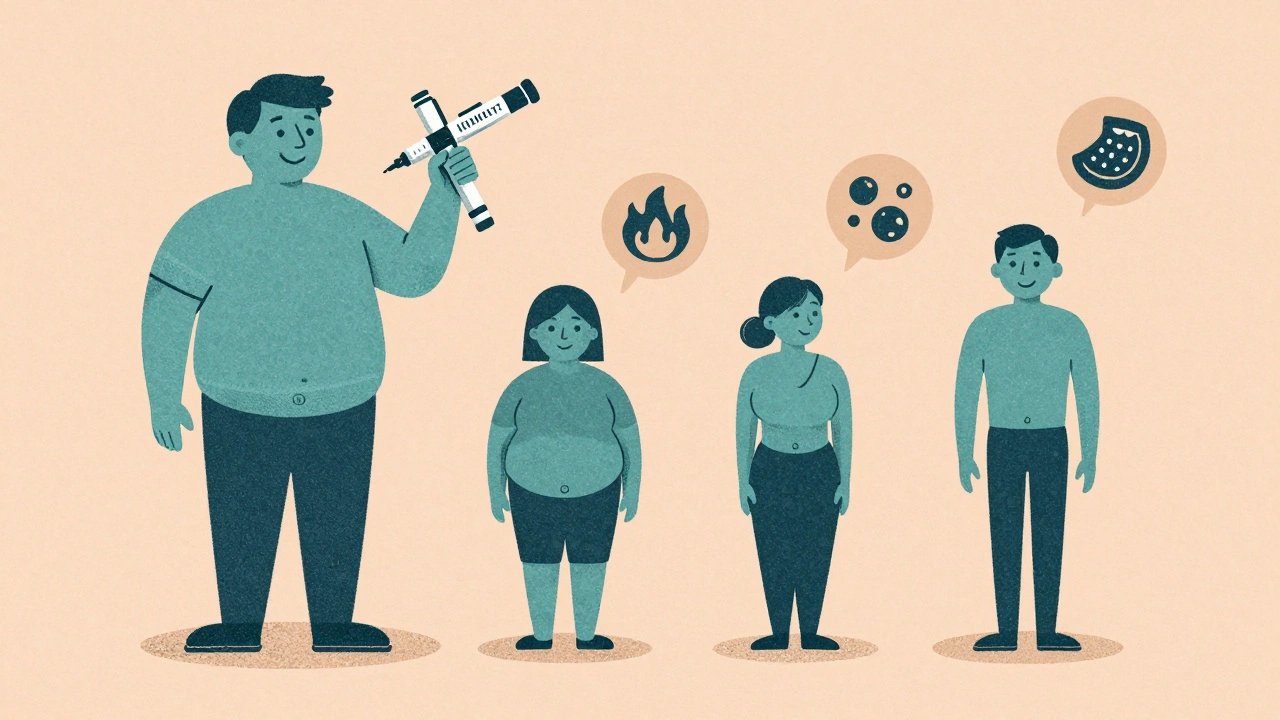
No medication is without risks. Tirzepatide’s most common side effects are gastrointestinal: nausea (20-25%), vomiting (7-10%), diarrhea (15-18%), and constipation. Most of these improve over time, especially if you follow the slow titration schedule. But for some, they’re enough to stop treatment. About 32% of users in aggregated reviews discontinued tirzepatide due to intolerance.
There’s also a boxed warning from the FDA about thyroid C-cell tumors. This came from rodent studies where high doses caused tumors. No such link has been found in humans, but the warning remains because we can’t rule it out entirely. Tirzepatide should not be used by people with a personal or family history of medullary thyroid cancer or those with MEN2 syndrome.
Other rare risks include pancreatitis and gallbladder disease, but these occur at rates similar to other GLP-1 drugs. The biggest concern among doctors isn’t the side effects-it’s what happens after you stop. Studies show people regain 12-15% of lost weight within six months of discontinuing tirzepatide. That’s not a failure of the drug-it’s a reminder that obesity is a chronic condition. Like high blood pressure or diabetes, it often needs ongoing management.
How It’s Prescribed and Used
Tirzepatide is given as a once-weekly subcutaneous injection. You can inject it in your abdomen, thigh, or upper arm. It comes in pre-filled pens, similar to insulin pens. The starting dose is 2.5 mg per week for the first four weeks. Then, every four weeks, the dose increases: 5 mg → 10 mg → 15 mg. Most people reach the 15 mg dose by week 20. That’s the dose linked to the highest weight loss in trials.
But not everyone needs to go to 15 mg. Some people get great results at 10 mg and prefer to stay there to avoid side effects. Others can’t tolerate even 5 mg. Doctors now know that flexibility matters. A 2024 analysis found that 38% of patients needed longer than four weeks at each dose level to adjust. If you’re new to GLP-1 drugs, you might need even more time. Those who’ve used semaglutide before tend to adapt faster-72% hit their target dose on schedule, compared to 58% of first-time users.
Storage is simple: keep unopened pens refrigerated. Once you start using one, you can store it at room temperature for up to four weeks. Always check the liquid-clear and colorless is good. If it’s cloudy or has particles, don’t use it.
Cost and Access
The list price for a 4-week supply of Zepbound is around $1,023. That sounds steep. But most people pay far less. Thanks to manufacturer co-pay programs, 89% of commercially insured patients pay under $100 a month. The Lilly Cares Foundation also offers free medication to eligible low-income patients. Medicare and Medicaid coverage varies by state, but many plans now cover it for people with obesity (BMI ≥30) or overweight (BMI ≥27) with at least one weight-related condition like high blood pressure or sleep apnea.
In October 2024, the FDA expanded Zepbound’s approval to include treatment of obstructive sleep apnea in adults with obesity. That’s a big deal-it’s the first weight-loss drug approved specifically for this condition. Many people with sleep apnea struggle with weight, and now there’s a treatment that tackles both.
What’s Next?
Tirzepatide isn’t the end of the road-it’s the beginning. Eli Lilly is already testing a “triple agonist” called retatrutide, which targets GLP-1, GIP, and glucagon receptors. Early results show up to 24.2% weight loss in just 24 weeks. That’s even more than tirzepatide. Other companies are developing similar dual and triple agonists. The future of obesity treatment isn’t one drug-it’s a family of drugs that fine-tune multiple metabolic pathways.
For now, tirzepatide stands as the most effective weight-loss medication ever approved. It doesn’t promise miracles, but it does offer something rare: real, sustained, science-backed results. It’s not for everyone. Side effects are real. Cost can be a barrier. And it’s not a cure. But for people who’ve tried everything else and still struggle, it’s a powerful tool. The key is using it right-slowly, with medical support, and with the understanding that it works best when paired with lifestyle changes, not instead of them.
How much weight can you lose on tirzepatide?
In clinical trials, people lost an average of 16.5% to 22.4% of their body weight over 72 weeks. At the highest dose (15 mg), the average was 22.5%. For someone weighing 250 pounds, that’s about 56 pounds lost. Results vary based on dose, adherence, and individual metabolism.
Is tirzepatide better than semaglutide for weight loss?
Yes, in direct comparisons, tirzepatide outperforms semaglutide. In the SURMOUNT-1 trial, tirzepatide at 15 mg led to 22.5% average weight loss versus 14.9% for semaglutide. That’s a 51% greater relative weight loss. Tirzepatide also reduces more fat mass and improves metabolic markers more significantly.
What are the most common side effects of tirzepatide?
The most common side effects are nausea (20-25%), vomiting (7-10%), diarrhea (15-18%), and constipation. These usually improve over time, especially if the dose is increased slowly. About 32% of users stop taking it due to gastrointestinal intolerance.
How long does it take to see results with tirzepatide?
Most people start noticing reduced hunger and slight weight loss within 2-4 weeks. Significant weight loss (5-10% of body weight) typically occurs by 12-16 weeks. The full effect-up to 20%+ weight loss-usually takes 6-12 months, depending on the dose and how slowly it’s titrated.
Can you stop tirzepatide and keep the weight off?
Most people regain 12-15% of lost weight within 6 months after stopping tirzepatide. This is true for all weight-loss medications-it’s not unique to this drug. Obesity is a chronic condition, and stopping treatment often means the body returns to its previous metabolic state. Maintenance requires ongoing lifestyle changes or continued medication.
Is tirzepatide approved for sleep apnea?
Yes. In October 2024, the FDA approved Zepbound (tirzepatide) for treating obstructive sleep apnea in adults with obesity. It’s the first weight-loss drug approved specifically for this condition, based on trials showing improved breathing during sleep, even beyond what’s expected from weight loss alone.





14 comments
Elliot Barrett
I tried this stuff for 3 months. Nausea was brutal. Felt like my stomach was holding a grudge. Quit after the second dose increase. Worth it? Probably not for me.
Tejas Bubane
Let's be real - this isn't medicine, it's a luxury product for the overprivileged who can't be bothered to eat less and move more. 22% weight loss? Cool. But the cost? The side effects? The dependency? It's pharmaceutical capitalism at its finest.
Ajit Kumar Singh
People dont understand this is not magic its science you take it you get results you dont you get fat again like always stop acting like its a miracle drug its just another tool like a fork or a treadmill
Maria Elisha
I lost 40 lbs on it. But honestly? I felt like a zombie for the first two months. No energy. No appetite. No joy in food. Was it worth it? Maybe. But I miss tacos.
Angela R. Cartes
I mean, if you're going to spend $1k/month on a drug that makes you puke, why not just get a gastric sleeve? At least then you're not dependent on Big Pharma forever. 😒
Sabrina Thurn
The dual incretin mechanism is genuinely revolutionary. GLP-1/GIP co-activation enhances satiety signaling through hypothalamic pathways while simultaneously upregulating adiponectin and improving mitochondrial efficiency in adipose tissue. The metabolic rewiring here is unprecedented - this isn't just appetite suppression, it's systemic metabolic reprogramming. Most GLP-1 drugs are single-pathway band-aids. This is a full-system upgrade.
Courtney Black
We're treating obesity like a software bug you can patch with a weekly injection. But the body isn't a machine. It's a living, breathing, emotionally tangled mess of hunger, trauma, culture, and habit. You can suppress appetite all you want - but if the soul still craves comfort, the weight will come back. And it will. Always.
iswarya bala
I started at 2.5mg and stayed there for 8 weeks. No nausea. Lost 12lbs. Still going. Dont rush it. Its not a race. You got this 💪
Simran Chettiar
The notion that pharmaceutical intervention can supplant fundamental behavioral and environmental determinants of metabolic health is not only scientifically reductive but ethically precarious. One cannot pharmacologically absolve societal failures in food systems, sedentary infrastructure, and psychological distress through the administration of a synthetic peptide. The cure, if it exists, lies not in the pen, but in the policy.
Anna Roh
I lost 50 lbs. Then stopped. Gained back 30. Now I'm on it again. It's not a cure. It's a maintenance tool. Like insulin. Or blood pressure meds. Get over it.
om guru
Respectfully sir maam the journey of weight loss is not merely physical it is spiritual and mental and emotional and this medicine is a helper not a savior please walk with discipline and patience and gratitude
Richard Eite
America is so weak now we pay 1000 bucks to not feel hungry? In my day we just ate less and lifted weights. This is why we're falling behind the world. Pathetic.
Katherine Chan
To everyone who says 'just eat less' - try living in a food desert with 3 jobs and zero time. This drug gave me my life back. I can play with my kids now. I can breathe. Don't shame people for surviving.
Elliot Barrett
I'm back on it. Slowed the titration way down. 5mg for 12 weeks. Zero nausea now. Lost another 18 lbs. Turns out I just needed to go slower. Don't give up too soon.