
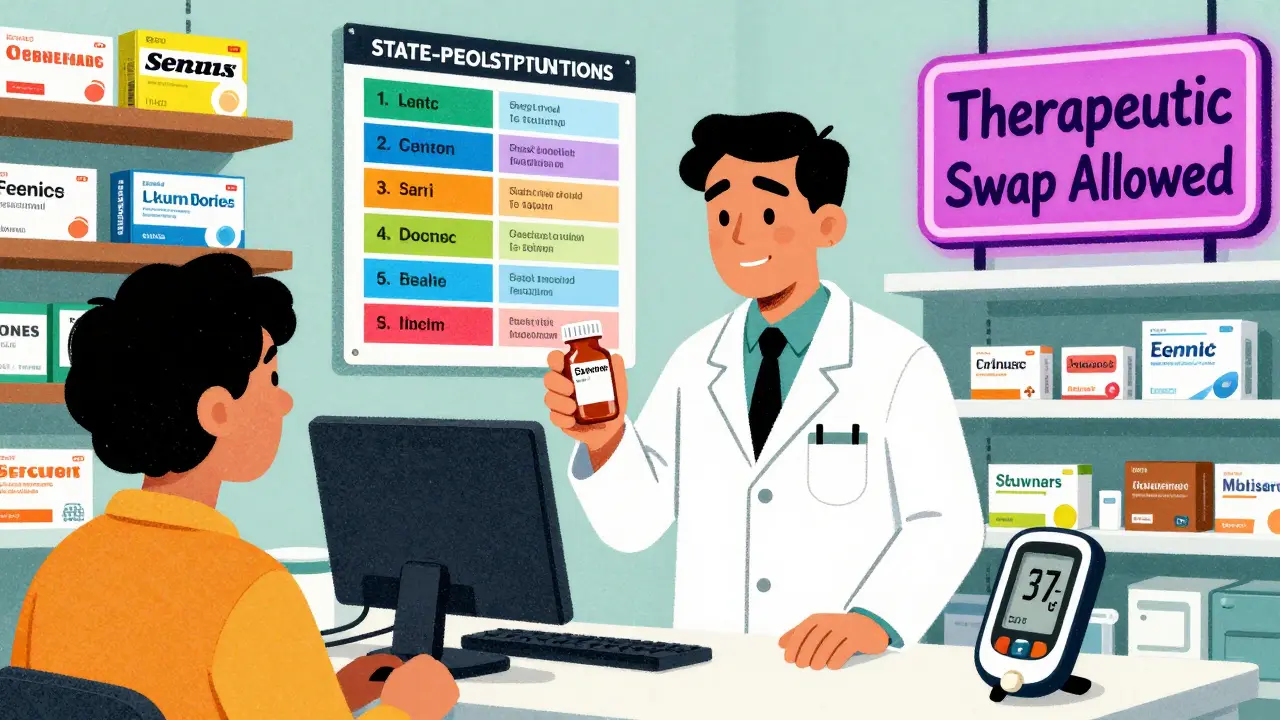
When you pick up a prescription, you probably assume the pharmacist just fills it. But in many states, they can do far more - swap out drugs, adjust doses, even prescribe certain medications without a doctor’s signature. This isn’t science fiction. It’s pharmacist substitution authority, and it’s changing how millions of people get care - especially in rural towns, small cities, and places where doctors are hard to find.
What Exactly Is Pharmacist Substitution Authority?
Pharmacist substitution authority means the legal right for pharmacists to change or replace a prescribed medication under specific rules. It’s not about guessing or overriding doctors. It’s about using clinical training to make safer, smarter choices when the original prescription isn’t ideal - or when the patient can’t easily reach their provider. This authority comes in different forms. The most basic is generic substitution. In every U.S. state, if a doctor writes a prescription for, say, Lipitor, the pharmacist can give you the generic version, atorvastatin, unless the doctor specifically says “dispense as written.” This saves money and is standard practice. But that’s just the start. Some states let pharmacists go further. In therapeutic interchange, a pharmacist can swap a drug for another in the same class - like switching from one blood pressure medication to another - even if they’re not chemically identical. Only three states have full therapeutic interchange laws: Arkansas, Idaho, and Kentucky. In Kentucky, the doctor must write “formulary compliance approval” on the script. In Arkansas and Idaho, they must write “therapeutic substitution allowed.” And in Idaho, the pharmacist has to clearly tell the patient what changed and get their permission before switching.Prescription Adaptation: Fixing Prescriptions Without a Doctor Visit
Imagine you’re in a small town in New Mexico. Your blood sugar is too high, and your doctor is 70 miles away. You can’t drive there today. Under prescription adaptation, your pharmacist can adjust your dose - increase it, decrease it, or even change the timing - based on your lab results and symptoms. They don’t need to call the doctor first. They just follow a written protocol approved by the state board of pharmacy. This isn’t allowed everywhere. But in states like Colorado, New Mexico, and Washington, pharmacists can do this for conditions like diabetes, high blood pressure, asthma, and even thyroid issues. The key is that these changes are pre-approved by state regulators and tied to clear clinical guidelines. The pharmacist can’t just pick any drug. They can only adjust what’s on the approved list.Collaborative Practice Agreements: The Middle Ground
Most states use collaborative practice agreements (CPAs) to expand pharmacist roles. These are formal, written partnerships between pharmacists and doctors. They spell out exactly what the pharmacist can do: prescribe certain drugs, order lab tests, adjust doses, or manage chronic conditions. CPAs aren’t new - all 50 states and D.C. allow them. But how they work is changing. In the past, doctors had to sign off on every decision. Now, in states like Minnesota and Oregon, pharmacists run these protocols with far less oversight. They can initiate treatment for strep throat, flu, or urinary tract infections without waiting for a doctor’s okay. The agreement still has to be filed with the state board, and the pharmacist must document everything in the patient’s electronic health record. This model is growing fast. In 2025, 16 new state laws expanded CPA rules, letting pharmacists take on more responsibility with fewer barriers. It’s not about replacing doctors. It’s about using pharmacists as part of a team - especially when doctors are overloaded.Independent Prescribing: The New Frontier
Some states have gone even further. In Maryland, pharmacists can prescribe birth control to anyone over 18 without a doctor’s script. In Maine, they can hand out nicotine patches for quitting smoking. In California, they can “furnish” emergency contraception or naloxone (the opioid overdose reversal drug) under statewide protocols. These aren’t random acts. They’re based on years of research showing pharmacists can safely manage these conditions. The FDA has approved many of these drugs for over-the-counter use. States are just letting pharmacists dispense them as part of routine care. The trend is clear: 100% of states now allow pharmacists to prescribe or dispense at least one type of medication under a statewide protocol. That’s not just a policy shift - it’s a structural change in how healthcare works.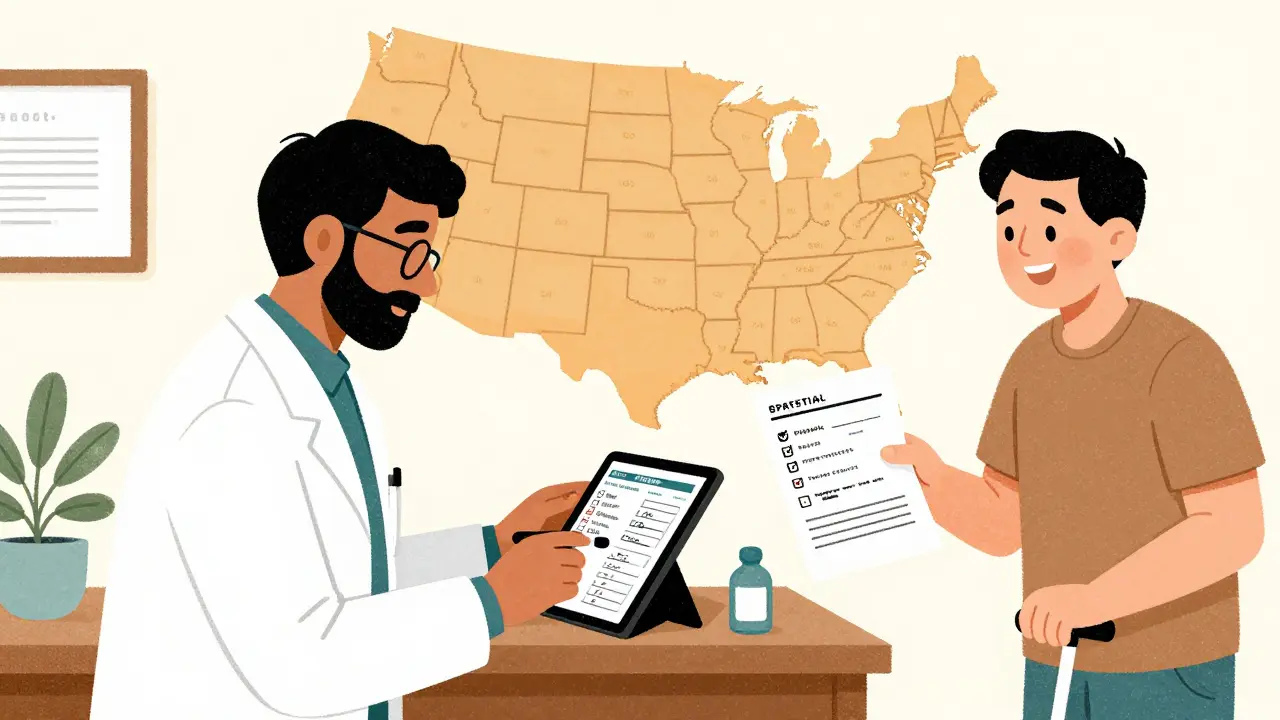
Why This Matters: Access, Equity, and Shortages
Sixty million Americans live in areas with too few doctors. Rural clinics close. Emergency rooms get backed up. People skip meds because they can’t get a refill. Pharmacist substitution authority fixes this. A 2023 study from the Health Resources and Services Administration found that in states with expanded pharmacist roles, patients with diabetes had better blood sugar control. In rural Oregon, emergency contraception was available within hours instead of days. In Illinois, pharmacists helped reduce hospital readmissions for heart failure by managing medication changes on the spot. It’s not just about convenience. It’s about fairness. Low-income patients, people without cars, those without insurance - they benefit the most. Pharmacists are often the most accessible health professional in their community.The Pushback: Who’s Against It?
Not everyone agrees. The American Medical Association still says pharmacists aren’t trained like physicians. They worry about safety, consistency, and the blurring of roles. Some doctors fear losing control over patient care. There are also concerns about corporate influence. Big pharmacy chains like CVS and Walgreens have pushed hard for expanded authority. Critics say they’re doing it to boost profits, not patient care. But the data doesn’t back that up. Studies show pharmacist-led care improves outcomes regardless of where the pharmacy is located. The real issue isn’t training - it’s reimbursement. Even in states where pharmacists can prescribe, insurance companies often won’t pay for it. Medicare doesn’t recognize pharmacists as providers. That means many can’t bill for their time, even when they’re doing the same work a doctor would.The Federal Push: ECAPS and What’s Next
A federal bill called the Ensuring Community Access to Pharmacist Services Act (ECAPS) is now in Congress. If it passes, Medicare Part B would pay pharmacists for services like testing, vaccinations, and chronic disease management - just like it pays doctors. That’s a game-changer. It would force private insurers to follow suit. It would give pharmacists the financial backing to expand services without losing money. And it would finally recognize them as full members of the healthcare team. Right now, 211 bills to expand pharmacist authority are working their way through state legislatures. That’s more than ever before. The momentum is real.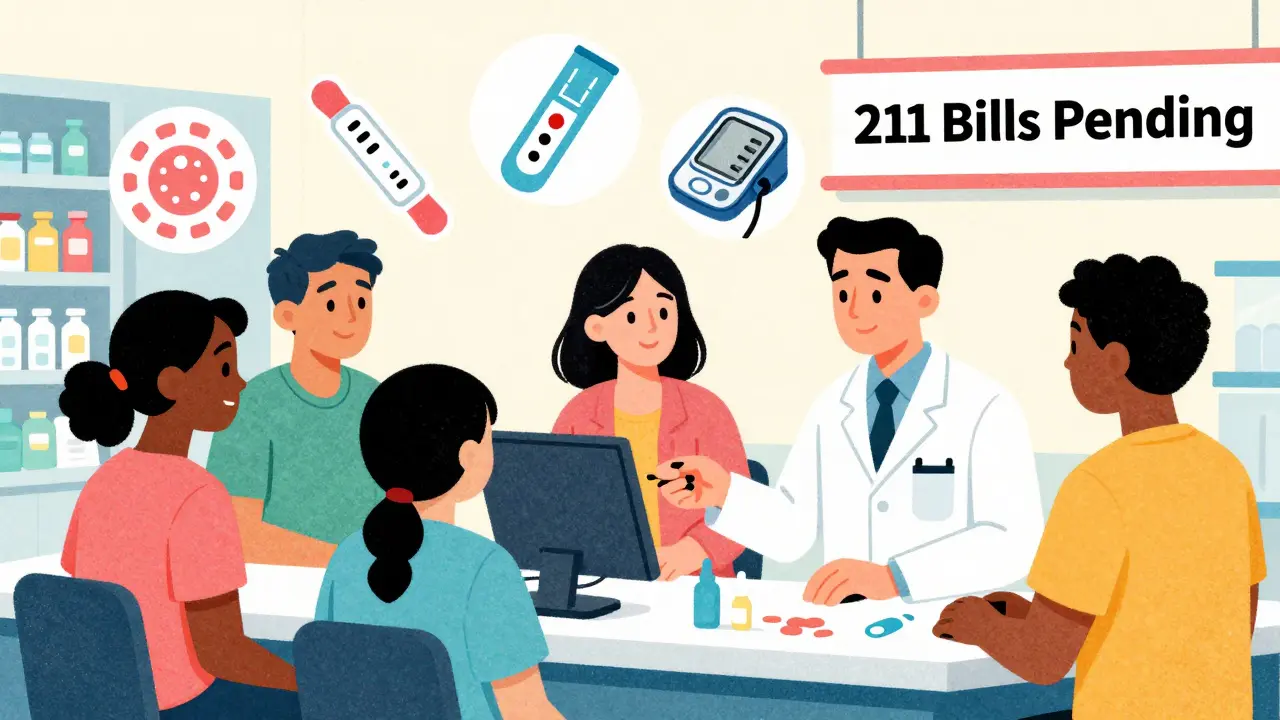
What You Need to Know as a Patient
If you’re on medication, ask your pharmacist: “Can you help me adjust this if something changes?” You might be surprised. In many states, they can:- Switch you to a cheaper generic or similar drug
- Refill your prescription early if you’re out of town
- Give you emergency contraception or naloxone without a doctor’s visit
- Adjust your blood pressure or diabetes meds based on your home monitor readings
- Test you for flu, strep, or COVID and treat it on the spot


12 comments
Jessica Salgado
So my grandma in rural New Mexico got her insulin dose adjusted by her pharmacist last month after her glucose monitor spiked. No doctor visit. No wait. Just a quick chat and a new script. I didn’t even know this was legal until I read this. People act like pharmacists are just candy dispensers, but they’re the real frontline heroes when the system breaks down.
And yes, she signed off on it. They don’t just change things. They explain everything. I’m convinced this should be standard everywhere.
Virginia Seitz
This is amazing 😍 My cousin in Kentucky got his blood pressure med switched and didn’t even know it till the bill came. Cheaper. Same effect. Pharmacist told him what changed. He was cool with it. Why aren’t we doing this everywhere??
Linda Caldwell
Stop treating pharmacists like order takers. They know more about your meds than your doctor does sometimes. Let them help. Let them save lives. Let them do their damn job.
And yes I’m yelling at my screen right now.
Sachin Bhorde
As a med student in India, this is wild. We got no such flex. Pharmacist here just hand out pills and say ‘take thrice a day.’ No protocol, no adapt, no CPA. Even if a patient’s BP is 200/110, they won’t touch the script unless doc says. Sad. Here, docs are overworked, pharmacists are underutilized. We need this model stat. The data proves it works. Why are we still stuck in 1990s thinking?
Also, ECAPS bill? Need that. Medicare pays docs for everything. Why not pharmacists? They’re the only ones who actually know what’s in the pill bottle.
Sam Clark
While the expansion of pharmacist authority is commendable from a public health standpoint, one must not overlook the foundational principle of medical accountability. The physician retains the ultimate responsibility for patient outcomes, and while pharmacists possess exceptional pharmacokinetic expertise, their training does not encompass the comprehensive diagnostic acumen required for independent clinical decision-making.
Therapeutic interchange, when governed by stringent protocols and documented consent, may serve as a pragmatic adjunct-but it must never supplant the physician-patient relationship. The integrity of clinical judgment must remain anchored in the physician’s assessment, not the pharmacist’s protocol.
Michael Whitaker
Oh please. Let the pharmacy techs prescribe now. Next thing you know, they’ll be reading EKGs and ordering MRIs. I’m sure the corporate overlords at CVS love this-more profit, less oversight. You think these pharmacists are doing this for the patients? Nah. They’re doing it because they get paid per script now. And if you think ‘formulary compliance’ is about safety, you’re naive.
Doctors spend 12 years training. Pharmacists? Four years of chem and a license. Don’t pretend this is about ‘team-based care.’ It’s about cost-cutting disguised as innovation.
Anna Giakoumakatou
Wow. So now the guy who used to hand me my Zyrtec is also my primary care physician? I’m sure my thyroid will be thrilled. Next up: pharmacists doing colonoscopies and writing love letters to patients. This is what happens when we stop calling things by their names.
‘Prescription adaptation’? That’s just medical improvisation with a PowerPoint slide. I’ll take my doctor’s 15 years of training over a 4-year pharmacy degree any day. Especially when the ‘protocol’ is written by someone who’s never seen a patient in person.
Nishant Desae
Hey everyone, I’m from a small village in Bihar, India, and I’ve seen how hard it is to get medicine even when you have a script. Here, if you don’t have a doctor’s note, you can’t even buy antibiotics. But I read this and I thought-what if we had this? Not the corporate stuff, but the real deal-trained pharmacists who can help people who live 50 km from a clinic.
My aunt had diabetes. She missed her refill because the bus didn’t come. If someone could just adjust her dose based on her sugar readings, she wouldn’t have ended up in the hospital. This isn’t about replacing doctors. It’s about filling gaps. And honestly? We need more of that in places where no one else shows up.
Also, I typed this on my phone so sorry for the typos. But I really hope this spreads. We don’t need fancy titles. We need people who care enough to act.
Evelyn Vélez Mejía
There is a quiet revolution unfolding in the corner of every town where a pharmacy stands-not in the form of legislative hearings or corporate press releases, but in the unspoken exchange between a weary patient and a pharmacist who remembers their name, their allergies, their child’s birthday, and the fact that they skipped their last refill because they couldn’t afford the copay.
This isn’t about authority. It’s about dignity. The doctor’s office is a cathedral of uncertainty. The pharmacy is the hearth. Here, the medicine is not a transaction-it is a covenant. And when we grant pharmacists the power to honor that covenant without bureaucratic interference, we are not expanding their role.
We are finally recognizing that healing doesn’t always require a white coat. Sometimes, it just requires someone who knows the difference between a pill and a promise.
Jonathan Morris
Let me guess-this is all funded by the same pharmaceutical companies that pushed for opioid prescriptions. Now they’re pushing pharmacists to prescribe everything from birth control to naloxone. Why? Because they want to lock patients into their brand-name drugs. The ‘protocols’? Written by lawyers, not clinicians. The ‘data’? Cherry-picked from pilot programs funded by Walgreens.
And don’t even get me started on Medicare not paying for it. Of course they don’t. They’re not paying for care. They’re paying for control. This isn’t progress. It’s a Trojan horse. The AMA is right. Let the pharmacists fill bottles. Leave the medicine to the doctors. Or we’ll end up with a system where the only thing worse than a bad doctor is a well-trained pharmacist with a corporate KPI.
Pawan Chaudhary
Man this is so cool. I work at a pharmacy in Nebraska and we’ve been doing CPAs for flu shots and refills for years. People come in scared, we help them, they leave better. No drama. No drama. Just good care. Why do people make it so complicated? We’re not trying to steal jobs. We’re trying to help. If you need help, come talk to us. We’re here. We’re trained. We care. Seriously, stop being scared. Let’s just fix stuff together.
Anu radha
I’m from India and I feel so sad reading this. Here, even if a patient is in pain, the pharmacist will say ‘call your doctor.’ No one has time to help. No one has training to help. I wish we had this. I wish people here knew that pharmacists can be the first line of care. Not just sellers of medicine. But healers too. Thank you for sharing this. It gave me hope.