
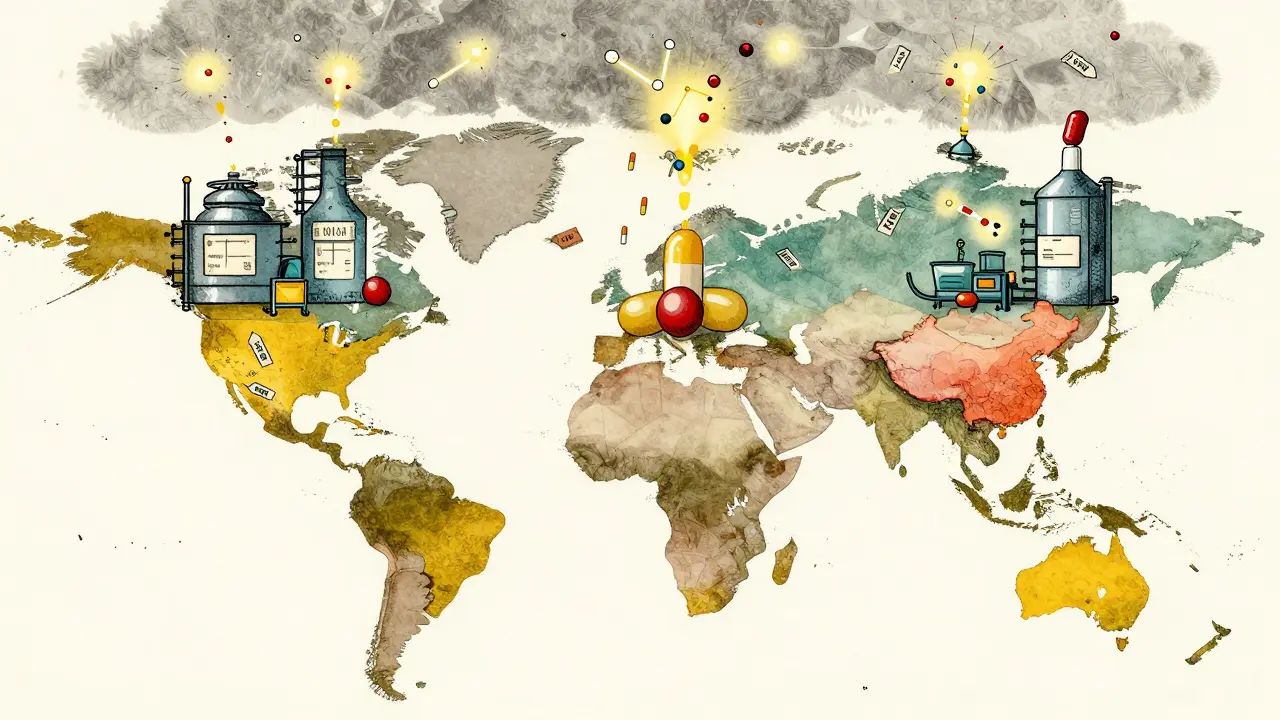
The global generic drug market is on track to become the backbone of affordable healthcare by 2030. With over $490 billion in sales in 2024 and projections pushing it toward $700 billion or more by the early 2030s, this isn’t just a niche sector anymore-it’s a financial and medical necessity. As branded drugs lose patent protection, manufacturers worldwide are rushing to produce cheaper, equally effective versions. But it’s not just about price. It’s about access, scale, and who controls the supply chain.
Why Generic Drugs Are Exploding Right Now
The biggest driver? Patent cliffs. Between 2025 and 2030, drugs generating $217 billion to $236 billion in annual sales will lose exclusivity. That’s not a small number-it’s more than the entire GDP of New Zealand. Drugs like ustekinumab and vedolizumab, used for autoimmune diseases, are just the start. These aren’t old pills; they’re high-tech biologics, meaning the next wave of generics won’t be simple tablets but complex biosimilars that mimic living-cell-based medicines.
And it’s not just the U.S. driving this. Europe, India, and China are all accelerating approvals. The FDA approved over 1,200 generic drugs in 2024 alone. The European Medicines Agency is speeding up biosimilar reviews with new fast-track pathways. In India, manufacturers are producing 20% of the world’s generic volume. China’s government-run volume-based procurement programs are forcing global price drops-sometimes by 90%-on drugs like metformin and atorvastatin.
Where the Growth Is: Regions and Therapies
Not all markets are growing at the same pace. The Asia-Pacific region is expected to lead with an 8.19% annual growth rate through 2030. India’s dominance comes from low-cost manufacturing and a massive domestic population that needs affordable meds. China’s influence is even more structural: its tender system now sets global benchmarks. If a drug gets a low price in China, every other country follows.
In contrast, Latin America, the Middle East, and Africa are catching up slowly. Brazil and South Africa are building regulatory frameworks, but infrastructure gaps remain. The U.S. and Europe have mature markets, but they’re still growing because of aging populations. More people over 65 means more chronic conditions-and more need for daily meds like insulin, blood pressure pills, and cholesterol drugs.
Therapeutically, three areas are exploding:
- Diabetes: Generic versions of GLP-1 agonists like liraglutide are already in development. Once approved, they could cut monthly costs from $1,000 to under $50.
- Oncology: Cancer drugs are the most expensive class of medicines. As patents expire, biosimilars for drugs like rituximab and trastuzumab will save systems billions.
- Anti-inflammatories: Dupixent and Skyrizi are next in line. These injectables treat eczema and psoriasis and are used by millions. Their generic versions could be available by 2029.
Biosimilars: The New Frontier
Biosimilars aren’t just generics with a fancy name. They’re copies of biologic drugs-complex molecules made from living cells. Unlike traditional generics, which are chemically identical to their brand-name counterparts, biosimilars are highly similar but not exact. That makes them harder and more expensive to develop. But they’re also more profitable.
The biosimilars segment is growing at 8.2% annually-faster than traditional generics. Why? Because the payoff is huge. Ustekinumab, a psoriasis drug, brought in $6.8 billion in 2024. When its patent expires in 2025, even a 30% market share for biosimilars could mean $2 billion in annual sales. Companies like Sandoz and Amgen are investing billions in manufacturing and clinical trials to be first to market.
Europe is ahead here. The EU has approved over 60 biosimilars since 2006. Japan is now catching up with fast-track rules. In the U.S., payers are starting to push biosimilars harder. Medicare Part B now reimburses them at the same rate as the brand, removing financial disincentives for doctors.
Manufacturing and Technology Shifts
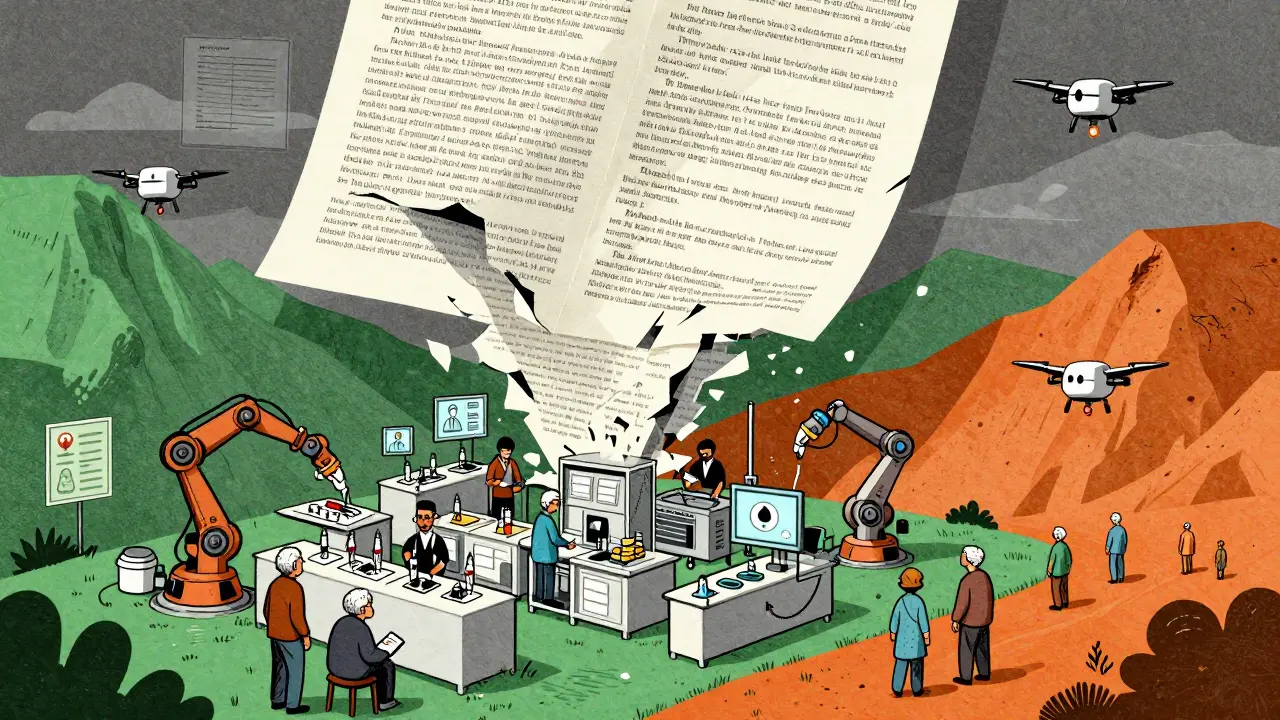
It’s not just about who makes the drugs-it’s how. Robotic automation is now standard in top-tier generic plants. One facility in Gujarat, India, uses AI-driven quality control to monitor 20,000 data points per batch. This reduces contamination risks and speeds approvals.
Supply chains are also changing. With geopolitical risks and pandemic lessons fresh in mind, manufacturers are building dual-source production. A company might make a drug in both India and Vietnam, so if one country faces export restrictions, the other picks up the slack. Southeast Asian countries are now offering incentives for fill-and-finish operations-where drugs are packaged and labeled-within their borders.
Technology isn’t just in the factory. Digital tools are helping patients stay on their meds. Apps that sync refills with pharmacy systems, text reminders, and even smart pill bottles that track usage are boosting adherence. Higher adherence means fewer hospitalizations-and more savings for health systems.
Who’s Winning and Who’s Struggling
The market is consolidating. Big players like Teva, Viatris, and Sandoz control nearly 40% of global generic sales. But they’re under pressure. In the U.S., price competition is brutal. A single generic pill can drop from $10 to $0.10 in months after a second manufacturer enters. Profit margins are thinning.
India’s companies-like Sun Pharma and Dr. Reddy’s-are expanding globally. They’re not just selling pills; they’re building R&D labs in the U.S. and Europe to develop complex generics and biosimilars. China’s state-backed firms are doing the same, using government funding to undercut prices worldwide.
Smaller players are struggling. Without scale, they can’t afford the clinical trials for complex drugs or the compliance systems needed for FDA or EMA approval. Many are being bought out or forced out.
Challenges Ahead
Despite the growth, risks remain. Patent litigation is still a major hurdle. In the U.S., branded drugmakers use legal tactics to delay generics-sometimes for years. In 2028, over $100 billion in drug sales will be at risk of patent challenges. If courts side with the brand, those savings vanish.
Pricing pressure is another threat. In China, a drug’s price can be slashed by 95% in a single tender. That’s great for patients but hard on manufacturers. Some companies are moving production out of China to avoid these deals.
And then there’s complexity. The next wave of generics won’t be aspirin or metformin. They’ll be inhalers with precise dosing, injectable gels, and combination therapies. That requires new equipment, new expertise, and new regulatory strategies.
The Bottom Line
The future of generic drugs is bright, but it’s not simple. The market will keep growing-likely hitting $700 billion by 2030. But the winners won’t be the ones who just make cheap pills. They’ll be the ones who master complexity: biosimilars, advanced manufacturing, global supply chains, and digital patient support.
For health systems, the message is clear: investing in generics isn’t a cost-cutting move-it’s a strategy for survival. As populations age and chronic diseases rise, affordable meds aren’t optional. They’re essential.
What’s the difference between generic drugs and biosimilars?
Generic drugs are chemically identical copies of small-molecule drugs, like aspirin or metformin. Biosimilars are highly similar-but not identical-copies of complex biologic drugs made from living cells, like insulin or monoclonal antibodies. Biosimilars require more testing and are more expensive to develop, but they offer huge cost savings on high-priced treatments.
Why are generic drug prices dropping so fast?
It’s competition. Once a patent expires, multiple manufacturers enter the market. In the U.S., a drug might have 20 generic versions within a year. In China, the government holds bulk auctions where the lowest bidder wins the entire national supply. This drives prices down dramatically-sometimes to pennies per pill.
Which countries are the biggest producers of generic drugs?
India is the largest producer by volume, supplying 20% of global generics and 60% of vaccines. China leads in volume-based pricing and is becoming a major exporter. The U.S. and Europe produce high-quality generics but at higher costs. India and China together account for over 70% of global generic manufacturing capacity.
Are generic drugs as safe as brand-name drugs?
Yes. Regulatory agencies like the FDA, EMA, and WHO require generics to prove they deliver the same active ingredient, in the same amount, at the same rate as the brand. They must meet the same quality, purity, and strength standards. The only differences are in inactive ingredients-like fillers or dyes-which don’t affect how the drug works.
Will generic drugs replace branded drugs completely?
No-and they shouldn’t. Branded drugs still lead in innovation. New drugs for rare diseases, cancer, and neurological conditions often start as branded products. But once patents expire, generics take over as the standard of care. The goal isn’t to eliminate brands-it’s to ensure affordable access after exclusivity ends.
How will AI affect the generic drug market?
AI is already speeding up development. It helps predict how a generic version will behave in the body, reducing trial failures. In manufacturing, AI monitors production in real time, catching defects before they happen. It’s also helping predict which patents are most likely to be challenged next, so manufacturers can prioritize development.


9 comments
Josh McEvoy
bro this is wild 🤯 generic insulin for $5 a month?? i’m not crying you’re crying
Heather McCubbin
They call it progress but really it’s just pharma letting go of their golden goose. We’re not saving money we’re just letting corporations off the hook. This isn’t healthcare it’s capitalism with a Band-Aid
Sawyer Vitela
Biosimilars aren’t cheaper because they’re better. They’re cheaper because the R&D was subsidized by taxpayers. Stop pretending this is innovation.
Shanta Blank
So let me get this straight - we’re gonna have $0.03 aspirin but my mental health meds are still $800 because they’re ‘complex’? That’s not a market. That’s a joke with a pharmacy label.
Helen Leite
They’re putting tracking chips in the pill bottles. You think that’s for adherence? Nah. They’re watching who takes what. Next they’ll charge you extra if you don’t scan your meds. #BigPharmaIsWatching
Sushrita Chakraborty
India’s role in this transformation cannot be overstated: the country’s regulatory framework, coupled with its unparalleled manufacturing efficiency, has enabled the production of high-quality, affordable generics on a scale unmatched globally. Moreover, the cultural emphasis on community health - not merely profit - has shaped a pharmaceutical ecosystem that prioritizes accessibility. This is not merely economic; it is ethical.
Marlon Mentolaroc
Honestly? I’m just glad my grandma can afford her blood pressure meds now. She used to skip doses. Now she takes them like clockwork. That’s what matters.
Gina Beard
The real question isn’t who makes the pills. It’s who controls the narrative. If we call it ‘affordable healthcare,’ we forget it’s still a commodity. And commodities can be taken away.
Don Foster
You think China’s doing this out of altruism? They’re building a global supply chain so they can dictate pricing to the West. This isn’t healthcare revolution it’s economic colonization with pill bottles