
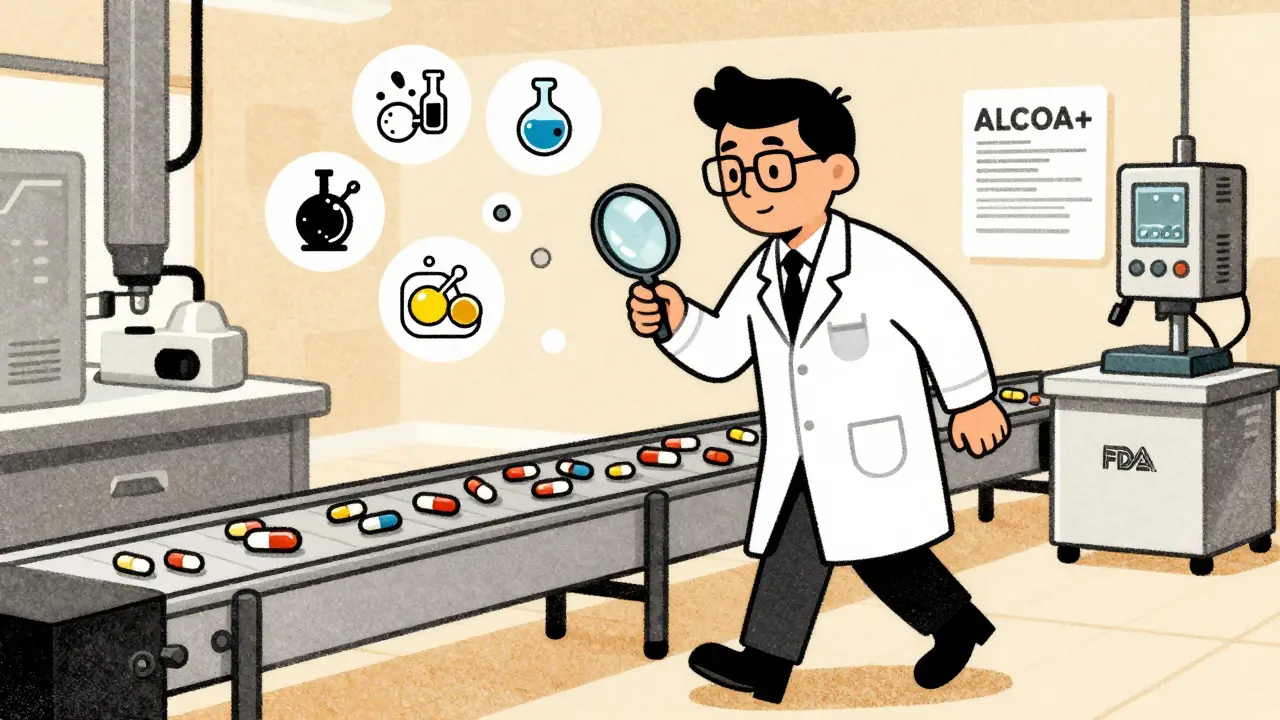
When you pick up a generic pill at the pharmacy, you expect it to work just like the brand-name version. That’s not luck. It’s the result of one of the most rigorous drug quality systems in the world - run by the U.S. Food and Drug Administration (FDA). The FDA doesn’t just check the final product. It watches every step of how a generic drug is made, from the raw chemicals to the sealed bottle on the shelf. This isn’t about saving money. It’s about making sure that $2 pills work as well as $200 ones.
Quality Isn’t Tested at the End - It’s Built In
For decades, drug makers relied on testing finished pills to catch problems. But in the 1960s, the FDA tested over 4,600 drugs and found that 8% didn’t deliver the right dose. Some had too much active ingredient; others had too little. That’s not just ineffective - it’s dangerous.
The fix? Stop trusting the final product. Start controlling the process. Today, the FDA enforces Current Good Manufacturing Practices (cGMP), written into federal law under Title 21 CFR Parts 210 and 211. These aren’t suggestions. They’re non-negotiable rules. If a factory skips one, the FDA can shut it down - no warning, no second chance.
cGMP means quality is built into every machine, every worker, every batch. It’s not about hoping the pill is good. It’s about proving the system that makes it is flawless.
The Five Pillars of FDA Drug Quality
There are five core areas the FDA checks in every generic drug plant - domestic or overseas.
- Control of Materials: Every ingredient, even the tiny ones, must be tracked from source to final product. The FDA demands proof of purity, potency, and origin. No guessing. No shortcuts. If a supplier changes, the manufacturer must retest everything - and tell the FDA.
- Production and Process Controls: Every step in making the drug - mixing, granulating, compressing, coating - has a written procedure. Machines must be calibrated. Temperatures must be logged. If a batch goes off-spec, the system flags it before it moves forward. No exceptions.
- Quality Control and Laboratory Testing: Every batch is tested. Not just for strength, but for purity, dissolution rate, and stability. The FDA requires testing methods to follow ALCOA+ standards: data must be attributable, legible, contemporaneously recorded, original, accurate, complete, consistent, enduring, and available. If a lab tech writes a number on a sticky note, that’s a violation.
- Packaging, Labeling, and Distribution: Labels must match the approved version exactly - no typos, no missing warnings. Bottles must protect the drug from moisture and light. Shipping conditions are monitored. A pill that’s fine in the factory can break down if shipped in a hot truck. The FDA checks that too.
- Documentation and Record Keeping: Every action, every test, every deviation is recorded. These records aren’t for show. They’re the FDA’s evidence during inspections. If it’s not written down, it didn’t happen. Period.
These aren’t theoretical standards. They’re enforced with surprise visits. FDA inspectors show up unannounced. They stay for days. They review raw data, interview workers, and even check the trash for discarded records. They don’t ask for permission. They just walk in.
How Generic Drugs Get Approved - And Why It Takes So Long
Getting a generic drug approved isn’t fast. It’s not supposed to be. Manufacturers submit an Abbreviated New Drug Application (ANDA), which includes detailed data on chemistry, manufacturing, and controls. The FDA doesn’t repeat brand-name clinical trials. Instead, they prove the generic is bioequivalent - meaning it absorbs into the body at the same rate and amount as the original.
But here’s the catch: the FDA doesn’t just look at one batch. For each drug strength, manufacturers must submit three separate batches of intermediate material. One batch is used to make all strengths. The other two are used to test the lowest and highest doses. This prevents a situation where a drug works at 10 mg but fails at 50 mg.
Each ANDA goes through multiple review cycles. Each cycle takes months. Some take over a year. Why? Because the FDA doesn’t just read the paperwork. They dig into the data. They compare it to past submissions. They look for patterns. If a manufacturer has a history of violations, the review gets even tougher.
Global Factories, One Standard
More than 70% of generic drugs sold in the U.S. are made overseas - mostly in India and China. The FDA inspects about 1,200 facilities worldwide each year. That’s nearly half of all global drug plants that supply America.
Inspection rates are higher for foreign plants. In 2021, the Government Accountability Office found that 17% of foreign facilities had cGMP violations - compared to 8% in the U.S. That doesn’t mean foreign plants are worse. It means the FDA is more likely to find problems there because they’re harder to monitor.
But the rules are the same. A factory in Hyderabad must follow the same ALCOA+ standards as one in Ohio. A bottle of generic metformin from India must dissolve in the body at the exact same rate as the brand version. No exceptions.
What Happens When Things Go Wrong
When the FDA finds a violation, they issue a Form 483 - a list of observations. It’s not a fine. It’s a warning. If the company doesn’t fix it, the FDA can refuse approval, block imports, or even issue a public alert.
In 2022, 42% of Form 483s cited data integrity issues - falsified logs, deleted files, backdated records. That’s the biggest red flag. It’s not about poor quality. It’s about lying about quality.
Some companies respond by fixing the problem. Others try to hide it. The FDA’s response is swift. In 2023, the agency blocked imports from 12 foreign manufacturers for cGMP violations. One company had been shipping pills for years with unapproved ingredients. The FDA didn’t wait for complaints. They found it during an inspection.
Why This System Works - And Why It’s Expensive
Generic drugs make up 90% of all prescriptions filled in the U.S. That’s 6.8 billion pills a year. And 98-99% of them work exactly as intended.
That’s not an accident. It’s the result of a system that costs manufacturers $2-5 million just to set up a compliant facility before they even submit their first application. Training staff, installing lab equipment, building documentation systems - it’s a massive investment.
But here’s the trade-off: those pills cost 80-85% less than brand-name versions. Without the FDA’s strict oversight, that savings wouldn’t be worth it. People would lose trust. And then they’d stop taking their meds.
Smaller manufacturers complain the rules are too heavy. One executive told Pharmaceutical Technology that documentation eats up 30-40% of their development time. But the same survey found that 82% of manufacturers agree: these rules make their products better.
The Future: Smarter, Faster, More Transparent
The FDA isn’t standing still. In 2023, they launched the Drug Quality Reporting System (DQRS), a digital portal where manufacturers must report quality issues in real time. No more waiting for complaints.
They’re also using remote inspections more often - 35% of inspections in 2022 were done partially online. Video walkthroughs, live data feeds, digital document reviews. It’s faster, and it lets inspectors check more sites.
Looking ahead, the FDA is pushing for advanced manufacturing - like continuous production, where drugs are made in one long, uninterrupted flow instead of in batches. This reduces errors and improves consistency. Draft guidance for this is expected in 2024.
By 2025, new rules will require full traceability of active ingredients. If your generic blood pressure pill uses a chemical from a plant in China, you’ll be able to trace it back - not just to the supplier, but to the exact batch.
What You Should Know
You don’t need to be a scientist to understand this: the FDA doesn’t trust generic drug makers. They don’t trust anyone. That’s the point. They’ve seen what happens when you do. So they built a system that doesn’t rely on trust - it relies on proof.
Every time you take a generic pill, you’re benefiting from thousands of inspections, millions of dollars in compliance, and decades of hard lessons learned. It’s not perfect. But it’s the best system we have. And it’s working.
Are generic drugs really as safe as brand-name drugs?
Yes. The FDA requires generic drugs to have the same active ingredient, strength, dosage form, and route of administration as the brand-name version. They must also be bioequivalent - meaning they work the same way in the body. The FDA tests thousands of batches each year and finds that 98-99% of generics perform identically to their brand-name counterparts.
Does the FDA inspect foreign drug factories?
Yes. The FDA inspects over 1,200 manufacturing facilities worldwide each year - more than half of them outside the U.S. Foreign plants are inspected at a higher rate than domestic ones because they’re harder to monitor. The same cGMP rules apply everywhere.
Why do some generic drugs look different from the brand version?
The active ingredient must be identical, but inactive ingredients - like color, flavor, or filler - can differ. These don’t affect how the drug works. The FDA only requires that the pill delivers the same dose at the same rate. Shape and color are often changed to avoid trademark issues.
Can the FDA shut down a drug factory?
Yes. If a facility violates cGMP rules and fails to fix the problems, the FDA can refuse to approve new products, block imports, or issue a public warning. In some cases, the agency has halted production entirely. This has happened to both U.S. and foreign plants.
How often does the FDA inspect drug plants?
The FDA inspects high-risk facilities every two years on average, but inspections are unannounced and can happen more often if there are concerns. In 2023, the agency conducted over 1,200 inspections globally. Some plants are inspected annually if they’ve had past violations or produce critical medications.
What’s the difference between cGMP and regular GMP?
The "c" stands for "current." cGMP means the manufacturer is using up-to-date systems and technologies - not outdated methods from decades ago. The FDA requires companies to continuously improve their processes. GMP without the "c" is outdated and no longer accepted by the FDA.
Do generic drugs have the same side effects as brand-name drugs?
Yes. Since generic drugs contain the same active ingredient and work the same way in the body, their side effects are identical. Differences in inactive ingredients may cause rare reactions in sensitive individuals, but these are uncommon and are monitored by the FDA through its adverse event reporting system.



13 comments
Allen Davidson
Really appreciate this breakdown. I used to think generics were just cheap knockoffs until I learned how deep the FDA’s oversight goes. It’s wild to think that every single pill has to pass through this gauntlet of checks. My grandma takes five generics a day and never had an issue - now I know why.
john Mccoskey
The entire system is a monument to bureaucratic overreach disguised as public safety. Let’s be honest - 98% efficacy is not 100%. The FDA’s obsession with ALCOA+ and paper trails doesn’t make drugs safer - it just makes them more expensive to produce. Meanwhile, patients in countries without this level of oversight get the same active ingredients at a fraction of the cost. The real question is whether we’re protecting people or just feeding the regulatory industrial complex.
Rob Deneke
Man I never realized how much goes into a generic pill
It’s not just chemistry it’s like a whole engineering project
Every batch tracked every machine logged every lab result
That’s insane dedication
And yet we still act like generics are second rate
evelyn wellding
This made my day 😊 I’ve been taking generics for years and always felt a little guilty like I was settling - turns out I’m just being smart and safe! Thanks for explaining it so clearly. The FDA might be annoying but they’re doing something right here 💪
Isabella Reid
It’s interesting how much trust we place in systems we don’t understand. The FDA doesn’t ask for faith - they demand proof. That’s rare in any industry. I’ve seen how fast things can go wrong when oversight slips - this system, flawed as it is, is the reason I don’t panic every time I refill a prescription.
Jody Fahrenkrug
My dad works in pharma logistics and he says the inspections are brutal. One time they had to throw out an entire shipment because the label font was 0.2mm too small. People think it’s ridiculous but then you realize - what if that tiny error meant someone got the wrong dose? Better safe than sorry.
Kasey Summerer
So let me get this straight - the FDA spends millions to make sure a $2 pill works… but we still can’t get decent public transit? 🤔
Also why does every generic metformin taste like regret?
Corey Sawchuk
Canada’s Health Canada does something similar but they don’t inspect as often. Still the core principles are the same. I’ve seen Indian-made generics work just fine here. The system isn’t perfect but it’s not broken either
Chelsea Harton
ALCOA+ is just corporate jargon for don’t lie
Corey Chrisinger
It’s funny how we fear what we don’t understand. We trust the FDA not because we believe in bureaucracy but because we believe in truth. The pill doesn’t care if it’s branded or generic - it only cares if the molecule is right. And somehow, this system makes sure it is. 🌍💊
Bianca Leonhardt
Of course it works. You think a factory in India can just slap some powder in a capsule and ship it to the U.S. without consequences? Wake up. The FDA doesn’t play. If you fake data you’re done. Period. And you know what? That’s exactly how it should be.
Travis Craw
people always complain about the cost but no one talks about how much safer this makes things
like i get it paperwork is boring but if it stops someone from getting a bad batch then its worth it
Christina Bilotti
Oh wow. So the FDA is basically the strict mom who checks your homework before you go to school. And we’re supposed to be grateful? Let’s be real - this system exists because someone once sold pills made of chalk and glitter. And now we’re all paying for it in paperwork and higher prices. Congrats. We turned medicine into a compliance theater.