
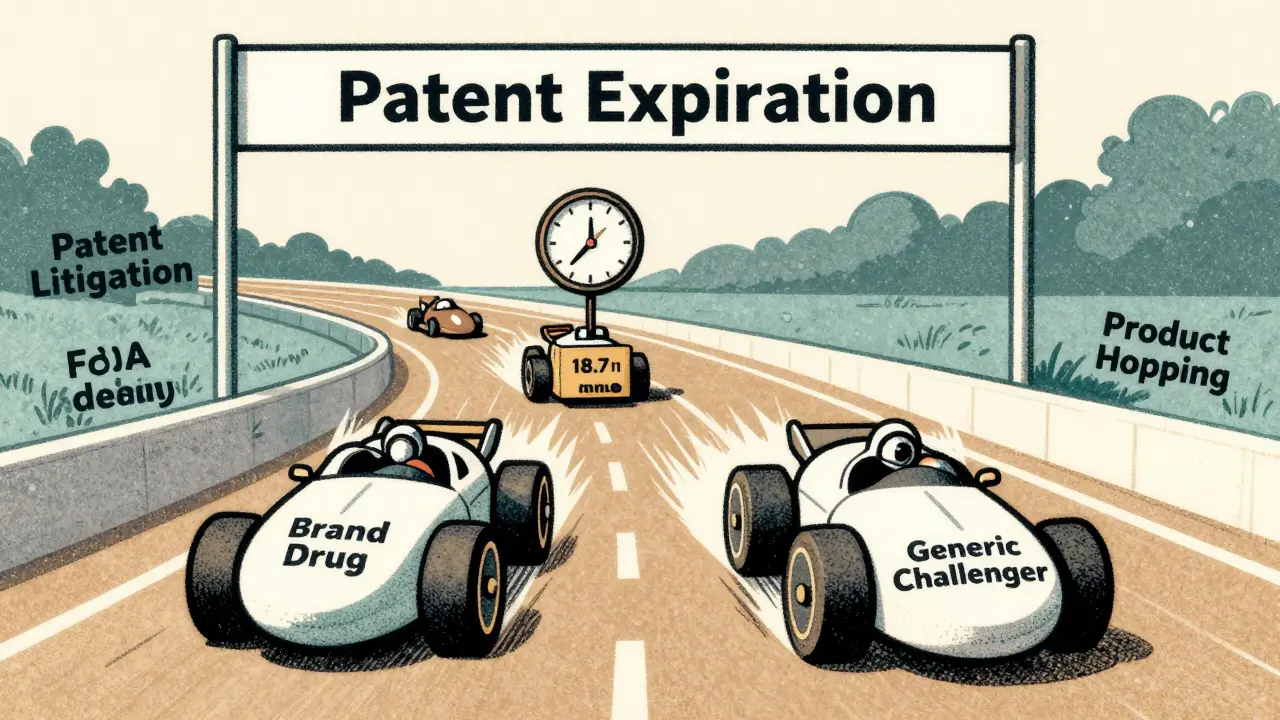
When a brand-name drug’s patent runs out, prices don’t just drop-they collapse. But when exactly does that happen? And how many generic versions will flood the market? For pharmaceutical companies, getting this wrong can mean losing hundreds of millions in revenue overnight. For generic manufacturers, missing the window means wasting millions on failed development. Predicting generic entry isn’t guesswork-it’s a high-stakes science built on patents, regulations, and competitive strategy.
How the System Works: The Hatch-Waxman Act and ANDAs
The foundation of generic drug entry in the U.S. started in 1984 with the Hatch-Waxman Act. This law created a legal shortcut for generic companies to bring cheaper versions to market without repeating the expensive clinical trials that brand-name drugmakers had to do. Instead, they file an Abbreviated New Drug Application, or ANDA. The catch? They can’t submit it until the brand’s patent expires-or if they challenge the patent, they can file early but risk a lawsuit. The real game-changer? The 180-day exclusivity period for the first generic company to file an ANDA challenging a patent. That’s a huge incentive. If you’re first, you get to be the only generic on the market for six months before anyone else can enter. That’s when prices start to tumble. The brand might still be selling, but now you’ve got 80% of the market at 60% less cost. That’s why companies race to be first.What Actually Delays Generic Entry?
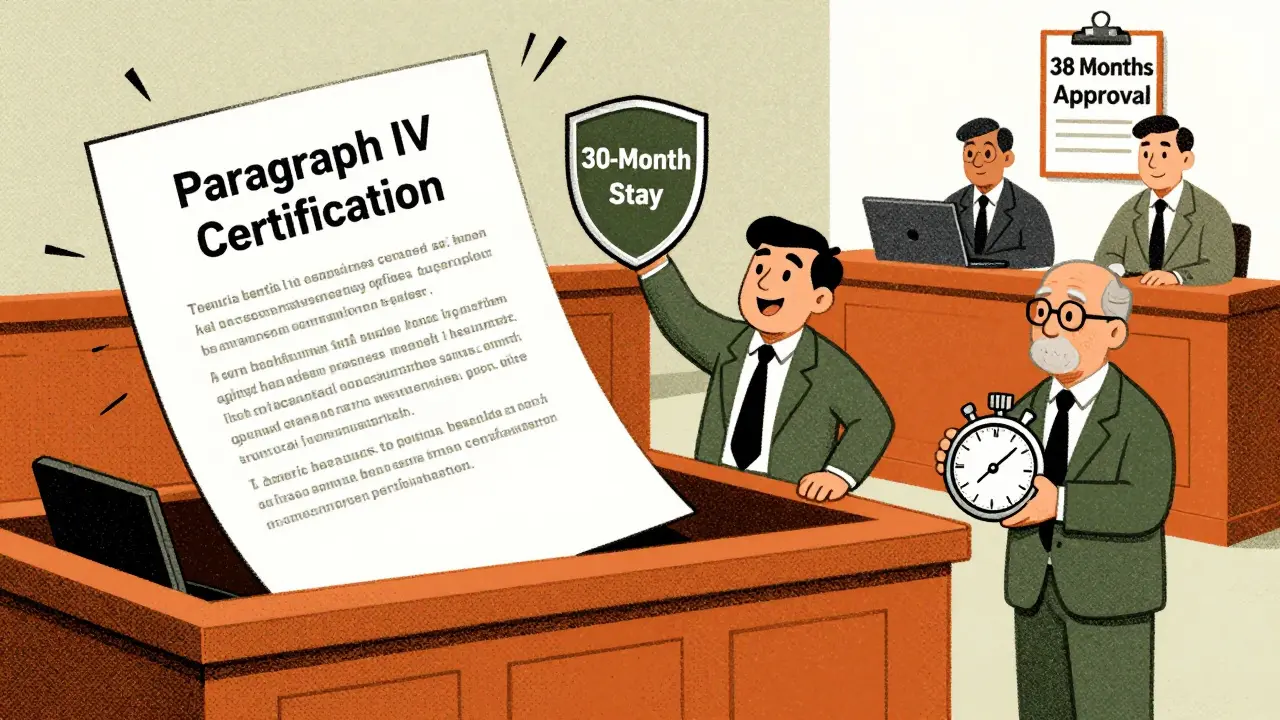
You’d think if a patent expires on January 1, 2026, generics arrive the next day. But that almost never happens. Here’s what really slows things down:- Patent litigation: If a generic company files a Paragraph IV certification (meaning they say the patent is invalid or won’t be infringed), the brand can sue. That automatically triggers a 30-month stay. On average, this delays entry by 18.7 months.
- Regulatory delays: The FDA takes about 38 months to approve an ANDA from submission to approval. If a company submits too early, they’re just waiting. If they submit too late, they miss the window.
- Product hopping: Some brands change the drug’s form-switching from a pill to a capsule, or adding a new delivery system-right before the patent expires. This tricks pharmacists and doctors into thinking it’s a new drug. In 63% of top-selling drugs, this tactic extends market control by 18 to 24 months.
- Authorized generics: Sometimes, the brand company itself launches a generic version under a different label. This happens in 41% of cases, but most forecasting models miss it entirely.
- REMS programs: Risk Evaluation and Mitigation Strategies, meant to control dangerous side effects, can block generic access if the brand refuses to share distribution systems. This delays entry by an average of 14.3 months.
How Accurate Are the Forecasts?
Simple models that just look at patent expiration dates? They’re wrong about half the time. R² values (a statistical measure of accuracy) hover around 0.45-meaning less than half the variation in timing is explained by the patent date alone. Advanced models use 40+ data points: patent litigation outcomes, FDA approval timelines, market size, therapeutic class, and even the number of patents clustered around the drug. The best models-like Evaluate Pharma’s J+D Forecasting-use machine learning to analyze 15 years of ANDA data. They’re hitting R² values of 0.82. That’s a 35% improvement over basic models. But even the best models struggle with:- Biologics: These are complex proteins, not simple chemicals. They’re not called generics-they’re biosimilars. Approval takes 12-18 months longer, and price drops are slower. Only 25-35% of the original price falls after three biosimilars enter, compared to 85% for small-molecule drugs.
- Complex generics: Inhalers, injectables, topical creams-these require specialized manufacturing. Approval times average 52 months, not 38. Forecasting these is like predicting a weather pattern with missing sensors.
- Pay-for-delay deals: Sometimes, the brand pays the generic company to delay entry. These secret settlements are hard to detect until they’re revealed in court.
Price Drops After Generic Entry
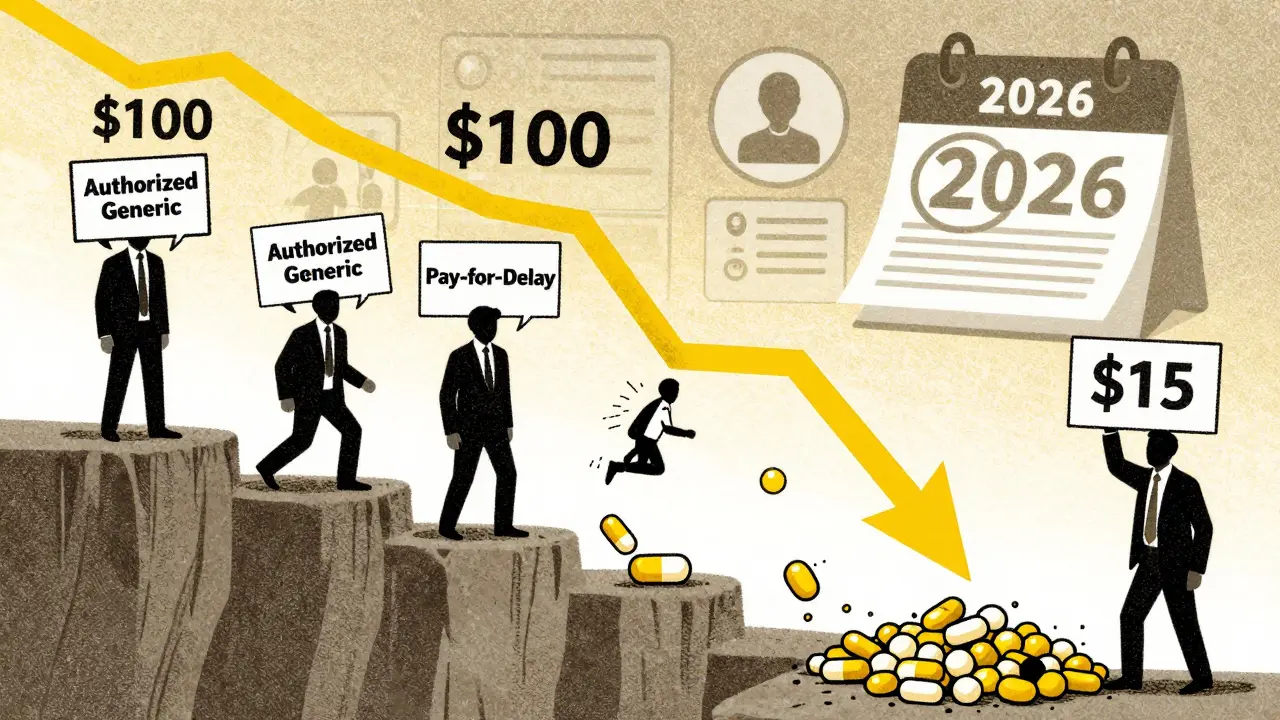
Once generics start rolling in, prices don’t just fall-they spiral:- First generic: Drops price by 39% below brand level.
- Second generic: Price falls another 15%, totaling 54% below brand.
- Fifth or sixth generic: Prices hit 85% below original brand price.
Who Uses These Forecasts-and Why?
Brand-name companies use them to plan. If they know a $1.2 billion drug will lose exclusivity in 14 months, they might:- Launch a new formulation (product hop)
- Start a patient transition program (like AbbVie did with Humira → Skyrizi)
- Adjust pricing or marketing budgets
What’s Changing in 2026?
The landscape is shifting fast:- Competitive Generic Therapy (CGT) pathway: The FDA now offers 180-day exclusivity to generics targeting drugs with little competition. This is new, and models are still learning how to predict it.
- AI models: By 2026, AI-driven tools will cut prediction errors from 11.4 months to under 7 months by reading court filings, FDA letters, and patent claims automatically.
- Medicare drug price negotiation: Starting in 2025, Medicare will negotiate prices for some high-cost drugs. That could reduce the price drop after generics enter by 15-20%-because the brand was already priced lower than expected.
- State substitution laws: California’s 2022 law made it harder for pharmacists to switch patients to generics without doctor approval. That slowed price declines by 8.2% compared to national models.
What You Need to Know
If you’re in pharma-whether you’re on the brand side or the generic side-here’s what matters:- Don’t rely on patent expiration dates alone. They’re just the starting line.
- Track Paragraph IV certifications. They’re the first real signal that a generic challenger is coming.
- Monitor FDA Orange Book updates weekly. That’s where patent and exclusivity data live.
- Watch for product hopping. If a brand suddenly changes the dosage form or adds a new delivery system, assume they’re trying to delay generics.
- Know your therapeutic class. Oncology drugs delay generic entry 32% longer than cardiovascular drugs.
How long does it take for a generic drug to hit the market after patent expiration?
It’s not instant. Even if a patent expires on January 1, 2026, the first generic might not launch until 12 to 24 months later. Delays come from patent lawsuits (which can add 18+ months), FDA approval timelines (average 38 months from submission), or strategic delays like product hopping. The fastest generics enter within 6 months if there’s no litigation and the ANDA was submitted early.
What’s the difference between a generic drug and a biosimilar?
Generic drugs are exact chemical copies of small-molecule drugs, like pills or tablets. Biosimilars are similar-but not identical-to complex biologic drugs made from living cells, like insulin or cancer antibodies. Biosimilars take longer to develop (12-18 months vs. 12-24 months for generics), cost more to produce, and face stricter approval rules. Price drops are also slower: biosimilars reduce costs by 25-35% after three competitors, while generics drop 85%.
Why do some generic drugs never come to market?
Three main reasons: patent litigation delays, complex manufacturing requirements (like inhalers or injectables), and lack of profit incentive. If a drug has low sales or high production costs, generic makers won’t risk the investment. Also, if the brand company launches its own generic (authorized generic), there’s no financial upside for others to enter.
Can a brand company legally delay generics?
Yes, but within legal limits. They can file lawsuits when a generic challenges their patent, triggering a 30-month stay. They can also change the drug’s form (product hopping), extend exclusivity with pediatric studies, or file citizen petitions to delay FDA approval. While some tactics are controversial, many are legal under current rules. The FTC has cracked down on pay-for-delay deals, but product hopping and patent thickets remain largely unchallenged.
How do I find out when a specific drug’s patent expires?
Check the FDA’s Orange Book, which lists patents and exclusivity periods for brand-name drugs. It’s updated weekly. You can also use commercial tools like Drug Patent Watch or Cortellis Generics Intelligence, which combine Orange Book data with litigation tracking and FDA approval timelines. For accurate forecasts, you need more than just the patent date-you need the full legal and regulatory context.


14 comments
Stephen Archbold
So the real game is who can game the system the longest? Patent litigation, product hopping, REMS traps - it’s like a board game where the brand gets to roll the dice twice and the generics have to play by Monopoly rules. And don’t even get me started on authorized generics. That’s just the brand saying ‘lol, we’re still in charge’ while pretending to be the cheap option.
Joanna Reyes
I’ve been tracking ANDA filings for five years now, and honestly? The models that only look at patent expiration dates are laughable. I work in pharma analytics, and what I’ve seen is that the real predictor isn’t the patent - it’s the timing of Paragraph IV certifications. The moment that hits the Orange Book, you’ve got maybe 30-60 days before the litigation dominoes start falling. And if you’re watching FDA submission dates? You’ll notice most generics submit 8-10 months before the patent expires, hoping to hit that 38-month approval window. But here’s the kicker - if the brand has a REMS program and refuses to share distribution, that’s an automatic 14-month delay, no matter how clean the application is. I’ve seen drugs with zero litigation still stuck for 22 months because of a single signed agreement the FDA can’t force them to release. It’s not about law. It’s about leverage.
Nick Hamby
There’s a deeper philosophical question here: if a drug’s value is defined by its patent, is it really a medicine - or a financial instrument? The system was designed to balance innovation and access, but we’ve turned it into a derivatives market. The 180-day exclusivity window isn’t a reward for innovation - it’s a lottery ticket for corporate arbitrage. And when you layer in pay-for-delay, product hopping, and authorized generics, you’re not predicting market entry - you’re forecasting a legal chess match where the rules are written by lawyers, not scientists. We talk about ‘affordable medicine,’ but the architecture of access was engineered to delay affordability. Maybe the real innovation isn’t in the drug - it’s in dismantling the system that hides behind it.
Haley Gumm
Wow. So the FDA takes 38 months to approve a generic? That’s longer than it takes to get a green card. And you’re telling me we’re surprised generics don’t hit the market instantly? I mean, if I had to wait 3 years to get a pill I could’ve had for $0.50, I’d riot. Also - ‘product hopping’? That’s not innovation. That’s a scam. Someone’s getting rich while patients get stuck on a $200 pill because the new version ‘has a different coating.’ What a joke.
Larry Zerpa
Let’s be real - the whole system is a fraud. You say ‘patent expiration’ like it’s a deadline, but it’s a suggestion. Brands have entire legal teams whose sole job is to delay generics. And the FDA? They’re not regulators - they’re gatekeepers who get pressured by lobbyists. The 30-month stay? It’s not a ‘stay’ - it’s a vacation for the brand. And don’t even mention pay-for-delay. That’s not a settlement - it’s bribery with a law degree. The fact that we call this ‘healthcare’ is the real tragedy.
Vanessa Drummond
Can we just admit that the U.S. is the only country that lets pharmaceutical companies run this entire circus? In Canada, generics hit within weeks. In the UK, they’re priced at 10% of brand. Here? We’re stuck in a 2-year legal maze while people ration pills. And now Medicare’s negotiating prices? Great. So now we’re paying less for the brand AND the generic? That’s not saving money - that’s just making the system more confusing. I work in pharmacy. I see patients skipping doses because they can’t afford the ‘discounted’ version. This isn’t economics. It’s cruelty with a spreadsheet.
Natanya Green
Okay, but what about the emotional toll?! I mean, imagine being a patient who’s been on this one drug for 10 years, and then suddenly your doctor says ‘oh, we’re switching you to this new thing’ - but it’s the same chemical, just in a different color capsule?! That’s not science - that’s psychological warfare! And the pharmacists? They’re told they can’t switch unless the doctor says so? WHAT?! I’ve seen people cry because they ‘can’t handle the change’ - even though it’s the same exact molecule! This isn’t healthcare - it’s trauma with a patent number.
Brandice Valentino
Ugh, I hate how basic this analysis is. Like, duh, patent expiration doesn’t equal market entry - we’ve known that since 2012. But you didn’t even mention the role of private equity in generic manufacturing! Like, the real story is that PE firms buy generic companies, strip them of R&D, then flip them after they win exclusivity. And then? They shut down the plant. So you get one wave of generics - then nothing. No competition. No price drop. Just a monopoly in disguise. But hey, at least the spreadsheets look pretty, right? #PharmaBro
Nerina Devi
As someone from India, where generics are the backbone of healthcare access, I find this deeply ironic. In the U.S., you’re treating generic entry like a high-stakes chess match. In India, we make these drugs for $0.10 a pill and ship them globally. The fact that a $1.2 billion drug can be replicated for $200 million in R&D and still be blocked by lawsuits… it’s not a market failure. It’s a moral one. The Hatch-Waxman Act was meant to help patients - not turn drug access into a corporate arms race. The real innovation isn’t in the algorithms - it’s in the courage to say: medicine shouldn’t be a profit center.
Michael FItzpatrick
Y’all are overcomplicating this. It’s simple: if a drug’s patent expires and no generic shows up? That’s not a delay - that’s a market signal. If it’s a complex injectable or a drug with low volume, nobody’s gonna risk the capital. It’s economics. Not conspiracy. Also - authorized generics? That’s not cheating. That’s a brand saying ‘I’m not a monster, I’ll let you have it cheap - but only if I control the supply.’ It’s not evil. It’s strategic. Stop treating pharma like a cartoon villain. They’re just playing the game you gave them.
Dominic Punch
Let’s talk about biosimilars again. You said price drops are slower? Yeah, because the FDA treats them like new drugs. But here’s the thing - in Europe, biosimilars entered at 70% price cuts within 18 months. Here? We’re at 30% after three entrants. Why? Because the brand companies bundle them with their original drug in ‘combo contracts’ with insurers. So even if a biosimilar is cheaper, the hospital gets a discount on the original - so they don’t switch. It’s not about science. It’s about contracts. And no model I’ve seen accounts for that. You’re forecasting molecules - not corporate leverage.
kirti juneja
Imagine if we treated drugs like we treat smartphones. You buy an iPhone - after 2 years, Apple can’t stop you from using a third-party charger. But with drugs? The brand owns the entire ecosystem - the pill, the packaging, the distribution, the patient education, even the pharmacy’s ability to substitute. That’s not innovation. That’s feudalism. And the worst part? We call it ‘intellectual property.’ What we’re really protecting is control. We need a new framework - one where the molecule belongs to the patient, not the patent holder.
Dinesh Dawn
Just wanted to say - this whole thread is so fascinating. I work in a small clinic in rural India, and we rely on generics every day. The fact that here in the U.S., people are fighting over 180-day windows while patients go without… it makes me sad. But also kind of hopeful. Because if we can map this stuff so precisely, maybe we can fix it. Not with more lawsuits. With more transparency. The Orange Book should be open-source. The litigation data should be public. The FDA approval timelines should be live-streamed. We don’t need better models. We need more light.
Erin Pinheiro
Ugh. I can’t believe you all are still talking about patent expiration like it’s some sacred date. It’s not. It’s a suggestion. The real trigger is when a generic company files a Paragraph IV ANDA - that’s the only thing that matters. And even then, if the brand is owned by a company with deep pockets and a history of litigation? You’re looking at 3+ years. Also - FDA approval? Please. The agency has a backlog longer than my ex’s apology text. And don’t even get me started on REMS. The brand refuses to share distribution? They’re not ‘blocking’ - they’re ‘protecting patient safety.’ Right. Sure. I’ve seen the same drug in 3 countries - in two of them, the REMS didn’t exist. Coincidence? I think not.