
Getting your medication right isn’t just about taking a pill every day. It’s about building a habit that fits your life - not the other way around. Too many people stop taking their meds because the plan feels too big, too vague, or too disconnected from their daily reality. The good news? You don’t need to be perfect. You just need to be consistent. And that starts with setting goals that actually work for you.
Why Most Medication Plans Fail
Let’s be honest: telling someone to "take your blood pressure pill every morning" doesn’t cut it. People forget. They get busy. They run out. They feel fine and think they don’t need it anymore. Studies show that up to 50% of people with chronic conditions don’t take their meds as prescribed. And the cost? Over $300 billion a year in the U.S. alone - from ER visits to hospital stays that could’ve been avoided.
The problem isn’t laziness. It’s poor design. Generic instructions don’t account for real life. You might work two jobs. You might have memory issues. You might not have reliable transportation to refill your prescription. If your goal doesn’t fit your life, it won’t stick.
What Makes a Goal Actually Achievable?
Not all goals are created equal. The best ones follow a simple structure called SMART: Specific, Measurable, Achievable, Relevant, and Time-bound. But in healthcare, there’s an even better version: B-SMART. It adds one crucial step before everything else: Barriers.
Before you even think about taking a pill, ask: What’s stopping me?
- Do I forget because I take meds at night, but I’m always tired?
- Do I skip doses because the bottle is in the garage, and I don’t go out often?
- Is the cost too high, so I ration pills?
- Do I feel embarrassed to take meds in front of others?
Identifying these blockers first changes everything. You’re not just setting a goal - you’re removing the roadblocks before they stop you.
How to Build Your B-SMART Adherence Goal
Here’s how to turn a vague idea like "I’ll take my medicine better" into something real.
- Barrier: "I forget to take my diabetes pill because I’m rushing out the door in the morning."
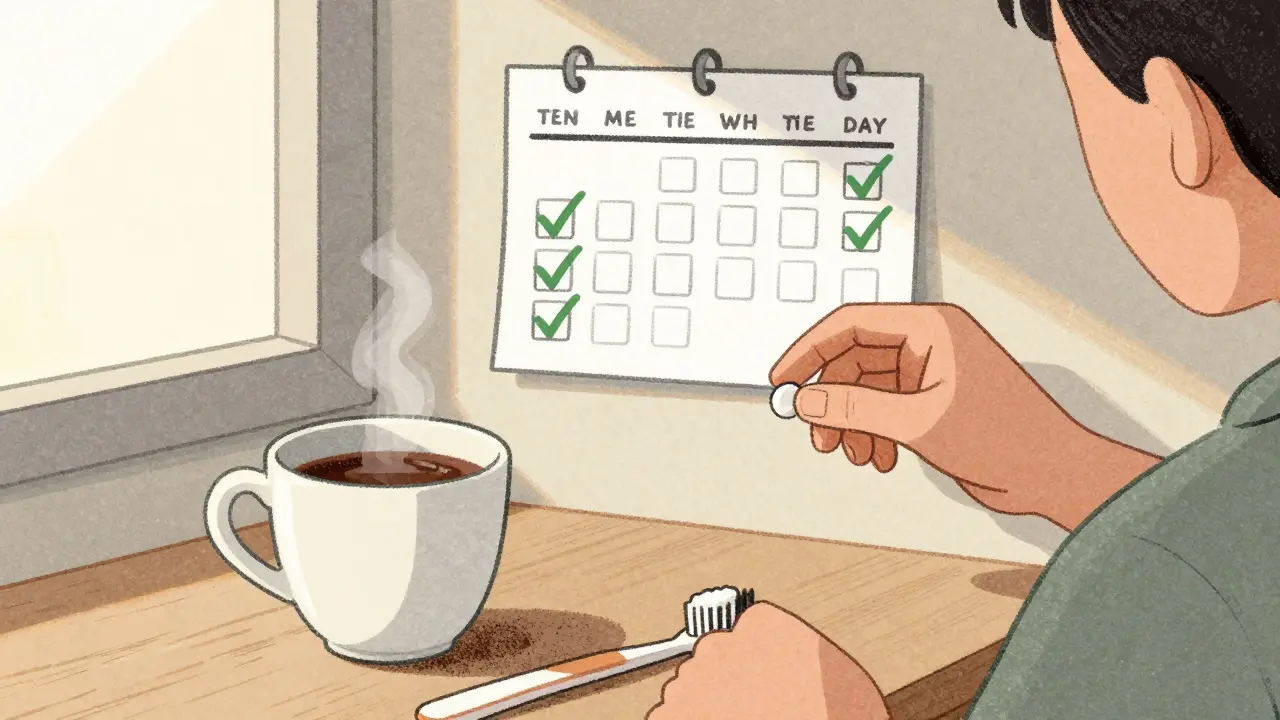
- Specific: "I will take my metformin pill with my morning coffee, right after I brush my teeth."
- Measurable: "I’ll count how many pills are left in the bottle every Sunday. I need at least 28 pills left by the end of the month."
- Achievable: "I drink coffee every day. I always brush my teeth. This fits my routine."
- Relevant: "My doctor said my A1C is too high. Taking this pill every day will help me feel more energy and avoid kidney problems."
- Time-bound: "I’ll check my pill count every Sunday for the next 4 weeks."
This isn’t just theory. A 2021 study found that patients who used B-SMART goals during community health visits hit 65.5% adherence - nearly double the rate of those given generic advice.
How to Track Progress Without Feeling Overwhelmed
Tracking doesn’t mean logging every dose in an app. It means checking in - simply - and often.
Here are three real, low-tech ways people actually stick to their goals:
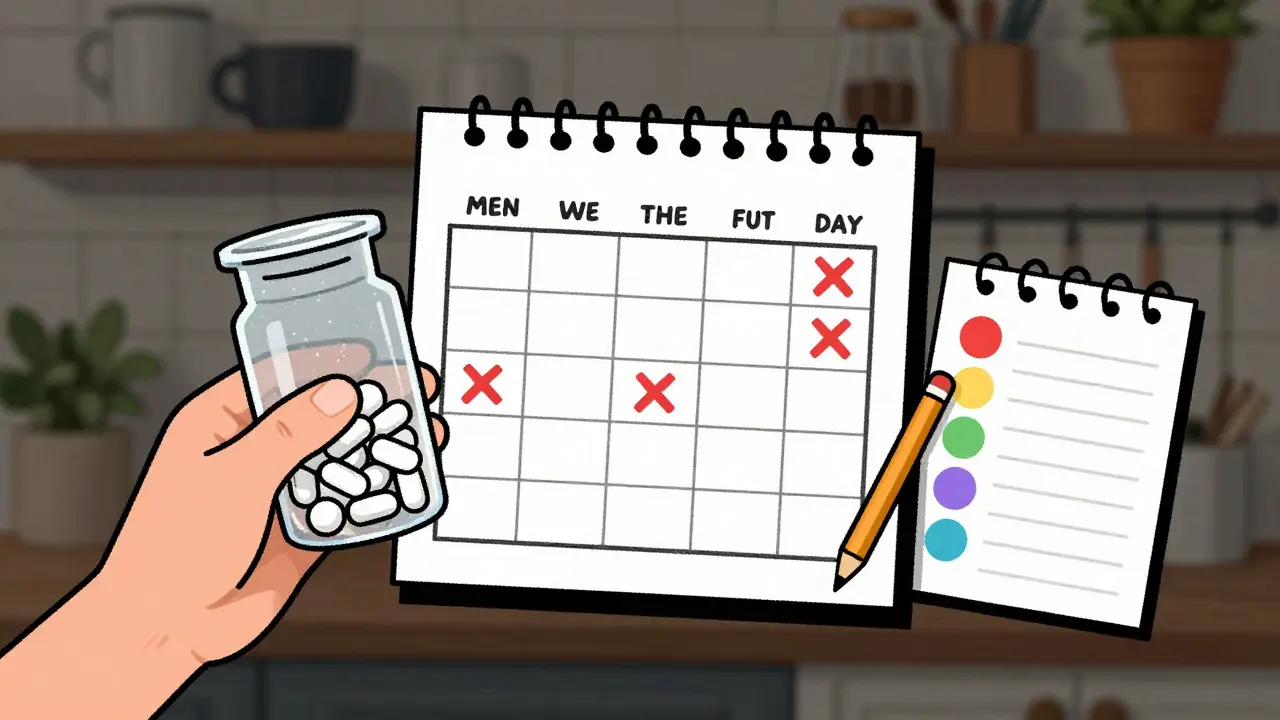
- Pill counts: Keep your meds in a clear container. Every Sunday, count how many pills are left. If you’re supposed to take one a day and you have 24 left on Sunday, you missed 4 doses. No app needed.
- Visual charts: Print a calendar. Put a big green checkmark for each day you take your pill. After 7 days, you’ve got a streak. People love streaks. They’re motivating.
- Phone alarms: Set two alarms: one for when you wake up, and one for when you eat dinner. If you miss one, you still have another shot.
For tech-savvy users, apps like Medisafe or ThoroughCare can sync with your EHR and send alerts. But here’s the catch: 52% of adults over 65 abandon digital trackers within 30 days. Simplicity wins.
What Works Best for Different Conditions
Not all meds are the same. Your tracking method should match your condition.
- Diabetes: Track blood sugar readings alongside pill intake. If your A1C drops over 3 months, you’re doing something right.
- Hypertension: Use a home blood pressure monitor. Write down your numbers weekly. If your systolic drops below 130 consistently, you’re on track.
- Asthma: Use a smart inhaler. It logs when you use it. No guesswork. Some even send reports to your doctor automatically.
- Depression or anxiety meds: Track mood and sleep on a scale of 1-10 each day. Small improvements matter more than perfection.
For heart failure patients, every 10% increase in adherence cuts hospital readmissions by 5.7%. That’s not just numbers - that’s days spent at home, not in a hospital bed.
What to Do When You Slip Up
You missed a week. You forgot three days in a row. You feel guilty. Stop. This is normal.
Adherence isn’t about being perfect. It’s about getting back on track. Here’s how:
- Don’t restart from zero. Start from where you are.
- Ask yourself: What changed? Were you sick? Traveling? Stressed?
- Adjust your goal. Maybe you need a pill organizer. Maybe you need a reminder from a family member.
- Celebrate small wins. Even if you took your pill 5 out of 7 days this week - that’s progress.
One diabetes educator shared a story: A patient missed her weekly weigh-ins. So they started a sticker chart. Every time she weighed in, she got a sticker. After five stickers, she got a small reward - a new book or a coffee. Her weigh-ins jumped from twice a month to five times a week.
How Providers Can Help (Without Adding More Work)
If you’re a patient, your provider should help you build this plan - not just hand you a script. But many doctors are pressed for time.
Good clinics use templates in their electronic records that auto-fill B-SMART goals. They ask: "What’s one thing that makes it hard to take your meds?" Then they write down your answer and the goal together.
Studies show this cuts documentation time by 37% and improves outcomes. You don’t need fancy tech. You need a conversation that goes like this:
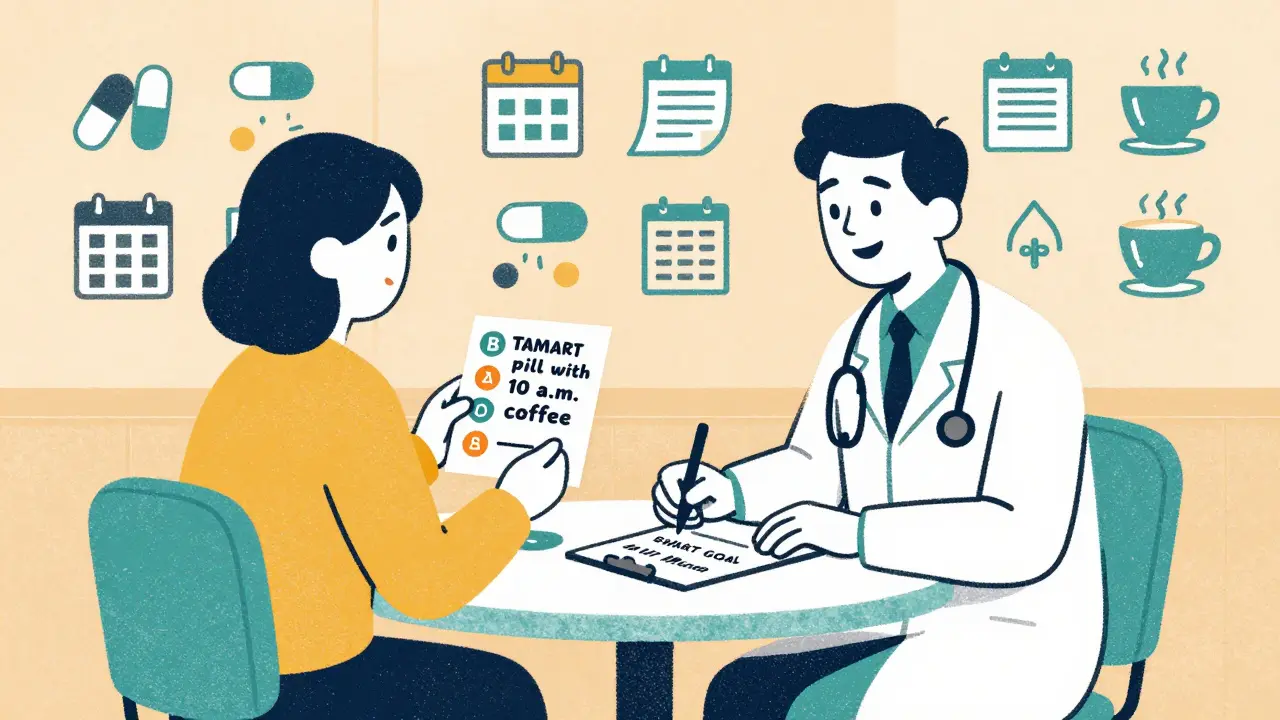
Provider: "What’s the biggest reason you miss your pills?"
Patient: "I forget when I’m at work."
Provider: "Okay. What’s one thing you do every day at work? Maybe lunch? Can we tie it to that?"
Patient: "I drink coffee at 10 a.m."
Provider: "Great. Let’s make your goal: Take your pill with your 10 a.m. coffee. We’ll check in two weeks."
That’s it. No forms. No apps. Just a plan that fits.
What’s Changing in 2025 and Beyond
Technology is getting smarter. New ingestible sensors can tell if you swallowed your pill. Voice assistants like Amazon Halo can remind you and log your response. AI can predict when you’re likely to miss a dose - 14 days in advance.
But the biggest shift isn’t tech. It’s policy. Starting in 2026, all electronic health records in the U.S. must include standardized fields for adherence goals. Insurance companies are tying payments to how well patients stick to their plans.
That means more support. More tools. More focus on what actually works - not just what looks good on paper.
Final Thought: It’s About Your Life, Not the Pill
Your medication is a tool. Your life is the goal. The best adherence plan isn’t the one with the most features. It’s the one you’ll actually follow.
Start small. Identify your real barrier. Tie your pill to something you already do. Track it simply. Celebrate the wins. And if you slip? That’s not failure. That’s data. Adjust. Try again.
People don’t need more discipline. They need better systems. And you’re already building yours.
What’s the most common mistake people make when setting medication goals?
The biggest mistake is setting goals that are too vague - like "take my pills every day" - without tying them to a daily habit or identifying what’s stopping them. People forget because they’re not linked to something routine, like brushing teeth or eating breakfast. Adding a barrier check first makes all the difference.
Do I need an app to track my medication adherence?
No. Apps can help, but they’re not required. Many people, especially older adults, stop using apps after a few weeks. Simple methods like counting pills each Sunday, using a paper calendar with checkmarks, or setting phone alarms work just as well - and are easier to stick with.
How do I know if my goal is realistic?
Ask yourself: Can I do this even on my worst day? If you’re exhausted, sick, or rushed, can you still take your pill? If the answer is no, your goal isn’t achievable yet. Start smaller - maybe just two days a week - and build up. Progress beats perfection.
What if I miss a dose? Should I double up next time?
Never double up unless your doctor says so. Missing a dose happens. The key is to get back on track without guilt. Just take your next dose at the regular time. Use the missed day as a clue - what changed? Did you run out? Were you traveling? Adjust your plan so it doesn’t happen again.
How long does it take to see results from adherence goals?
You’ll start noticing small wins in 2-4 weeks - like fewer missed doses or better sleep. But clinical improvements, like lower blood pressure or better blood sugar, usually take 3-6 months. The goal isn’t instant results. It’s consistent behavior over time.
Can family members help with adherence tracking?
Absolutely. A simple text reminder from a loved one can increase adherence by 30%. Ask someone to check in once a week: "Did you take your pill today?" Don’t make it a chore - make it a connection. Celebrate together. It’s not about control. It’s about support.
Are there free tools I can use to track my meds?
Yes. Use a free printable calendar from the CDC or your pharmacy. Many pharmacies offer free pill organizers. You can also use your phone’s built-in alarm or calendar app. No subscription needed. The best tool is the one you’ll use - not the one with the most features.
What should I bring to my next doctor’s visit about my adherence?
Bring your pill count, your calendar with checkmarks, or a note of when you missed doses. Don’t say "I forgot." Say: "I missed two doses last week because I was traveling and didn’t bring my pillbox. I’m going to start keeping one in my bag." That’s the kind of detail that helps your doctor help you.



15 comments
Himanshu Singh
i just started taking my bp meds and honestly i was gonna quit till i read this. now i tie it to my morning chai 😅 i miss a day sometimes but i count the pills on sunday and feel kinda proud when i still have 26 left. thanks for the real talk!
Jasmine Yule
THIS. I’m so tired of doctors acting like we’re lazy when we miss doses. I work two jobs, have two kids, and my pills are in the garage. OF COURSE I forget. B-SMART is the first thing that made sense. I put mine next to my coffee maker. Done. No guilt. Just results. 🙌
Greg Quinn
It’s funny how we treat medication like a moral failing instead of a system design problem. We don’t blame people for forgetting their keys if they’re not on the hook by the door. Why do we expect the brain to magically remember pills without environmental scaffolding? The B-SMART framework isn’t a hack-it’s just basic human-centered design. We’re biological creatures, not robots with perfect recall.
Lisa Dore
My grandma started using the sticker chart after her doctor suggested it. She got a sticker every time she took her meds and after 7, she picked a small treat-ice cream, a new flower, whatever. Now she asks me every Sunday to help her check the calendar. It’s not about compliance anymore-it’s about connection. And her numbers? Down 20 points. I cried.
Sharleen Luciano
While I appreciate the sentiment, this article is dangerously oversimplified. B-SMART? That’s not a validated clinical framework-it’s a marketing rebrand of SMART goals with a buzzword. And citing a 2021 study without a DOI or journal name? Unprofessional. Real adherence interventions require behavioral economics, pharmacokinetic modeling, and EHR integration-not sticky notes and coffee triggers. This is what happens when non-clinicians try to fix systemic problems with feel-good hacks.
Henriette Barrows
My mom has diabetes and she used to skip her pills because she was scared of the side effects. We didn’t talk about it till I asked her, ‘What’s the worst part about taking them?’ She said, ‘I feel like I’m admitting I’m broken.’ That hit me. We changed her goal to: ‘Take it after I brush my teeth so I don’t feel like I’m giving in.’ Now she says it’s like brushing off a bad thought. I didn’t fix her meds-I fixed how she felt about them.
Teresa Rodriguez leon
Everyone’s so quick to celebrate ‘small wins’ but what about the people who just can’t afford their meds? You talk about coffee and calendars like it’s a choice. My insulin costs $400 a month. I ration. I skip. I feel like trash every time. No sticker chart fixes that. No ‘B-SMART’ fixes systemic greed. This post is tone-deaf.
Nisha Marwaha
From a clinical pharmacy perspective, the B-SMART model aligns with the WHO’s adherence taxonomy and the COM-B behavioral framework. The barrier identification phase is critical-it maps directly to the Capability-Opportunity-Motivation construct. When integrated into structured medication therapy management (MTM) sessions, adherence rates increase by 41–68% depending on comorbidity burden. The low-tech tracking methods are not merely pragmatic-they’re evidence-based in resource-constrained settings.
Paige Shipe
People need to stop making excuses. If you can’t remember to take your pills, you’re just not trying hard enough. I take 7 different meds and I never miss one. I set 5 alarms, I use a pillbox, I write it on my mirror. If you’re too lazy to do that, don’t blame the system. Take responsibility. This article is just coddling people.
David Chase
USA is the only country where people think a sticker chart fixes healthcare. In Germany, they have free meds and automatic refills. In Canada, pharmacists call you if you haven’t picked up your script in 3 weeks. Here? We tell people to drink coffee and pray. This is why our ERs are full. Stop glorifying band-aids. Fix the system. 💥
Duncan Careless
I’ve used the pill count method for my statins since last year. It’s not glamorous, but it works. I don’t need an app. I just look at the bottle every Sunday morning with my tea. If it’s down more than 7, I know I’ve missed some. Then I ask myself why-was I away? Stressed? Tired? That reflection is the real tool, not the count. Simple. Quiet. Effective.
Russell Thomas
Oh wow. So the solution to chronic illness is… tying pills to coffee? Congrats, you’ve turned medicine into a TikTok hack. Meanwhile, people are dying because they can’t afford the damn pills. This feels like a corporate wellness brochure written by someone who’s never had to choose between rent and insulin. Thanks for the laugh.
Nicole K.
If you’re missing your meds because you’re busy, you’re just selfish. Your health isn’t a side project. You have one body. One life. Stop making it about convenience. Just do it. No excuses. No charts. No stickers. Just take it.
Fabian Riewe
Just wanted to say-this post saved my dad’s life. He’s 72, hates tech, and used to skip his heart meds because he thought he was fine. We made a calendar with big red X’s for missed days. After 3 weeks, he started coloring the X’s green with his marker. Said it felt like he was winning. Now he asks me to help him hang it up every month. No app. Just a piece of paper and a lot of love.
Amy Cannon
It is imperative to acknowledge that the paradigm shift toward patient-centered adherence interventions represents a significant departure from the paternalistic medical model that dominated clinical practice for much of the 20th century. The B-SMART heuristic, while colloquially framed, resonates with the principles of shared decision-making as codified in the Patient-Centered Outcomes Research Institute (PCORI) guidelines. Furthermore, the emphasis on low-tech, non-digital tracking mechanisms is not merely a pragmatic concession to digital illiteracy, but a strategic alignment with health equity imperatives, particularly in aging and rural populations where technology adoption remains suboptimal. The longitudinal sustainability of such interventions, as evidenced in community health center pilot programs, suggests that behavioral economics may yet outperform pharmaceutical innovation in the domain of chronic disease management.