
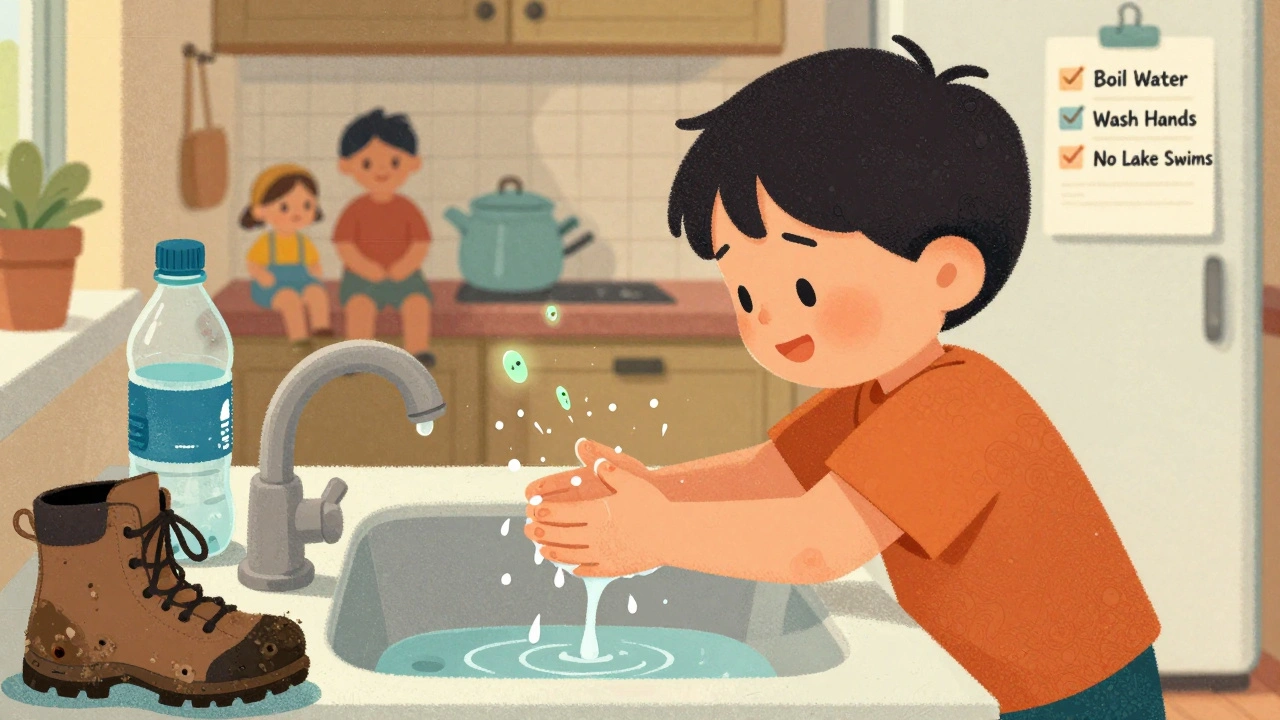
Parasitic infections might sound like something from the past, but they’re still very much alive-especially in homes with kids, travelers, and communities with limited access to clean water. Two of the most common culprits? Giardia and pinworms. Both are tiny, easy to catch, and often mistaken for a bad stomach bug. But they’re not the same, and they don’t respond to the same treatments. Knowing the difference can save you weeks of discomfort-and stop the spread before it gets out of hand.
What Is Giardia, and How Do You Get It?
Giardia is a one-celled parasite called Giardia lamblia. It lives in the small intestine and causes giardiasis, one of the most frequent causes of traveler’s diarrhea and waterborne illness in the U.S. You don’t need to travel overseas to catch it. Backcountry hiking, poorly filtered tap water, or even swallowing water while swimming in a lake can do it. The parasite survives as a hardy cyst, invisible to the naked eye, and can live for months in cold water.
It only takes 10 to 25 cysts to make someone sick. Once swallowed, they hatch in the gut and turn into active trophozoites that cling to the intestinal lining. This damages the brush border-tiny finger-like projections that help absorb nutrients. That’s why people with giardiasis often have watery, greasy stools, bloating, and weight loss. Some feel fine for days before symptoms hit. The incubation period? Usually about a week.
Outbreaks happen in daycare centers, camps, and households where hygiene slips. A 2023 CDC report showed that 30% of cases in children under five were linked to daycare exposure. Adults often catch it from kids who haven’t washed their hands after using the bathroom. And yes, pets can carry it too-though human-to-human transmission is far more common.
What Are Pinworms, and Why Are They So Persistent?
Pinworms, or Enterobius vermicularis, are tiny white worms about the length of a staple. They live in the colon and rectum. The real trick? The female worm crawls out of the anus at night to lay eggs on the skin around the anal area. That’s when the itching starts-intense, burning, and worse when you’re trying to sleep.
It’s not the worms themselves that spread the infection. It’s the eggs. They’re sticky, light, and can float in the air. You touch a contaminated doorknob, bedsheet, or toy. Then you touch your mouth. The eggs hatch in your gut, and within two to six weeks, you’re hosting adults. Children are the main carriers, but the infection spreads fast through families. One study found that when one child in a household has pinworms, 75% of other members test positive-even if they show no symptoms.
Unlike Giardia, pinworms don’t cause diarrhea or malabsorption. Their main symptom is nighttime anal itching. Sometimes you’ll see the worms around the anus or on underwear in the morning. They’re white, move slowly, and look like tiny threads. Kids might scratch so much they develop a rash or secondary skin infection.
How Are These Infections Diagnosed?
For Giardia, stool tests used to be the go-to-but they’re unreliable. Traditional microscopy misses up to 30% of cases. Today, the CDC recommends a stool antigen test. It detects specific proteins from the parasite and is 95% accurate. Some clinics use PCR testing, which is even more sensitive. If you’ve had diarrhea for more than a week, especially after camping, traveling, or swimming in a lake, ask for this test.
Pinworms are diagnosed differently. The scotch tape test is simple, cheap, and effective. First thing in the morning, before bathing or using the toilet, press a piece of clear tape against the skin around the anus. Then stick it on a slide and take it to your doctor. Eggs stick to the tape. One test catches about half the cases. Three tests over three days catch nearly 90%. It’s not glamorous, but it works.
Many doctors still rely on symptoms alone, especially with kids. If your child is scratching their bottom at night and nothing else explains it, treatment often starts before test results come back.

Treatment: What Actually Works?
Both infections respond well to medication-but only if you do it right.
For giardiasis, the most common drugs are:
- Metronidazole: 250 mg three times a day for 5 to 7 days. It’s effective but comes with side effects-metallic taste (78% of users report it), nausea, and sometimes dizziness. Avoid alcohol while taking it.
- Tinidazole: A single 2-gram dose. Just as effective as metronidazole, but fewer doses mean better compliance. Side effects are similar but shorter-lived.
- Nitazoxanide: 500 mg twice daily for 3 days. Approved for kids as young as 1 year. Fewer side effects, but more expensive.
Cure rates are 80-95% with proper dosing. But reinfection is common. If symptoms come back, it’s not always drug resistance. More likely, you or someone in your household is still shedding cysts.
For pinworms, the CDC recommends:
- Mebendazole: 100 mg once, repeated in two weeks.
- Albendazole: 400 mg once, repeated in two weeks. Newer CDC guidelines (January 2024) suggest a triple dose (400 mg x3, spaced two weeks apart) for stubborn cases-98% effective in trials.
- Pyrantel pamoate: Available over the counter. 11 mg per kg of body weight, up to 1 gram. Same dosing as mebendazole.
Don’t treat just one person. Treat everyone in the house at the same time. Even if someone feels fine. Eggs can survive on surfaces for up to three weeks. That means bedding, towels, clothes, toys, and even vacuum cleaner bags can harbor them.
Prevention: Stop the Cycle Before It Starts
Medication alone won’t fix this. You need to break the transmission chain.
For Giardia:
- Boil water for at least one minute if you’re unsure of its safety. Filtering with a 1-micron or smaller pore filter works too.
- Wash hands with soap and water after using the bathroom, changing diapers, or before eating. Hand sanitizer doesn’t kill Giardia cysts.
- Avoid swallowing water in pools, lakes, or rivers. Use bottled water for brushing teeth when traveling.
- Children with giardiasis should stay home from daycare or school for at least two weeks after symptoms stop.
For Pinworms:
- Wash all bedding, pajamas, and underwear in hot water after treatment.
- Shower in the morning to wash off eggs laid overnight.
- Keep fingernails short. Scratching spreads eggs to fingers, then to everything else.
- Don’t shake bedding or towels before washing-they can send eggs airborne.
- Disinfect surfaces like toilet seats, doorknobs, and toys with a bleach-based cleaner.
Handwashing alone reduces transmission by 30-50%, according to WHO. It’s the single most effective tool you have.

Why Do Some People Keep Getting Infected?
Reinfection is the biggest problem. People think, “I took the medicine, I’m fine.” But if their kid still has eggs on their hands, or the family didn’t wash the sheets, the cycle restarts.
A Reddit user in March 2024 shared their story: After treating the whole family twice, the pinworms came back. Only when they hired a professional cleaner to deep-clean the house, wash everything in hot water, and steam the mattress did it finally stop.
Another common issue: metronidazole side effects. The metallic taste is so strong that many people stop taking it early. That’s how resistance builds. A 2024 study in Southeast Asia found 15% of giardiasis cases no longer respond to metronidazole. Tinidazole or nitazoxanide are better alternatives there.
Immunocompromised people-those with HIV, cancer, or on immunosuppressants-are at higher risk for chronic giardiasis. Their infections can last months, not weeks. They need longer treatment and close follow-up.
What’s Next? Vaccines and Changing Patterns
There’s no vaccine yet for either parasite. But research is moving forward. A Phase I Giardia vaccine called GID1 showed 70% seroconversion in a 2023 Lancet study. It’s still early, but promising.
Climate change is also shifting where these infections pop up. The Merck Manual predicts that by 2040, giardiasis could spread into 20-30% more temperate regions due to increased flooding and water contamination. That means places like Wellington, New Zealand, or parts of Canada might see more cases in the coming decades.
Meanwhile, global demand for antiparasitic drugs is rising. The market hit $3.2 billion in 2023, with giardia and pinworm treatments making up nearly 20% of it. That’s not just because of travel-it’s because we’re better at testing now, and more people are asking for answers.
Bottom line? These infections aren’t glamorous, but they’re treatable. The key isn’t just the medicine. It’s knowing how they spread-and stopping them at every step.
Can you get giardia from pets?
Yes, but it’s rare. Dogs and cats can carry Giardia, but the strains that infect them are usually different from the ones that infect humans. Human-to-human transmission through contaminated water or poor hygiene is the main source. Still, if your pet has diarrhea and you’re sick too, it’s worth getting tested.
Do pinworms go away on their own?
Sometimes, yes-but it can take months, and you’ll keep spreading eggs to others. The worms live only 4-6 weeks, but if eggs are still present, new worms hatch. Treatment breaks the cycle faster and prevents reinfection. Don’t wait it out.
Is giardia dangerous if left untreated?
In healthy adults, it usually clears in a few weeks. But it can cause long-term problems like malabsorption, lactose intolerance, and chronic fatigue. In kids, it can affect growth and development. In people with weak immune systems, it can become chronic and life-threatening.
Can you test for pinworms at home?
You can do the scotch tape test yourself, but you need to take the sample to a lab for confirmation. The tape itself won’t tell you if eggs are present-you need a microscope. Most pharmacies sell pinworm test kits that include the tape and a prepaid envelope for lab submission.
Why does metronidazole make everything taste metallic?
Metronidazole interferes with taste buds and alters how your brain processes flavor signals. It’s harmless but annoying. Drinking milk, chewing gum, or eating citrus can help mask it. Avoid alcohol-it can cause severe nausea and flushing when mixed with the drug.
How long should I wait before returning to work or school after treatment?
For giardiasis, wait at least two weeks after symptoms stop, even if you feel fine. For pinworms, you can return the day after treatment if you’ve washed all clothes and bedding and practiced strict hand hygiene. No need to stay home longer unless there’s an outbreak in your school or workplace.





13 comments
Ben Choy
Wow, this is such a clear breakdown-I’ve been dealing with recurring pinworms in my household and didn’t realize how easily eggs survive on surfaces. The tape test tip is gold. I’m gonna try it tomorrow morning before the kids even get out of bed. 😅
Jordan Wall
Let’s be real-this post is basically a public health PSA dressed up as a blog. 🤓 The Giardia cyst resilience is wild-10-25 organisms to wreck your week? That’s like a micro-scale bioweapon. And don’t even get me started on the fact that hand sanitizer is useless against it. 🤮 Water filtration > ‘just wash your hands’ bro. Also, metronidazole tastes like licking a battery. I speak from experience. 🧪
Ashley Elliott
Thank you for writing this with so much care. I’m a nurse, and I see so many parents stressed out because they think their kid’s ‘just got a stomach bug’-and then it’s been weeks. This info is exactly what families need. The scotch tape test? So underused. I always show parents how to do it. And yes-treat everyone. Even the quiet one who ‘doesn’t scratch.’ They’re still shedding.
Also, please don’t shake the bedding. I’ve seen so many outbreaks because someone thought ‘a quick fluff’ was fine. 🙏
Chad Handy
I’ve had giardia three times. First was backpacking in Colorado. Second was from my nephew who went to daycare. Third? My dog. Yeah, I know the strains are different, but I swear my labrador was the vector. I didn’t even know dogs could carry it until I read this. Also, tinidazole is the real MVP. One pill. Done. Metronidazole? No. Just no. I threw up for two days straight. And yes, the metallic taste? Like licking a copper wire dipped in battery acid. I still dream about it.
Also, stop using hand sanitizer. It’s a placebo for parasites. Soap and water. That’s it. No exceptions.
And why is nobody talking about the fact that giardia can cause permanent lactose intolerance? I can’t drink milk anymore. Not even a splash in coffee. This isn’t a ‘minor stomach bug.’ It’s a life changer.
Also, I’ve seen people go back to work after 3 days. Don’t. Two weeks. At least. You’re still contagious. I’ve ruined three jobs because I thought I was fine. Don’t be me.
Ollie Newland
Pinworms are the ultimate silent invaders. I thought my daughter’s nighttime scratching was just stress-turns out she had eggs on her eyelashes. I didn’t even know they could get that far. The tape test saved us. We did it three days in a row. Found eggs on day two. Treated the whole family. Washed everything. And yes, we steamed the mattress. It’s been 8 months-no recurrence. Also, albendazole triple dose? Game changer. My doctor was skeptical. I wasn’t.
Also, don’t forget to clean the vacuum cleaner bag. I didn’t. Eggs were still flying out every time I used it. Like a parasite drone.
And yes-kids will touch everything. And then their fingers. And then their mouths. It’s a biological inevitability. You can’t win. You can only mitigate.
Rebecca Braatz
STOP WAITING. If your kid is scratching their butt at night, treat them. TODAY. Don’t wait for a doctor’s appointment. Don’t wait for a test. Don’t wait for ‘it might go away.’ It won’t. It’ll spread. It’ll get worse. You think you’re being patient? You’re being negligent. This isn’t a cold. It’s a parasite circus, and your house is the tent.
And yes, you need to wash pajamas. Every single one. Even the ones ‘that look clean.’ They’re not. I’ve seen it. I’ve lived it. I’ve cried over stained sheets. You don’t want this. Don’t gamble with it.
Also, bleach the toilet seat. Every day for a week. I’m not joking. I’ve done it. It worked. You’re welcome.
Benjamin Sedler
Okay but why are we treating this like it’s a new discovery? This stuff has been around since the 1800s. Giardia was called ‘beaver fever’ because people thought beavers were the problem. Turns out it’s just humans being gross. And pinworms? Kids have had them since cavemen. We’ve had meds for 60 years. Why is this even a thing in 2024?
Also, ‘steaming the mattress’? That’s not science. That’s a TikTok trend. You’re not killing eggs with steam-you’re just making your house smell like a sauna. Use bleach. Or heat. Or just burn the damn thing. I’m not paying $200 for a professional cleaner. That’s a scam.
And ‘treat everyone’? Yeah, sure. Except my neighbor’s kid who came over for a playdate. Should I treat them too? Do I need to quarantine the whole block?
Also, metronidazole tastes like regret. I agree. But it’s not the drug’s fault. It’s the fact that we still let people drink alcohol while on it. That’s not a side effect. That’s a crime.
Heidi Thomas
Most of this is common sense. You wash your hands. You don’t drink lake water. You treat the whole family. Why is this even an article? It’s like writing a 2000-word essay on ‘don’t touch fire.’ Also, ‘professional cleaner’? You’re joking right? That’s a scam for rich people who think their house is cursed. Just wash everything in hot water. Use bleach. Done.
And ‘lactose intolerance from giardia’? That’s not a side effect. That’s your body being done with you. Get over it. You’re not special.
Also, the ‘vaccine coming’? Please. There’s no vaccine for the common cold. Why would there be for parasites? This is fearmongering dressed as science.
And why are you talking about climate change? That’s not relevant. This is about hygiene. Not global warming.
Stop overcomplicating it. Wash your hands. Treat the family. Move on.
George Graham
I grew up in rural Kentucky, and we had pinworms every other year. My mom would take the tape test herself every morning before school. We didn’t have a doctor’s office nearby, so we did it ourselves. We didn’t have fancy meds-just pyrantel pamoate from the pharmacy. And yes, we washed everything. Even the curtains. My grandma would boil the towels. She said, ‘If it touched skin, it’s contaminated.’
And you know what? We never had a recurrence after that. No drama. No stress. Just routine.
These parasites aren’t scary. They’re just persistent. And they don’t care if you’re rich or poor. They just want a warm gut and a dirty hand.
So wash. Treat. Repeat. That’s the whole thing.
Also, don’t feel guilty. You didn’t do anything wrong. You just lived. And now you know better.
John Filby
I just found out my 4-year-old has pinworms after seeing a white thread in his poop. I panicked. Then I read this. Then I did the tape test. Found eggs. Treated everyone. Washed everything. Even the stuffed animals. I didn’t know they could hold eggs. I thought they were safe. Nope. They’re little parasite sponges.
Also, the tinidazole thing? I took it. One pill. Felt fine. No metallic taste. I thought I was getting scammed. But it worked. I’m so glad I didn’t go with metronidazole.
And the part about not shaking bedding? That was a game-changer. I used to shake everything out before washing. Now I just put it straight in the washer. No air. No eggs. No problem.
Also, I didn’t know Giardia could last for months in cold water. I thought it was just summer stuff. Now I boil all my camping water. Even in the Alps. I’m not taking chances.
Emmanuel Peter
Why are we even talking about this? It’s just worms and protozoa. You take a pill. You wash your hands. You don’t lick toilet seats. End of story. Why is this a 10-minute read? This isn’t a TED Talk. It’s a public health pamphlet. Also, ‘professional cleaner’? That’s a red flag. You’re being scammed. Just use bleach. And stop treating this like it’s a horror movie. It’s not. It’s biology.
Also, ‘climate change will spread giardia’? Cool. So what? People in the Arctic aren’t drinking lake water. They’re drinking bottled water. Or melting ice. Neither of which have Giardia. This is fearmongering with a PhD.
And ‘lactose intolerance’? That’s not a side effect. That’s your body saying ‘I’m done with you.’ Move on.
Also, the tape test? It’s not glamorous. But it’s not rocket science. Do it. Or don’t. But stop acting like you’re a scientist because you know what a trophozoite is.
Alex Piddington
Thank you for this thorough and compassionate overview. As someone who works with immunocompromised patients, I can’t stress enough how dangerous untreated giardiasis can be. Chronic infection leads to malnutrition, weight loss, and even failure to thrive in children. The psychological toll is often overlooked-parents feel guilty, kids feel embarrassed, and families isolate themselves unnecessarily.
One thing I’d add: don’t use antibacterial soap. Regular soap works better for removing cysts. The surfactants, not the antimicrobials, are what break down the cyst wall.
And for pinworms: yes, treat everyone. Even asymptomatic adults. Even grandparents. Even the dog walker. Eggs are airborne. They’re everywhere. And they don’t care about your social status.
This isn’t about fear. It’s about responsibility. And knowledge. Thank you for sharing both.
Rebecca Braatz
And just to add-don’t wait for symptoms to disappear before returning to school. For pinworms, you’re safe the day after treatment if you’ve washed everything. For giardia? Two weeks. No exceptions. I’ve seen kids sent back too early. They reinfected the whole class. Again. And again. And again. Don’t be that parent.