
When you take a pill for high blood pressure or antibiotics, there’s a good chance it was made in either China or India. These two countries supply most of the world’s generic drugs and active pharmaceutical ingredients (APIs). But behind the low prices and steady supply lies a complex web of risks-and the FDA is watching closely.
Why China and India Dominate Global Pharma Manufacturing
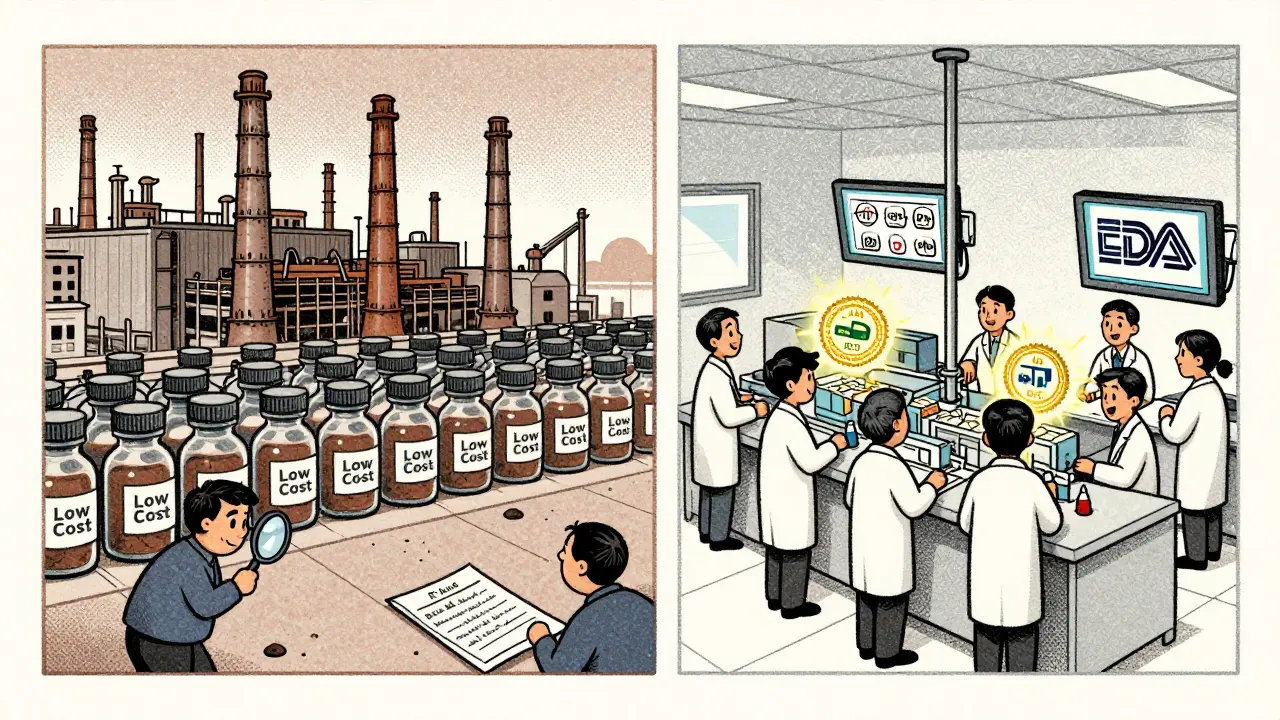
China controls about 80% of the global supply of active pharmaceutical ingredients. That’s the raw chemical backbone of most medications. It’s not just volume-it’s cost. Making APIs in China is cheaper than anywhere else. Labor, scale, and state-backed investment have turned it into the world’s factory for the building blocks of medicine. India, on the other hand, is the world’s third-largest producer of medicines by volume. Its strength isn’t in making the raw chemicals-it’s in turning them into finished pills, capsules, and injections that meet Western standards. Over 100 Indian manufacturing plants are approved by the U.S. FDA. China has only 28. That gap isn’t random. It’s the result of decades of focused regulatory discipline in India versus inconsistent enforcement in China.The FDA’s Watch: What Gets Flagged and Why
The FDA doesn’t just approve factories-it inspects them. And the numbers tell a clear story. Between 2020 and 2023, Chinese facilities received 30% more Form 483 observations than Indian ones. Form 483s are official notices of violations: dirty floors, missing records, unvalidated equipment, or data manipulation. In 2023, 37% of Chinese pharmaceutical facilities faced import alerts from the FDA. That means shipments were blocked at the border until problems were fixed. For India, that number was 18%. Why? Indian companies have built compliance into their DNA. They train staff on FDA’s 21 CFR Part 211 rules. They use digital systems to track every batch. They audit themselves before the FDA even shows up. China has improved. Many factories now meet ISO, CE, and RoHS standards. But quality isn’t consistent. A plant in Shanghai might be spotless. One in a smaller city might still use handwritten logs. The FDA can’t be everywhere. So when they find a problem, they don’t just shut down one factory-they flag the whole country.India’s Secret Weapon: Compliance Culture
India’s advantage isn’t luck. It’s strategy. After the 1970 Patents Act, India focused on making affordable generics. But to sell them in the U.S. and Europe, they had to meet strict rules. That forced companies to adopt global standards early. Today, over half of Asia-Pacific contract research organizations (CROs) are in India. That means more expertise in clinical trials, quality control, and regulatory filing. Indian pharma workers speak English. They understand FDA expectations. They’ve lived through multiple inspections. One sourcing executive told Bain & Company: “We’ve had more audit fatigue with Chinese suppliers than with Indian ones.” In 2023, India revised its Schedule M regulations-its domestic manufacturing rules-to match international standards even more closely. The goal? To move beyond generics into biosimilars and cell therapies. The government has poured nearly $3 billion into production incentives. Investors have responded with $4 billion in new funding.
China’s Problem: Scale Without Stability
China’s strength is also its weakness. It can make 10 billion tablets a year. But who’s checking each batch? The answer: not enough. Many Chinese suppliers are small, privately owned, and focused on price-not process. A 2023 Medstown analysis found that rising labor costs and shrinking price gaps are making China less attractive. Companies that once chose China for cheap production are now asking: “Is this worth the risk?” Geopolitical tensions haven’t helped. The U.S. government now actively pushes for supply chain diversification. That’s why the “China+1” strategy became popular. Companies don’t want to rely on one country. They want backup. And India is the backup. But China isn’t disappearing. It still dominates APIs. And it’s investing heavily in biologics. Its biopharmaceutical market grew at 19.3% annually from 2015 to 2024. India’s is growing faster at 22%, but from a much smaller base. So while India leads in generics, China is catching up in high-value drugs.The Hidden Vulnerability: India’s Dependence on China
Here’s the twist: India can’t make its own APIs. About 72% of India’s bulk drug imports come from China. That’s up from 66% in 2022. So even though India makes the pills, China makes the medicine inside them. One senior procurement manager at a U.S. drugmaker put it bluntly: “We’re one supply chain disruption away from a national shortage.” If China cuts off exports-or if a factory gets shut down by the FDA-India’s entire production line stalls. That’s why India’s government is now pushing for domestic API production. But building these plants takes years. And the technology? Much of it still comes from China.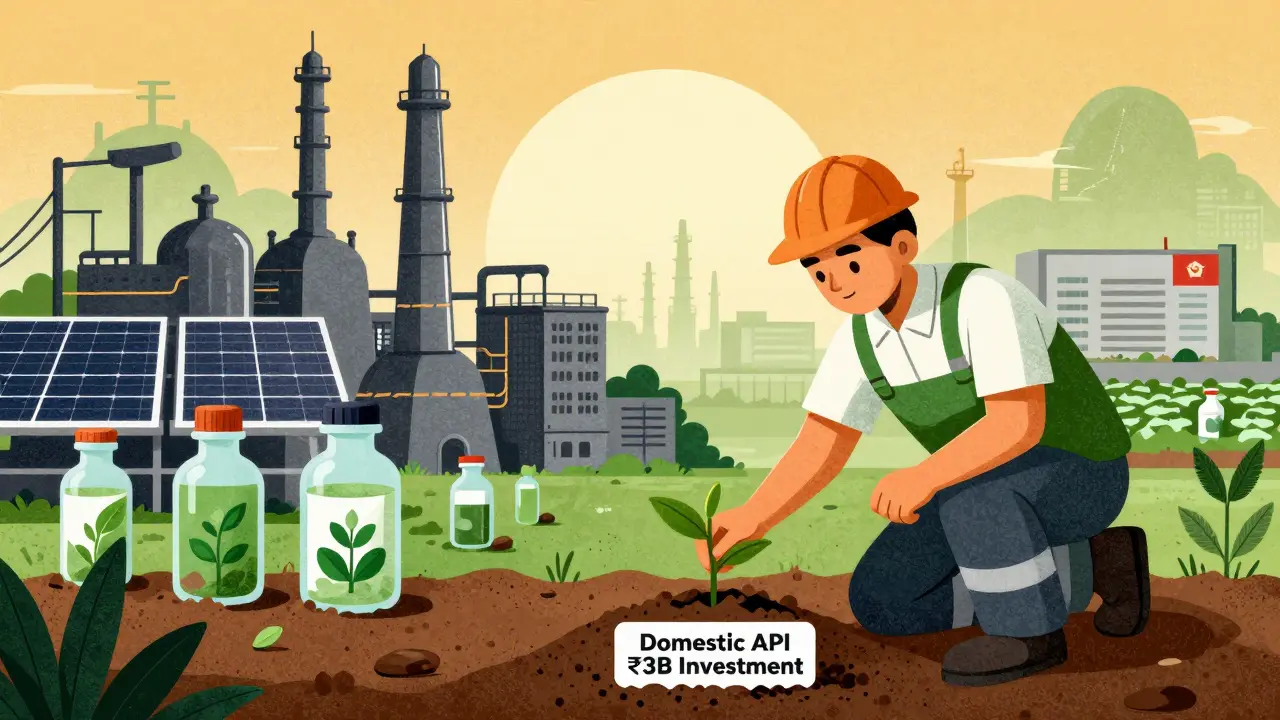
Which Country Should You Trust?
If you’re a U.S. pharmaceutical company, the choice isn’t about cost anymore. It’s about reliability. India wins if you need FDA-approved finished products. If your patients depend on consistent quality, if your brand can’t afford a recall, if you want fewer inspections and smoother audits-India is the safer bet. It’s why 12% of U.S. companies prefer India over 9% who choose China. China wins if you need massive volumes of low-cost APIs. If you’re making drugs for markets with looser regulations. If you’re building a supply chain that can absorb risk through scale. But you’ll need to audit every supplier. You’ll need to build redundancy. You’ll need to expect delays.What’s Next? The Long Game
By 2047, India could export $350 billion in pharmaceuticals-if it solves its API problem. That’s a 10- to 15-fold increase from today. But that only happens if India builds its own API factories and moves into biologics, not just generics. China’s share of the global outsourced pharma market is expected to drop from 25% to 15% by 2030. It won’t vanish. But its role will change. It’ll be the supplier of last resort, not the first choice. The real winners? Companies that use both-but don’t rely on either. They’re setting up dual sourcing. They’re investing in Vietnam, Mexico, and Eastern Europe. They’re building resilience, not just savings.What This Means for You
If you’re a patient: Your medication is likely safe. The FDA blocks unsafe products before they reach shelves. But you should know: the system isn’t perfect. Supply chain risks are real. If you’re in healthcare: Understand where your drugs come from. Ask your supplier about API sourcing. Push for transparency. If you’re in business: Don’t chase the lowest price. Chase the most reliable partner. India’s compliance edge matters more than China’s cost advantage today. The global drug supply chain is no longer just about economics. It’s about trust. And right now, trust leans toward India.Why does the FDA inspect Indian and Chinese drug factories more than others?
The FDA inspects Indian and Chinese factories more because together they supply over 80% of the world’s generic drugs and active pharmaceutical ingredients. Since these drugs are used by millions in the U.S. and Europe, any quality issue could affect public health. The FDA prioritizes facilities that produce the highest volume of imported medications to prevent unsafe products from reaching patients.
Are drugs made in India safer than those made in China?
Statistically, yes. Indian facilities receive fewer FDA violations and import alerts than Chinese ones. Over 100 Indian plants are FDA-approved compared to 28 in China. Indian manufacturers have invested heavily in compliance systems, staff training, and digital quality controls. While China has improved, quality remains inconsistent across its thousands of smaller suppliers, making inspections more frequent and failures more common.
Does India make its own active pharmaceutical ingredients (APIs)?
Not enough. India imports about 72% of its bulk drug ingredients from China. While India excels at turning APIs into finished medicines, it still relies on China for the core chemicals. This creates a vulnerability: if China restricts exports or a factory is shut down, India’s drug production can stall. The Indian government is now investing billions to build domestic API capacity, but it will take years to catch up.
What is the "China+1" strategy in pharma manufacturing?
The "China+1" strategy means companies no longer rely solely on China for manufacturing. Instead, they add a second, more reliable source-usually India-to reduce risk. This approach emerged after supply chain disruptions and FDA inspection failures in China. India is the top choice because of its strong compliance record, English-speaking workforce, and existing FDA-approved facilities. It’s not about replacing China, but having a backup.
Can the U.S. government block drugs from China or India?
Yes. The FDA can issue import alerts that stop shipments at the border if a facility has repeated violations. In 2023, 37% of Chinese pharmaceutical facilities faced these alerts, compared to 18% of Indian ones. Drugs from flagged facilities are held until the company proves the issue is fixed. This has happened dozens of times with Chinese API suppliers, leading to drug shortages in the U.S.
Why are Indian pharmaceutical exports growing faster than China’s?
Indian exports are growing because global buyers prioritize reliability over price. India’s FDA compliance record, skilled workforce, and alignment with Western regulatory standards make it the preferred partner for branded and generic drugs in the U.S. and Europe. China’s growth is slowing due to rising costs, stricter scrutiny, and shifting supply chain policies. India’s exports are projected to grow 10- to 15-fold by 2047, while China’s share of the global market is expected to decline.




10 comments
Nikki Brown
This is exactly why we can't trust foreign governments to handle our medicine. China's lax standards are a public health time bomb, and India? They're just better at hiding their messes. 🤦♀️
Peter sullen
It is imperative to acknowledge the systemic regulatory disparities that underpin the global pharmaceutical supply chain. The FDA’s Form 483 observations, when contextualized within the framework of cGMP compliance, reveal a statistically significant divergence in operational integrity between Chinese and Indian manufacturing entities. Moreover, the structural advantages conferred by India’s institutionalized quality assurance protocols cannot be overstated.
Natasha Sandra
OMG I had no idea we were this dependent on China for meds 😱 Like, my blood pressure pills? Probably made in a factory with handwritten logs?? That’s wild. India’s doing the heavy lifting though, and honestly? I’m glad someone’s keeping it clean. 🙌
sakshi nagpal
As an Indian professional in pharma quality assurance, I can confirm that compliance is not just policy-it’s culture. We train for years to understand FDA expectations. But let’s be honest: we still rely on China for APIs. It’s a paradox we’re working hard to solve. The government’s ₹25,000 crore push for API manufacturing is real. We’re not just making pills-we’re building sovereignty.
Sandeep Jain
India good, china bad? not that simple bro. we need both. china makes the chem, india makes the pill. if china stops, we all in trouble. my cousin works in a pharma plant in hyderabad-he says even their machines are made in china. so yeah, we depend. but we try.
roger dalomba
Wow. A 12% preference for India over 9% for China. Truly groundbreaking. I’m sure the FDA’s 37% import alert rate is just a coincidence. 🤓
Brittany Fuhs
China’s a threat. Not just to pharma-to our nation. They poison our meds, steal our IP, and now they want to control our health. We need to ban imports from there. Full stop. America First. Always.
Sophia Daniels
Let me get this straight: we’re outsourcing our life-saving drugs to a country that still uses paper logs and another that’s basically a Chinese vending machine? 😭 This isn’t globalization-it’s a horror movie with a side of insulin. And don’t even get me started on the ‘China+1’ strategy. That’s not resilience. That’s just hoping your backup plan doesn’t also suck.
Steven Destiny
India’s compliance edge is real, but don’t sleep on China’s biologics surge. They’re not just making cheap aspirin anymore-they’re building mRNA factories, CRISPR platforms, and CAR-T therapies. The game’s changing. We need to stop treating this like a moral panic and start investing in innovation, not just blame.
Fabio Raphael
It’s fascinating how India’s regulatory discipline was born out of necessity-not privilege. They had to prove themselves to survive in Western markets. Meanwhile, China’s scale was rewarded with volume, not rigor. But the real question is: why aren’t we building more API capacity in the U.S. or Mexico? Why do we keep betting on two countries for 80% of our medicine? That’s not strategy. That’s gambling with public health.