
Tacrolimus-Azole Dose Adjustment Calculator
Dose Adjustment Guide
This tool helps determine appropriate tacrolimus dose adjustments when adding an azole antifungal. Based on American Society of Transplantation guidelines.
| Antifungal | Typical Increase | Recommended Reduction | Monitoring |
|---|---|---|---|
| Ketoconazole | Over 500% | 75% (avoid if possible) | Every 12 hours |
| Voriconazole | 100-300% | 60-75% | Daily for 5 days |
| Posaconazole | 50% | 50% | Every other day |
| Isavuconazole | 30-50% | 25% | Every 2-3 days |
When someone gets a kidney, liver, or lung transplant, they’re given tacrolimus to keep their immune system from rejecting the new organ. But if they later get a fungal infection - and many do - doctors often reach for an azole antifungal like voriconazole or posaconazole. What they might not realize is that combining these two drugs can send tacrolimus levels soaring, sometimes within hours, and trigger serious kidney damage. This isn’t rare. It’s one of the most common and dangerous drug interactions in transplant care today.
Why Azoles and Tacrolimus Don’t Mix
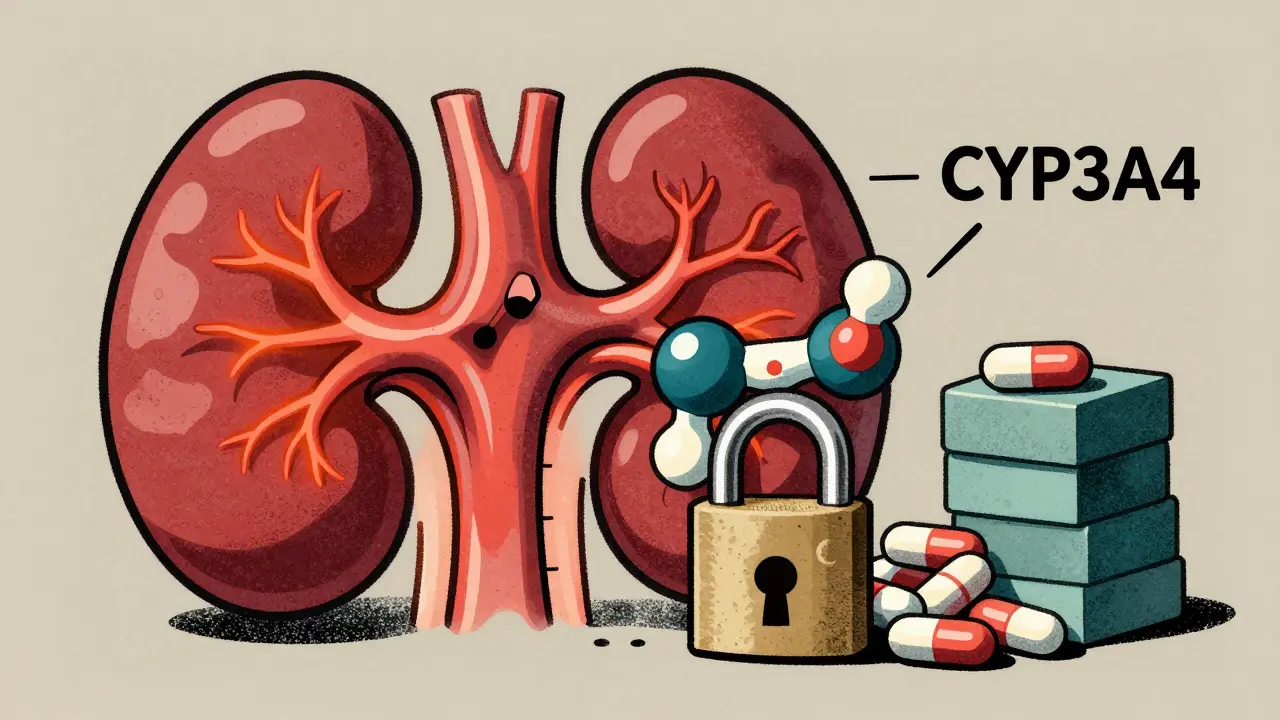
Tacrolimus doesn’t just float around in the bloodstream. It’s processed by the liver, specifically by enzymes called CYP3A4 and CYP3A5. These enzymes break down tacrolimus so it can be cleared from the body. Azole antifungals - ketoconazole, itraconazole, voriconazole, posaconazole - are powerful inhibitors of these same enzymes. Think of it like jamming a lock. The azole blocks the enzyme’s ability to do its job, so tacrolimus piles up instead of being broken down.This isn’t a minor bump in levels. Studies show that when voriconazole is added, tacrolimus blood concentrations can jump 100% to 300%. With ketoconazole, the increase can be over 500%. That means a patient taking 3 mg of tacrolimus twice daily might suddenly have levels equivalent to 9 mg or more. And since the therapeutic window is so narrow - between 5 and 15 ng/mL for most transplant patients - going above 20 ng/mL is a red flag.
Why does this matter? Because high tacrolimus levels don’t just make lab numbers look bad. They directly damage the kidneys. The drug causes blood vessels in the kidneys to constrict, reducing blood flow. Over time, this leads to scarring and loss of function. A 2020 analysis from Johns Hopkins found that 15-20% of all tacrolimus-related kidney injuries were tied to azole interactions. One patient described it this way: "My creatinine went from 1.2 to 2.6 in two days. I was dizzy, nauseated, and couldn’t walk without feeling like I’d run a marathon. They told me my kidneys were shutting down."
Not All Azoles Are Created Equal
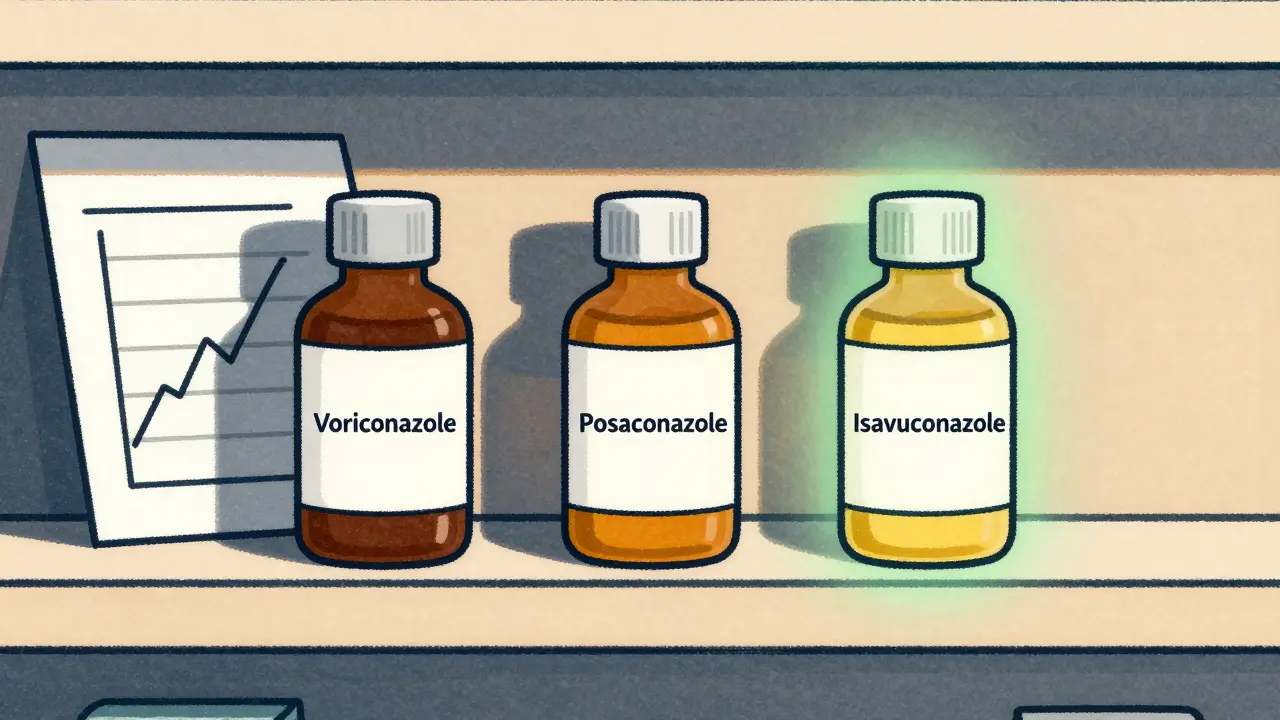
Some azoles are far worse than others. Ketoconazole is the strongest CYP3A4 inhibitor - so strong that it’s rarely used today, even for fungal infections, because of how risky it is with tacrolimus. Voriconazole is next in line. It’s commonly used for aspergillosis, a deadly infection in transplant patients, but it’s also the most frequent culprit behind sudden spikes. Posaconazole is a bit less potent, but still dangerous enough that most transplant centers reduce tacrolimus by 50% before starting it.Then there’s isavuconazole. It’s newer, and it’s a game-changer. Unlike the others, it barely touches CYP3A4. Studies show it only increases tacrolimus levels by 30-50%, which is manageable with a simple 25% dose reduction. But here’s the catch: insurance often won’t cover it as a first-line option. Many hospitals still default to voriconazole because it’s cheaper - even though it’s riskier. One transplant pharmacist in Chicago told me: "We had a patient on voriconazole who had acute kidney injury. We switched her to isavuconazole. Her creatinine dropped back to normal in five days. But our pharmacy still won’t list isavuconazole as preferred."
The Real Cost: Nephrotoxicity and Hospital Stays
The kidneys aren’t the only thing at risk. High tacrolimus levels can also cause tremors, seizures, confusion, and even permanent nerve damage. But kidney injury is the most common and measurable outcome. When levels spike, creatinine rises. GFR drops. Fluid builds up. Patients get swollen, tired, and short of breath. In severe cases, they need dialysis.A 2022 survey of 127 transplant pharmacists found that 76% saw at least one unplanned hospital admission per month because of this interaction. Many of these admissions were preventable. One center reported that before they implemented a protocol - reducing tacrolimus by 75% when starting posaconazole - they had 12 cases of acute kidney injury in a year. After the protocol? Just two. The difference? Standardized rules.
What Should Be Done? A Clear Protocol
There’s no guessing here. If you’re starting an azole in someone on tacrolimus, you need a plan. The American Society of Transplantation says it plainly: avoid strong inhibitors like ketoconazole. If you must use voriconazole or posaconazole, reduce the tacrolimus dose upfront.- For ketoconazole: Avoid entirely. If absolutely necessary, cut tacrolimus dose by 75% and monitor levels every 12 hours.
- For voriconazole: Reduce tacrolimus by 60-75%. Check levels daily for the first 5 days.
- For posaconazole: Reduce by 50%. Monitor every other day for the first week.
- For isavuconazole: Reduce by 25%. Monitor every 2-3 days.
Monitoring isn’t optional. Trough levels should be checked before starting the azole, then again 24-48 hours after. If levels rise more than 50% above baseline, cut the tacrolimus further. And don’t wait for symptoms. A patient can have no dizziness or swelling and still be in kidney danger. Creatinine is the early warning sign.
What About Alternatives?
If you want to avoid this whole mess, consider non-azole options. Echinocandins like micafungin or caspofungin don’t interact with CYP3A4 at all. They’re given intravenously, so they’re not great for long-term outpatient use. But for acute infections, they’re safe. Lipid-based amphotericin B is another option, though it carries its own kidney risk. So you’re trading one problem for another.That’s why many centers now use isavuconazole as first-line prophylaxis in high-risk patients - especially lung transplant recipients, where fungal infections are common. But again, cost is a barrier. In 2023, a 14-day course of isavuconazole cost nearly $12,000. Voriconazole? Around $1,800. Insurance companies still push the cheaper option, even though it leads to more hospitalizations. One transplant team in Minnesota calculated that switching to isavuconazole for 10 patients saved $180,000 in avoided hospital stays over two years.

The Future: Genes, Formulations, and Better Tools
Science is catching up. Researchers now know that about half of people of African descent have a genetic variant that makes them produce more CYP3A5. This enzyme helps break down tacrolimus even when CYP3A4 is blocked. So these patients may not see as big a spike in levels when given azoles. In the next few years, we’ll likely see guidelines that adjust tacrolimus dosing based on CYP3A5 genotype.There’s also a new extended-release version of tacrolimus that smooths out blood levels, reducing the peaks that cause kidney damage. Early data shows it lowers nephrotoxicity risk by 22% compared to the original formula - even when azoles are involved. And some centers are now using the C/D ratio (concentration divided by daily dose) instead of just trough levels. It’s more accurate, because it accounts for how much drug the patient is actually taking.
Still, the biggest problem isn’t science. It’s consistency. A 2023 survey found that 25-30% of transplant centers still have no written protocol for azole-tacrolimus interactions. That means some patients get the right care. Others get lucky. And some? They get admitted to the ICU because no one checked the interaction.
Final Takeaway: Don’t Guess. Act.
This interaction isn’t theoretical. It’s happening right now, in hospitals and outpatient clinics, every single day. It’s not about being cautious - it’s about being systematic. If you’re managing a transplant patient, and you’re about to prescribe an azole, pause. Check the drug interaction. Reduce the tacrolimus dose before the first dose of azole. Monitor levels like your patient’s life depends on it - because it does.There’s no room for exceptions. No "we’ve never had a problem before." No "they’re stable." If you’re using voriconazole or posaconazole with tacrolimus, you’re playing with fire. The data doesn’t lie. The patients don’t lie. And the kidneys? They don’t bounce back.
Can azole antifungals cause kidney failure in transplant patients?
Yes, azole antifungals can trigger acute kidney injury in transplant patients taking tacrolimus. This happens because azoles block the liver enzymes that break down tacrolimus, causing blood levels to spike. High tacrolimus levels constrict blood vessels in the kidneys, reducing blood flow and leading to tissue damage. In severe cases, this can require dialysis. Studies show that 15-20% of tacrolimus-related kidney injuries are directly linked to azole interactions.
Which azole antifungal has the lowest risk of interacting with tacrolimus?
Isavuconazole has the lowest risk. Unlike voriconazole, posaconazole, or ketoconazole, it only weakly inhibits CYP3A4. Clinical studies show it raises tacrolimus levels by just 30-50%, compared to 100-300% with voriconazole. This means a smaller dose reduction (25%) is usually enough. Despite its safety advantage, isavuconazole is often not used first because of higher cost and insurance restrictions.
How much should tacrolimus be reduced when starting an azole?
The reduction depends on the azole:
- Ketoconazole: Reduce by 75% (avoid if possible)
- Voriconazole: Reduce by 60-75%
- Posaconazole: Reduce by 50%
- Isavuconazole: Reduce by 25%
Always check tacrolimus trough levels before starting the azole, then again 24-48 hours after. Levels should be monitored daily for the first 5 days.
Do all transplant patients react the same way to this interaction?
No. Genetics matter. About 50-60% of people of African descent carry a gene variant (CYP3A5*1) that makes them produce more CYP3A5 enzyme. This enzyme helps break down tacrolimus even when CYP3A4 is blocked, so their levels don’t spike as dramatically. Caucasians are less likely to have this variant, meaning they’re more vulnerable to high levels. Future guidelines will likely include genetic testing to guide dosing.
Are there safer alternatives to azoles for fungal infections in transplant patients?
Yes. Echinocandins like micafungin and caspofungin don’t interact with CYP3A4 and are safe to use with tacrolimus. Lipid-based amphotericin B is another option, though it can also harm the kidneys. These are often used for acute infections. For long-term prophylaxis, isavuconazole is the safest azole alternative. The key is avoiding strong CYP3A4 inhibitors like voriconazole and posaconazole unless absolutely necessary and properly managed.





12 comments
Dylan Patrick
I've seen this kill patients. Not hyperbole. One guy went from stable to dialysis in 48 hours because they didn't drop the tacrolimus before voriconazole. No one meant to hurt him. Just didn't know. This needs to be a mandatory module for every transplant fellow.
Kathy Leslie
my cousin is a transplant nurse and she told me they literally have a checklist now for this. like, you can't even order the azole without the dose reduction already in the system. thank god for protocols.
Amisha Patel
this is so important i cant believe its not taught in med school early on. we focus so much on rejection and not enough on the meds that make rejection worse
Serena Petrie
so basically dont use voriconazole lol
Buddy Nataatmadja
in indonesia we rarely see this because azoles are expensive and most patients get amphotericin. but when we do, we always cut tacrolimus by half. better safe than sorry.
mir yasir
The pharmacokinetic interplay between CYP3A4 inhibition and calcineurin inhibitor metabolism represents a paradigmatic example of clinically significant drug-drug interaction. One must exercise rigorous therapeutic drug monitoring.
Stephanie Paluch
isavuconazole is a game changer 🤯 but why is insurance so stubborn?? my aunt had to pay $8k out of pocket just to not end up in the hospital. this is broken.
tynece roberts
i work in pharmacy and honestly most docs just wing it. they see "azole" and think "oh its antifungal" and don't even look at the interaction checker. i've had to chase down 3 different teams this month just to fix their tacrolimus doses. it's wild. we need alerts built into the ehr. like, pop up with a red flag and a scream. just make it impossible to ignore.
Hugh Breen
this is why we need to stop treating transplant care like a guessing game. 🚨 every time a patient gets an azole, it should be like a surgical checklist. confirm dose reduction. confirm baseline level. confirm follow-up plan. no exceptions. no "we've never had a problem." That's how people die. And if your hospital doesn't have a protocol? Demand one. Or find a better one.
Byron Boror
this is why americans need to stop being so soft on drug costs. if we just let hospitals buy generic isavuconazole in bulk like other countries, this wouldn't even be an issue. instead we let insurance companies play Russian roulette with people's kidneys.
Lorna Brown
it's not just about the science. it's about the ethics. if we know that 15-20% of kidney injuries are preventable, and we still choose cheaper drugs because of billing codes... what does that say about our system? we're not just managing drugs. we're managing lives. and right now, we're managing them poorly.
Rex Regum
you people are overreacting. i've been doing this for 20 years and i've never seen a single patient die from this. stop scaring everyone with stats. if the patient's fine, leave it alone. you're making a mountain out of a molehill.