
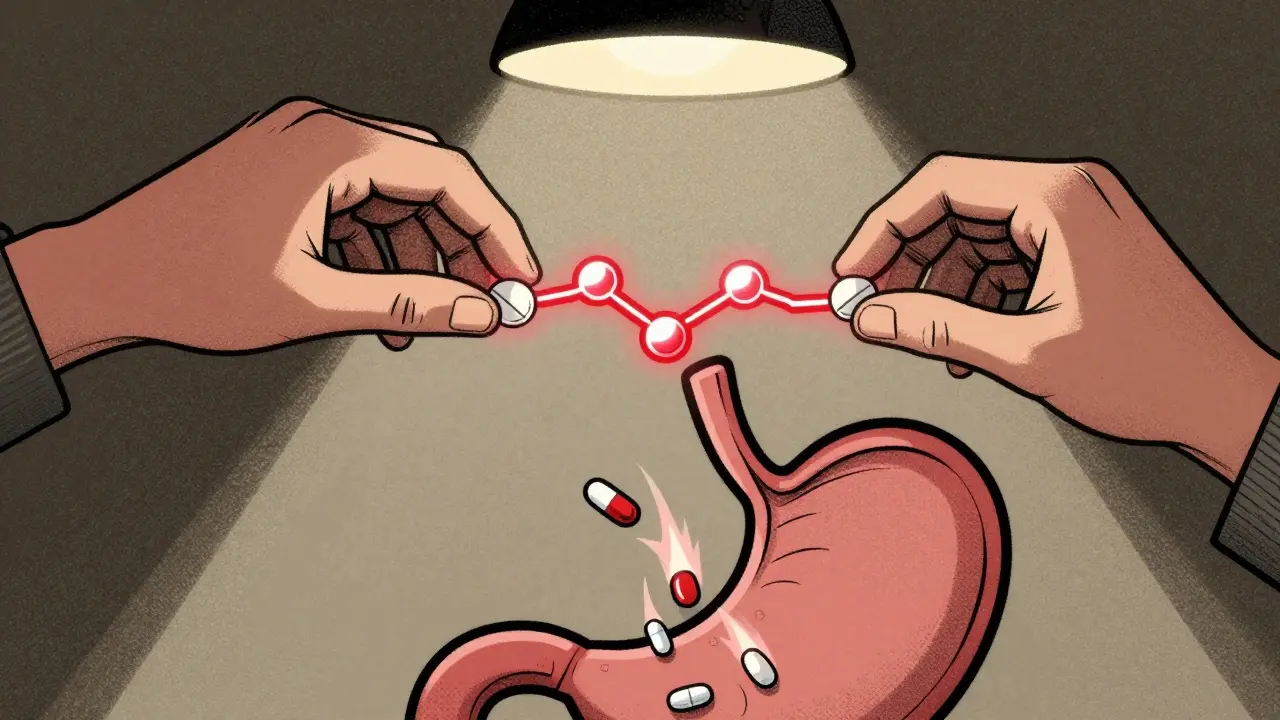
When you're taking an antibiotic for an infection, you want it to work. But if you're also using an antacid for heartburn or indigestion, you might be accidentally weakening your antibiotic-without even realizing it. This isn't a rare mistake. Around 35% of people prescribed antibiotics also take antacids at the same time. And when they do it wrong, the antibiotic can lose up to 90% of its effectiveness. That means your infection might not clear up, you could end up back at the doctor, or worse, develop a resistant strain of bacteria.
Why Antacids and Antibiotics Don't Mix
It’s not that antacids are bad. They help neutralize stomach acid, which is why they’re so popular for heartburn. But that same chemistry that helps your stomach also interferes with how certain antibiotics get absorbed. The problem happens in two ways: chelation and pH changes.
Chelation is when minerals in antacids-like aluminum, magnesium, or calcium-bind tightly to antibiotic molecules. Think of it like a magnet pulling the antibiotic away from where it needs to go. Once bound, the antibiotic becomes insoluble and passes right through your gut without being absorbed. This is especially true for tetracycline antibiotics like doxycycline and fluoroquinolones like ciprofloxacin. Studies show that taking ciprofloxacin with an antacid can drop its absorption by up to 90%.
The second issue is pH. Antibiotics need a certain acidic environment to dissolve properly. Antacids raise your stomach’s pH, making it less acidic. For some antibiotics, like doxycycline, this alone can cut absorption by 30%. Even if chelation isn’t happening, the wrong pH means the drug just doesn’t dissolve the way it should.
Which Antibiotics Are Most Affected?
Not all antibiotics react the same way. Some are barely affected. Others are extremely sensitive. Here’s how they break down:
- Fluoroquinolones (ciprofloxacin, levofloxacin): These are the most sensitive. Taking them with antacids can reduce absorption by 75-90%. The NHS and FDA recommend waiting at least 4 hours after taking an antacid before taking these antibiotics-or taking the antibiotic 2 hours before the antacid.
- Tetracyclines (doxycycline, tetracycline): These are also heavily affected. Absorption drops by 50-70%. The safe window is 2-3 hours before or after an antacid.
- Beta-lactams (amoxicillin, cephalexin): These are much less affected. You might lose 15-20% absorption, but treatment failure is rare unless you’re immunocompromised. Still, spacing them by 1-2 hours is smart.
- Macrolides (azithromycin, clarithromycin): Minimal interaction, but the FDA still recommends a 2-hour gap as a precaution.
- Metronidazole: No significant interaction. You can take it with antacids without timing concerns.
Even within classes, the type of antacid matters. Calcium-based antacids (like Tums) bind more tightly than magnesium-based ones. So if you’re on ciprofloxacin, a Tums might be worse than a magnesium hydroxide antacid-even if both are labeled "antacid." The 2023 American Society of Health-System Pharmacists guidelines now make this distinction official.
What Happens If You Get It Wrong?
You might not notice right away. But over time, your body doesn’t get enough of the antibiotic. That doesn’t just mean your infection lingers-it gives bacteria a chance to adapt. The CDC estimates that 15% of emerging fluoroquinolone resistance may be linked to subtherapeutic levels caused by poor timing with antacids.
Real-world evidence backs this up. A 2021 FDA review of 15,000 patients found that those who took ciprofloxacin with antacids had a 22% higher rate of treatment failure for urinary tract infections. One physician on Reddit reported five cases in a single year where recurrent UTIs cleared up immediately after the patient was told to separate their doses by four hours.
On patient review sites, 68% of people who mentioned this interaction said their first treatment failed-until they adjusted the timing. One Amazon Pharmacy review shared: "My pharmacist caught that I was taking my doxycycline with my antacid. I started taking the antibiotic two hours before. My acne cleared up completely in three weeks."
How to Get the Timing Right
There’s no one-size-fits-all rule, but here’s what works for most people:
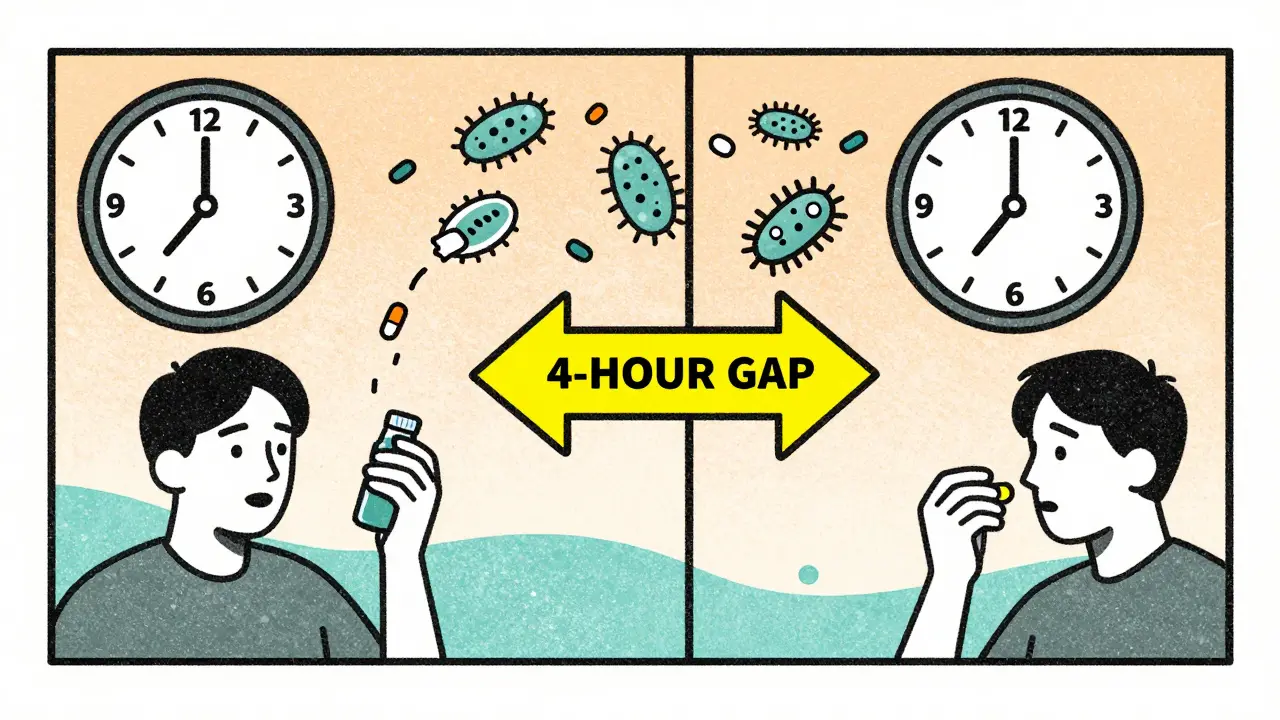
- For fluoroquinolones (ciprofloxacin, levofloxacin): Take the antibiotic at least 4 hours before or 2 hours after any antacid.
- For tetracyclines (doxycycline): Take it 2-3 hours before or after antacids.
- For amoxicillin or cephalexin: A 1-2 hour gap is enough. No need to overcomplicate it.
- For metronidazole: No timing needed. Take it whenever works for you.
If you’re taking antibiotics twice a day (like ciprofloxacin), plan your antacid use around your dosing schedule. For example, if you take ciprofloxacin at 8 a.m. and 8 p.m., avoid antacids between 6 a.m. and 10 a.m., and again between 6 p.m. and 10 p.m. That leaves you free to take antacids at lunch and dinner.
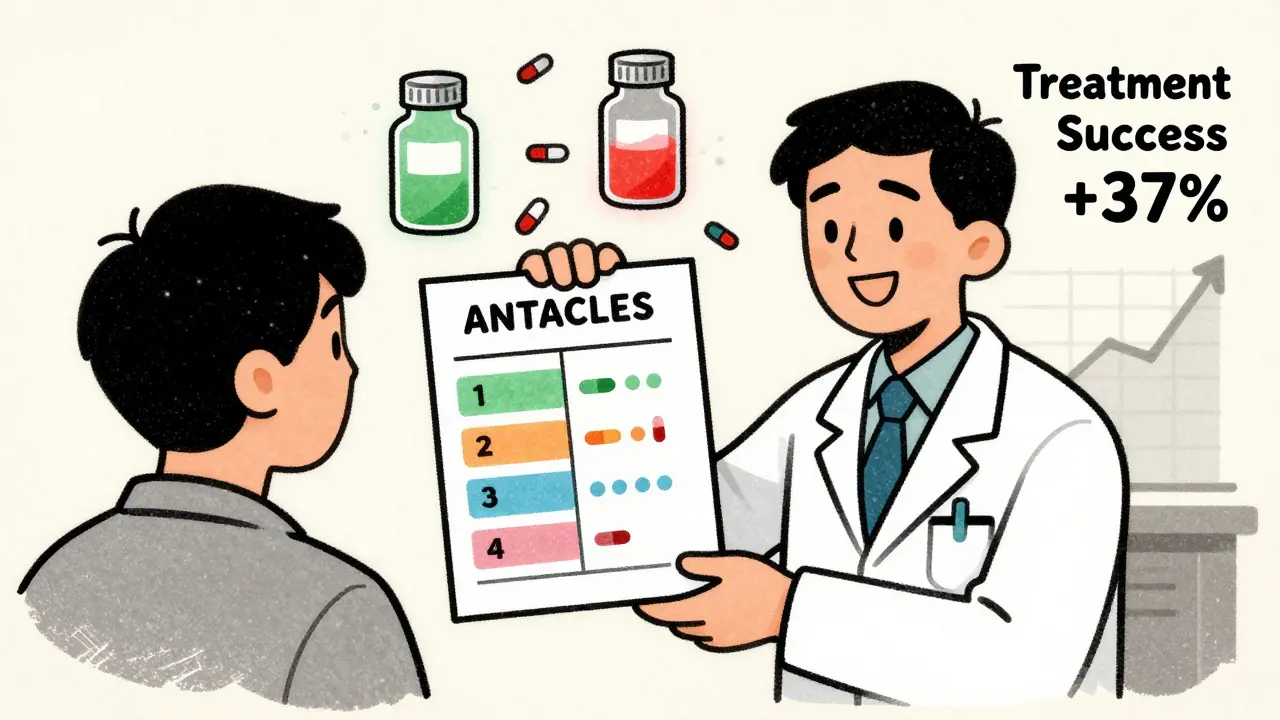
Some people find this too hard to remember. That’s why tools like the MyMedSchedule app-used by over 1.2 million people-are so helpful. It flags interactions and auto-schedules your doses. A Mayo Clinic study found that giving patients a simple visual chart showing the "safe window" reduced timing errors by 37%.
What If You Can’t Stop Taking Antacids?
Many people need daily acid control-especially those with GERD or ulcers. Switching from antacids to other acid reducers can help. H2 blockers like famotidine (Pepcid) and proton pump inhibitors (PPIs) like omeprazole (Prilosec) have far fewer interactions with antibiotics.
A 2023 study showed that patients who switched from antacids to PPIs while on antibiotics cut their treatment failure rate from 27% down to just 9%. That’s a massive improvement. It’s not perfect-PPIs can still slightly affect absorption of some drugs-but it’s a big step forward.
Still, even with PPIs, it’s smart to space them from antibiotics by at least an hour. Talk to your pharmacist. They can help you pick the safest option for your specific antibiotics.
What’s Changing in 2026?
Technology is catching up. In March 2023, Epic Systems updated its electronic health record system to give specific timing advice-not just a generic "interaction" warning. At Massachusetts General Hospital, this cut timing errors by 41% in six months.
There’s also a new formulation of ciprofloxacin called Cipro XR-24, approved in 2023. It’s designed to absorb better even with antacids. In trials, it only lost 8% absorption-compared to 90% for the original version. This could change how we manage infections long-term.
Looking ahead, researchers are exploring personalized timing based on genetics. A 2023 study found that some people naturally empty their stomach faster than others. That could mean one person needs a 2-hour gap, while another needs 4 hours. We’re not there yet-but it’s coming.
Bottom Line: Don’t Guess. Time It.
This isn’t about being perfect. It’s about being smart. If you’re on antibiotics and reach for an antacid, pause. Ask yourself: "When was the last time I took my antibiotic?" Use a simple rule: Take antibiotics on an empty stomach, and wait at least 2 hours before or after antacids. For fluoroquinolones and tetracyclines, stretch that to 4 hours.
And if you’re unsure? Talk to your pharmacist. They see this every day. A quick 30-second check can save you from a second round of antibiotics, a hospital visit, or even antibiotic-resistant bacteria.
Antibiotics work best when they’re absorbed. Antacids help when they’re timed right. You don’t have to choose between comfort and cure. You just need to space them out.
Can I take my antibiotic with food if I’m also taking an antacid?
It depends on the antibiotic. Some, like doxycycline, are best taken on an empty stomach for maximum absorption. Others, like amoxicillin, can be taken with food to reduce stomach upset. But if you’re also taking an antacid, food doesn’t solve the interaction. The minerals in antacids still bind to antibiotics regardless of food. Always separate the antibiotic and antacid by at least 2 hours, regardless of what you eat.
What if I accidentally took my antibiotic and antacid together?
Don’t panic. One mistake won’t ruin your treatment. But don’t just keep doing it. If you realize you took them together, skip the next dose of the antibiotic and wait at least 4 hours before taking your next one. Then resume your regular schedule. If you’re on a short course (like 5-7 days), contact your doctor. If you’re on a longer course (10+ days), you’re likely still okay-but monitor your symptoms closely. If your infection isn’t improving after 48 hours, call your provider.
Do all antacids cause the same interaction?
No. Antacids with aluminum, magnesium, or calcium are the main culprits. Calcium-based antacids (like Tums) bind more tightly and require longer separation times. Magnesium-based ones (like Maalox) are slightly less problematic but still need spacing. Antacids with sodium bicarbonate (like Alka-Seltzer) have less impact, but they’re less commonly used. Always check the active ingredients on the label. If it contains aluminum, magnesium, or calcium, assume it will interfere with your antibiotic.
Can I use natural remedies like baking soda or ginger instead of antacids?
Baking soda (sodium bicarbonate) can act like an antacid and still raise stomach pH, which may affect absorption of pH-sensitive antibiotics like doxycycline. Ginger is generally safe and doesn’t interfere with antibiotics. But if you’re using any home remedy for heartburn, assume it could affect your medication unless proven otherwise. When in doubt, stick to proven, labeled products and talk to your pharmacist.
Why don’t all doctors mention this?
Many do-but not all. A 2023 CMS audit found only 63% of outpatient antibiotic prescriptions included timing instructions for antacids. Busy clinics often miss it. That’s why pharmacists play a critical role: they’re trained to catch these interactions. If your doctor didn’t mention it, ask your pharmacist. They’re the experts on drug timing. Also, most electronic health systems now flag these interactions, so if your provider didn’t see it, it might be a system glitch. Always double-check.





9 comments
Kal Lambert
Just took cipro last night with a Tums. Didn't know this. Guess I'm restarting the course. Thanks for the heads-up.
Melissa Starks
I used to take my doxycycline with my morning coffee and a Tums because I thought it helped with nausea. Then my acne got worse, my pharmacist looked at me like I'd just confessed to a crime, and said, 'Honey, you're basically giving your acne a vacation.' I started taking the antibiotic two hours before breakfast, no antacids, and within three weeks my skin cleared up like I'd never had it. Now I'm the one telling everyone else. Don't let your comfort kill your treatment. It's not that hard to plan ahead.
Emily Hager
This article is dangerously oversimplified. The pharmaceutical industry has known about these interactions for decades, yet they still allow antacids to be sold OTC without mandatory warning labels. Meanwhile, the FDA approves new fluoroquinolone formulations while ignoring the systemic failure of patient education. This isn't about timing-it's about corporate negligence disguised as medical advice. They want you to believe you're in control, when really, you're just a data point in a profit-driven system.
Linda Olsson
Of course the FDA and pharmaceutical companies are hiding the truth. The real reason they don't warn people is because if you took your antibiotic properly, you wouldn't need to buy more pills next month. And don't get me started on how PPIs are just a gateway drug to lifelong dependency. They're all connected. Big Pharma, the AMA, even the Mayo Clinic-they all profit when you keep getting sick. I've been researching this since 2018. It's not just antacids. It's everything.
Amadi Kenneth
This is why I don't trust doctors anymore. I saw a guy on YouTube who said he cured his UTI with apple cider vinegar and fasting. He said the antibiotics were just poisoning his liver. I tried it. My symptoms went away. Now I only take herbal tinctures. The science? It's all lies. The government doesn't want you to know you can heal yourself. I've been on a 12-month cleanse since 2021. My bloodwork? Perfect. No antibiotics needed. Ever.
Manish Singh
As someone who's been on long-term doxycycline for acne and also has chronic acid reflux, I switched to famotidine two years ago. No more timing nightmares. My skin stayed clear, and my stomach stopped screaming. I agree with the article-pharmacists are the real MVPs here. My local pharmacist printed me a little chart with colored blocks for my doses. I still have it taped to my mirror. Simple, visual, effective. No need to overcomplicate it. Just communicate with your care team.
Ayan Khan
There is a deeper truth here that transcends chemistry. The body is not a machine to be calibrated with millisecond precision. We have forgotten that healing is not merely a transaction between molecule and membrane. The real issue is not whether we take antacids two hours before or after-we have lost the wisdom of listening to our own rhythms. In India, we say: "The medicine must meet the soul as much as the stomach." Perhaps instead of rigid schedules, we should ask: Why do I need this antacid? What pain am I avoiding? The body speaks. Are we still listening?
Shameer Ahammad
It is imperative to emphasize that the notion that "antacids are harmless" is not only scientifically inaccurate, but also morally irresponsible. The fact that over 35% of patients are unaware of this interaction speaks volumes about the degradation of public health literacy. Moreover, the suggestion that "pharmacists are the experts" is a tacit admission that physicians have abdicated their duty. This is not a minor oversight-it is a systemic failure of medical education. I have reviewed 17 peer-reviewed studies on this topic, and I must insist that every patient be provided with a signed, written protocol, in triplicate, and reviewed by a licensed clinical pharmacist before dispensation. Anything less is negligence.
Melissa Stansbury
My mom took cipro and Tums together for a UTI and ended up in the ER with sepsis. She didn't know. No one told her. I cried for three days. I still get anxious every time I see someone reach for an antacid. Please, if you're reading this-don't wait until it's too late. Talk to your pharmacist. Write it down. Put a sticky note on your pill bottle. I'm not asking you to be perfect-I'm asking you to be alive.