
Adolescent Medication Risk Assessment
Personalized Risk Assessment
This tool helps determine the appropriate monitoring frequency and risk level for teens taking psychiatric medications based on FDA guidelines and clinical research.
When a teenager starts taking psychiatric medication, the goal is clear: help them feel better. But for many families and clinicians, there’s a quiet, heavy question that follows: Could this make things worse? The answer isn’t simple. While medications can bring relief from depression, anxiety, or psychosis, they also carry a known risk-especially in young people-of triggering or worsening suicidal thoughts. This isn’t speculation. It’s a documented safety issue backed by decades of research and federal warnings. And if you’re managing care for an adolescent on these drugs, knowing how to monitor for suicidal ideation isn’t optional. It’s the most important part of treatment.
Why Teens Are Different
The brain doesn’t stop developing at 18. It’s still rewiring itself through the mid-20s. In adolescents, the parts responsible for impulse control, emotional regulation, and long-term thinking are still under construction. That means a medication that works safely in an adult might have very different effects in a 15-year-old. The FDA first issued a black box warning in 2004 after studies showed a small but real increase in suicidal thinking among children and teens taking antidepressants, especially in the first few weeks of treatment. This warning was updated in 2007 to include young adults up to age 24. It’s the strongest safety alert the FDA gives-and it applies to nearly every antidepressant, and increasingly, to other psychiatric medications too.What’s often misunderstood is that this doesn’t mean these drugs are dangerous for teens. It means they need careful handling. Many teens improve dramatically with medication. But the transition period-when the drug is starting, changing, or stopping-is when risk spikes. That’s why monitoring isn’t just about asking, “Are you having thoughts about dying?” It’s about watching for subtle shifts in behavior, mood, and communication that could signal trouble before it escalates.
When Risk Is Highest
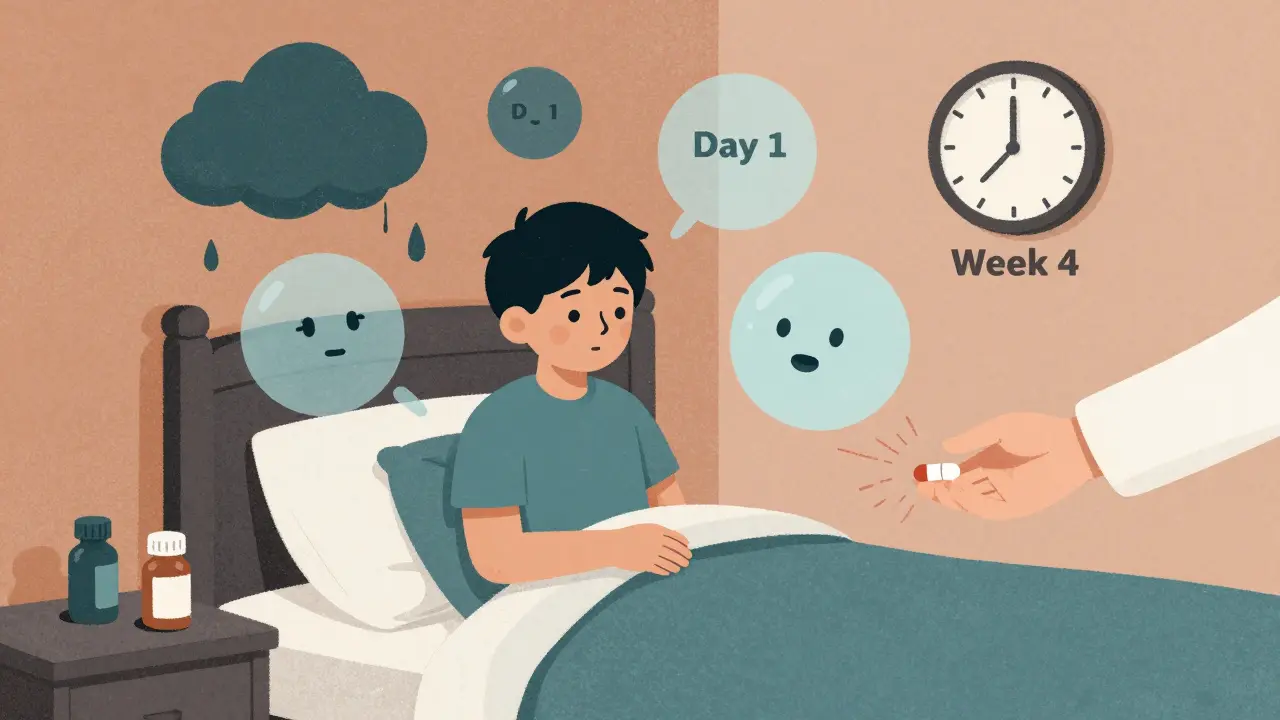
There are three key moments when suicidal ideation is most likely to emerge or worsen:- When the medication is first started. In the first 1 to 4 weeks, some teens experience increased anxiety, agitation, or emotional instability as their brain adjusts. This isn’t the depression returning-it’s a side effect of the drug kicking in. But it can look like it.
- When the dose is changed. Whether increasing or decreasing, any adjustment in dosage can disrupt the delicate balance of neurotransmitters. Even a small dose increase can trigger agitation. A reduction, even if planned, can cause withdrawal-like symptoms including low mood, irritability, or sudden hopelessness.
- When the medication is stopped. This is often overlooked. Many clinicians assume that once a teen is stable, they can taper off. But discontinuation can cause a rebound effect. A 2022 study in the Journal of the American Academy of Child and Adolescent Psychiatry found that nearly 30% of teens who stopped antidepressants experienced worsening suicidal thoughts within two weeks-even if they’d been stable for months.
These aren’t rare events. In practices that track this closely, about 1 in 10 adolescents on psychiatric medication show new or increased suicidal ideation during these critical windows. And while the absolute risk is low, the consequences are too severe to ignore.
What Monitoring Actually Looks Like
Monitoring isn’t a checklist. It’s a conversation-and it has to happen often.State guidelines vary, but the most thorough protocols-like those from California and New York City-outline clear expectations:
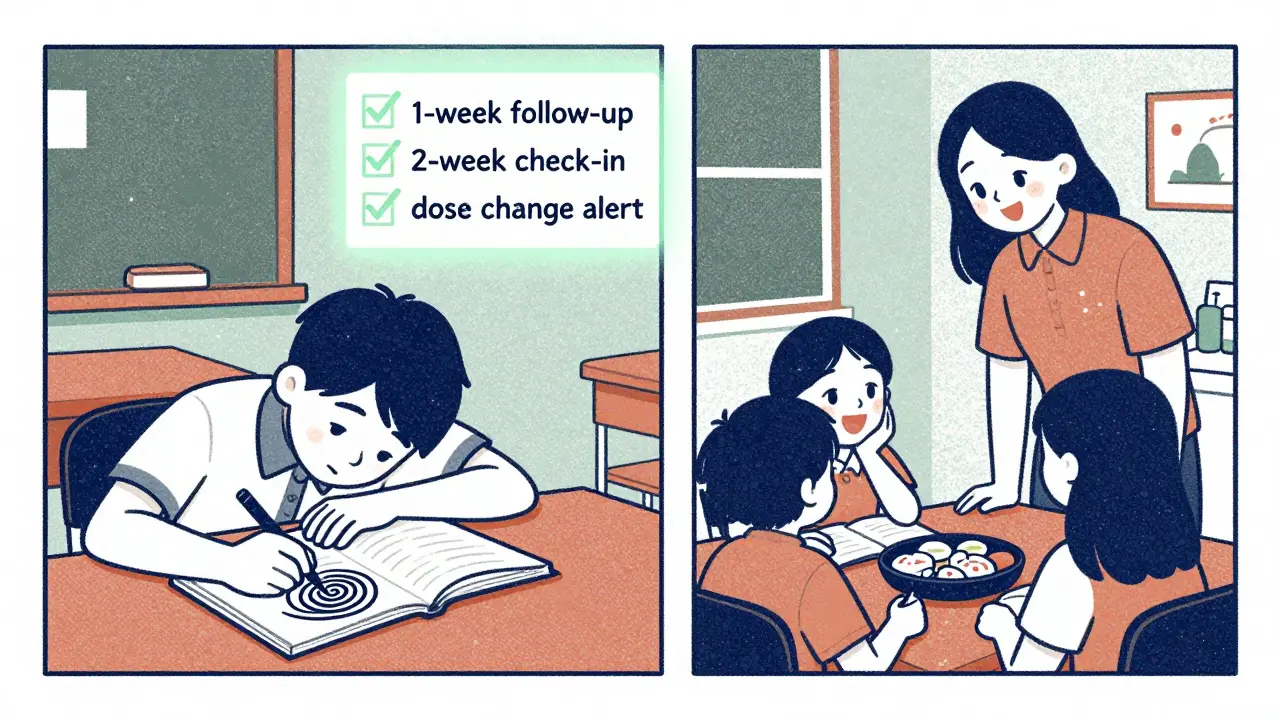
- First visit after starting: Within 1 week. Not 2. Not 14 days. One week. This is when side effects are most likely to surface.
- Follow-up visits: Every 2 weeks for the first month, then monthly for the next 3 months. After that, every 3 months-but only if the teen is stable and showing clear improvement.
- High-risk cases: Weekly visits, even after the initial phase, if the teen has a history of self-harm, recent loss, trauma, or active suicidal thoughts before starting medication.
- During dose changes or discontinuation: Increase frequency. Some guidelines recommend daily contact via phone for the first 7 days after reducing or stopping a medication.
And it’s not just about the clinician’s office. Monitoring means asking the right questions-in the right way.
Instead of asking, “Are you having suicidal thoughts?”-which many teens will say no to out of fear, shame, or confusion-better questions include:
- “Have you felt like giving up lately?”
- “Do you ever feel like things will never get better?”
- “Have you thought about what it would be like if you weren’t here?”
- “Do you feel like the medication is helping, or does it feel like it’s making things harder?”
These open-ended, non-judgmental prompts are more likely to get honest answers. And they should be asked both to the teen and to caregivers-parents, guardians, teachers-who see different sides of the teen’s behavior.
What to Watch For (Beyond Words)
Teens don’t always say what they’re feeling. But their behavior often does.Here are red flags that should trigger immediate follow-up:
- Sudden withdrawal from friends, family, or activities they once enjoyed
- Increased irritability, aggression, or emotional outbursts
- Changes in sleep or appetite-not just depression-related, but extreme shifts
- Giving away prized possessions
- Talking about being a burden or not having a future
- Writing or drawing with dark themes-especially if it’s new
- Using alcohol or drugs more frequently
One of the most overlooked signs is when a teen suddenly seems “better.” Not in a good way. Sometimes, when someone has made a plan to end their life, they feel a strange sense of calm. They stop crying. They smile more. They seem at peace. That’s not improvement-that’s danger.
Medications Beyond Antidepressants
Most people think the black box warning only applies to antidepressants. It doesn’t. While those carry the clearest warning, newer guidelines from California, New York, and the American Academy of Child and Adolescent Psychiatry now require suicidal ideation monitoring for all psychiatric medications in adolescents-antipsychotics, mood stabilizers, ADHD meds, even sleep aids.Why? Because any drug that affects brain chemistry can influence mood, impulse control, or emotional processing. A 2023 review from MedPsych Health found that teens on antipsychotics for psychosis or severe aggression had similar rates of emerging suicidal thoughts as those on antidepressants. The same was true for stimulants used for ADHD-especially if the teen had underlying depression.
This is critical. Too many providers focus only on the drug’s labeled risk. But the real issue is the individual. A teen with a history of trauma, self-harm, or family suicide is at higher risk regardless of the medication class. That’s why monitoring must be personalized-not standardized.
Where Systems Fail
Even with clear guidelines, monitoring often falls apart.One major gap: communication between school and home. A 2022 survey found that 68% of clinicians reported not knowing when a teen had a suicidal incident at school. School counselors often don’t share details with outpatient providers due to privacy concerns-or because they don’t know they should.
Another issue: consent. In a 2021 survey of child psychiatry fellows, 42% said they’d never received proper training on how to explain suicide risk to families during informed consent. Many parents don’t understand that the risk exists, or they assume “if it’s prescribed, it’s safe.”
And then there’s time. In busy clinics, 15-minute appointments aren’t enough to assess suicide risk. The Tennessee Department of Children’s Services notes that “market pressures for efficiency” often clash with the need for thorough, thoughtful care. But rushing through a medication check can cost a life.
What Works
The best programs do three things:- Document everything. Not just “patient is stable.” But: “Patient reports feeling less hopeless. Still has thoughts of worthlessness 2-3 times per week. No plan or intent. Family reports improved sleep. Medication dose unchanged.” Specifics save lives.
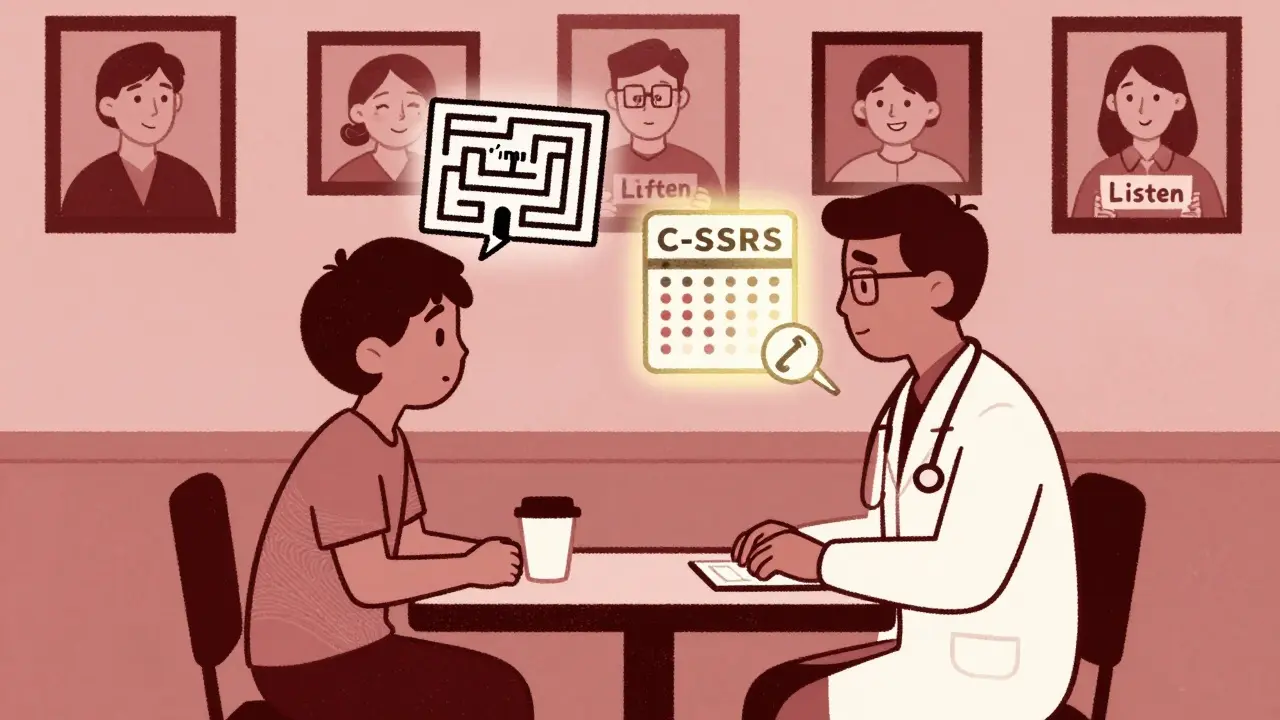
- Use validated tools. Simple screens like the Columbia-Suicide Severity Rating Scale (C-SSRS) take less than 5 minutes and are proven to catch risk early. Only 19% of clinics currently use tools designed for medication-related risk-but they’re becoming more common.
- Involve the teen. Ask them: “Do you feel like this medication is helping you, or just making you numb?” “Would you want to keep taking it if you could choose?” Their voice matters more than any score.
And when a teen is at risk? Don’t wait. Increase visits. Call the family. Involve a crisis team. Sometimes, the best decision is to pause the medication-even if it means going back to therapy first.
The Bigger Picture
We’re still learning. Research funded by the National Institute of Mental Health is now exploring biological markers-like brain activity patterns or blood proteins-that might predict who’s at risk for medication-induced suicidal thoughts. But that’s years away.Right now, the tools we have are simple: observation, connection, and consistency. The most effective monitoring isn’t high-tech. It’s human. It’s a clinician who calls the day after a dose change. It’s a parent who notices their teen hasn’t laughed in weeks. It’s a school counselor who says, “I’m worried. Can we talk?”
Medication can be life-saving. But it’s not magic. It’s medicine. And like all medicine, it needs careful watching. For adolescents, that watch must be constant, thoughtful, and deeply personal. Because when a teen is struggling, they don’t need more drugs. They need someone who sees them-and won’t look away.
Are all psychiatric medications risky for suicidal ideation in teens?
No, not all medications carry the same level of risk, but current guidelines treat all psychiatric drugs used in adolescents with caution. The FDA black box warning specifically applies to antidepressants and some other classes, but newer research and state guidelines (like California’s 2022 update) now require monitoring for suicidal ideation with any psychiatric medication, including antipsychotics, mood stabilizers, and stimulants. This is because any drug that alters brain chemistry can affect mood, impulse control, or emotional regulation-especially in a developing brain.
How often should a teen on psychiatric medication be checked for suicidal thoughts?
The first check should be within one week of starting or changing a medication. After that, visits should occur every two weeks for the first month, then monthly for the next three months. If the teen has a history of self-harm, suicidal ideation, or trauma, weekly visits are recommended during the first few months. During any dose change or discontinuation, monitoring should increase to weekly or even daily contact, depending on risk level. Stability doesn’t mean safety-ongoing assessment is key.
What should parents ask their teen about medication and mood?
Avoid yes/no questions like, “Are you suicidal?” Instead, ask open-ended questions that invite honesty: “Have you felt like giving up lately?” “Do you feel like the medication is helping you feel better, or just more numb?” “What’s been the hardest part since you started taking it?” Listen without judgment. If your teen says the medication isn’t helping-or makes them feel worse-that’s a signal to contact their provider immediately.
Can stopping medication cause suicidal thoughts?
Yes. Stopping psychiatric medication suddenly-or even tapering too quickly-can trigger withdrawal symptoms that include worsening mood, anxiety, irritability, and suicidal ideation. This is especially true for antidepressants and antipsychotics. Studies show that nearly one in three teens who stop medication experience a return or increase in suicidal thoughts within two weeks. Tapering must be slow, supervised, and accompanied by frequent check-ins. Never stop a medication without medical guidance.
Why don’t all doctors monitor for suicidal ideation consistently?
There are several reasons. Many clinicians lack training in how to talk about suicide risk with teens and families. Time constraints in busy clinics make thorough assessments difficult. Some providers assume the FDA warning only applies to antidepressants and overlook risk from other drugs. Others rely on outdated practices. A 2021 survey found only 34% of child psychiatry residents received adequate training in suicidal ideation monitoring. Systemic gaps in communication between schools, families, and providers also contribute to inconsistent monitoring.
What should I do if I suspect my teen is having suicidal thoughts because of medication?
Contact their prescriber immediately. Do not wait for the next appointment. If the provider isn’t reachable, go to the nearest emergency room or call a crisis line. Do not stop the medication on your own-sudden discontinuation can make things worse. Keep your teen safe by removing access to means of self-harm, staying close, and documenting any changes in behavior or mood. Your vigilance could save their life.
Next Steps
If you’re a parent, caregiver, or clinician: make sure you have a clear, written plan for monitoring suicidal ideation before starting any psychiatric medication. Ask: Who will check in? How often? What signs will trigger a call? What’s the emergency plan? Write it down. Share it. Review it monthly.If you’re a teen on medication: your feelings matter. If something feels off-whether it’s the drug, the dose, or just life-you have the right to speak up. Tell someone. Even if it’s hard. Even if you’re scared. You’re not alone.
There’s no perfect system. But there is a better way: one that puts safety before speed, connection before convenience, and the teen’s voice above all else.



14 comments
phyllis bourassa
Let me tell you something-this whole 'monitoring' thing is just another way for docs to cover their asses. I've seen so many teens on meds get worse, not better. And yeah, the FDA warning? Totally real. But nobody talks about how often these kids are just being medicated because their parents don't know how to deal with mood swings. I had a cousin who went from 'sad kid' to 'suicidal risk' after one script. No therapy. No talk. Just pills. And then everyone acted shocked when she started self-harming. We’re not fixing problems. We’re just silencing symptoms with chemicals.
And don’t even get me started on schools. They’ll send a kid home for being 'too emotional' but won’t blink when they’re handed an SSRI like it’s candy. Where’s the accountability? Nobody wants to admit that maybe the environment is the problem-not the brain.
I’m not saying meds don’t help. I’m saying we’re doing it backwards. Fix the family. Fix the school. Fix the loneliness. Then maybe, just maybe, you don’t need to numb the kid to survive it.
Sean Callahan
ok so i just read this whole thing and i have to say… i think you’re overcomplicating it. like yeah, the risk is real but also? most teens are fine. my bro was on zoloft for 8 months, never had a single issue. he’s 20 now, doing great. the real problem is parents who panic and pull the plug too soon. or worse-don’t monitor at all. i’ve seen both. the key is consistency. not over-scrutiny. just check in. ask how they feel. not like a therapist, just like a human. and if they say ‘meh’? don’t freak out. just call the doc. easy.
also-i typo’d like 5 times while typing this. sorry. my thumbs are tired.
Ferdinand Aton
Oh please. The black box warning? That’s just fearmongering. I’ve been prescribing SSRIs to teens for 15 years. The suicide rate didn’t go up because of meds-it went up because social media destroyed their self-esteem. You think a 14-year-old on fluoxetine is the problem? Nah. It’s the TikTok algorithm and the fact that nobody teaches them how to cope anymore.
And don’t get me started on ‘weekly visits.’ Who’s got time? My clinic sees 30 kids a day. You want me to call every parent every 7 days? I’ll be fired before lunch. This isn’t a safety protocol-it’s a bureaucratic nightmare dressed up as care.
William Minks
Hey, I just wanted to say this post made me cry a little. Not because I’m sad-but because I finally feel seen. My daughter started on sertraline last year. We had weekly calls, daily check-ins, and I even started journaling her moods. It felt exhausting. But when she said, ‘I think this is helping me breathe again,’ I knew it was worth it.
And yeah, the ‘suddenly calm’ thing? That scared me so much. One day she just… smiled. Like, real, bright, easy smile. And I thought, ‘Oh thank god.’ Then I read that part in your post and my stomach dropped. I called her therapist that night. Turns out, she’d been planning to overdose. She didn’t say it. But the quiet? That was the scream.
Thank you for writing this. We’re not alone. 🙏
Susan Purney Mark
I’m a school counselor and I’ve seen this firsthand. We had a student last semester who went from ‘quiet but okay’ to ‘smiling and handing out birthday gifts to everyone’ in 48 hours. We called the parents. They were furious. Said we were ‘overreacting’ because ‘she’s always been happy.’
Turns out, she’d been on a new ADHD med for 10 days. No follow-up. No monitoring. She’d been feeling ‘clearer’-and that clarity meant she could finally plan how to end it.
We got her help. She’s alive. But I’ll never forget how hard it was to convince a parent that their kid’s ‘improvement’ was a red flag.
PLEASE-teachers, coaches, aunts, uncles: if something feels off, SAY SOMETHING. Even if they roll their eyes. Even if they think you’re dramatic. You might be the only one who notices.
Bridget Verwey
Oh honey. You wrote a 10-page essay and didn’t even mention the real villain: insurance companies.
Let me guess-you think the problem is ‘lack of monitoring’? Nah. The problem is that the insurance won’t cover the 15-minute check-in unless it’s billed as ‘therapy,’ and the kid’s therapist is already booked 6 weeks out.
My kid’s psychiatrist only sees her for 10 minutes every month. 10 minutes. To assess suicide risk. To adjust meds. To ask if she’s still alive. And then they say, ‘We’ll call if we need to.’
So yeah, your guidelines are perfect. But they’re useless if the system won’t pay for them. We’re not failing our kids because we’re lazy. We’re failing them because capitalism doesn’t care if they live or die.
Weston Potgieter
Why are we still treating this like it’s a medical issue? It’s not. It’s a social one. Teens aren’t dying because of SSRIs. They’re dying because they’re lonely. Because they’re bullied. Because their parents are emotionally absent. Because they’ve never been taught how to feel without being medicated.
And you know what? Most of these meds are just placebos with side effects. The real treatment is connection. A hug. A listening ear. A parent who shows up. Not a script.
Also-why are we so scared to say that maybe, just maybe, some of these kids don’t need drugs at all? We’ve turned childhood into a clinical trial. And the placebo? It’s called love.
Vikas Verma
As a psychiatrist in India, I can confirm that the Western model of pharmacological intervention is not scalable in low-resource settings. Here, we rarely have access to weekly follow-ups. We rarely have psychiatrists. We rarely have even basic mental health literacy.
Our approach? Community-based care. Trained teachers. Peer support groups. Family involvement. We don’t have the luxury of 15-minute appointments. But we’ve seen lower suicide rates in communities where the stigma around mental health is actively dismantled-not by pills, but by presence.
Perhaps the real innovation isn’t monitoring-it’s belonging.
Jeff Mirisola
Look-I get it. The system is broken. But let’s not throw the baby out with the bathwater. My niece was on a mood stabilizer for bipolar disorder. She went from catatonic to writing poetry. She’s now in college. She’s happy. She’s alive.
Medication isn’t magic. But it’s not evil either. It’s a tool. Like a wheelchair. Like glasses. Like insulin. We don’t shame people for using them. We should stop shaming teens for needing them.
The problem isn’t the drug. It’s the silence around it. Talk about it. Normalize it. Don’t treat it like a dirty secret.
Ian Kiplagat
Interesting. We do the same in the UK. But we call it ‘safety planning.’ Not monitoring. Not risk assessment. Planning.
It’s a small shift. But it changes everything. Instead of ‘watching for signs,’ we ask: ‘What will you do if you feel this way?’ ‘Who will you text?’ ‘Where will you go?’
Empowerment > surveillance.
Also-emoji: 🌱
Amina Aminkhuslen
Oh my GOD. I’ve been waiting for someone to say this. The ‘suddenly calm’ thing? I’ve seen it twice. Both times, the kids were dead within 72 hours. One was a 16-year-old girl who started smiling after her SSRI dose was doubled. Her mom thought she was ‘finally better.’ I called CPS. They laughed. Said she was ‘just adjusting.’
She jumped off the bridge. Left a note: ‘I thought the pills were working.’
Stop calling it ‘improvement.’ Call it danger. Call it what it is.
And if you’re a parent and your kid says, ‘I don’t feel anything anymore’-that’s not stability. That’s erasure.
Tim Hnatko
My 17-year-old started on bupropion last year. We did everything right. Weekly calls. Daily check-ins. Journaling. But I still missed the signs. He started sleeping 14 hours a day. Said he was ‘just tired.’ I thought it was the meds. Turns out, he was depressed again. The bupropion made him feel worse.
We switched meds. He’s okay now. But I learned something: you can’t monitor from a distance. You have to be there. Not just physically. Emotionally. You have to sit in the silence with them. Not try to fix it. Just be there.
And if you’re a teen reading this? I’m sorry you’re going through this. You’re not broken. You’re not a burden. You’re just human.
Aaron Pace
Y’all are overthinking this. Just ask them: ‘Do you wanna die right now?’ If they say yes-call 988. If they say no-ask again tomorrow. That’s it.
Also-my cousin died on lithium. She was 19. We didn’t monitor. We didn’t care. Now I do. So stop being so dramatic. Just care. 💔
Joey Pearson
My son is 15. He’s on a low-dose SSRI. We check in every night before bed. No screens. Just talk. ‘How’s your head today?’ That’s it.
He says: ‘Sometimes it feels like I’m underwater.’
I say: ‘I’m right here. Let’s breathe together.’
That’s all. No forms. No checklists. Just presence.
And when he says, ‘I think the medicine helps me hear my own voice’-that’s the win.
You don’t need a PhD to save a life. Just love. And consistency. ❤️