
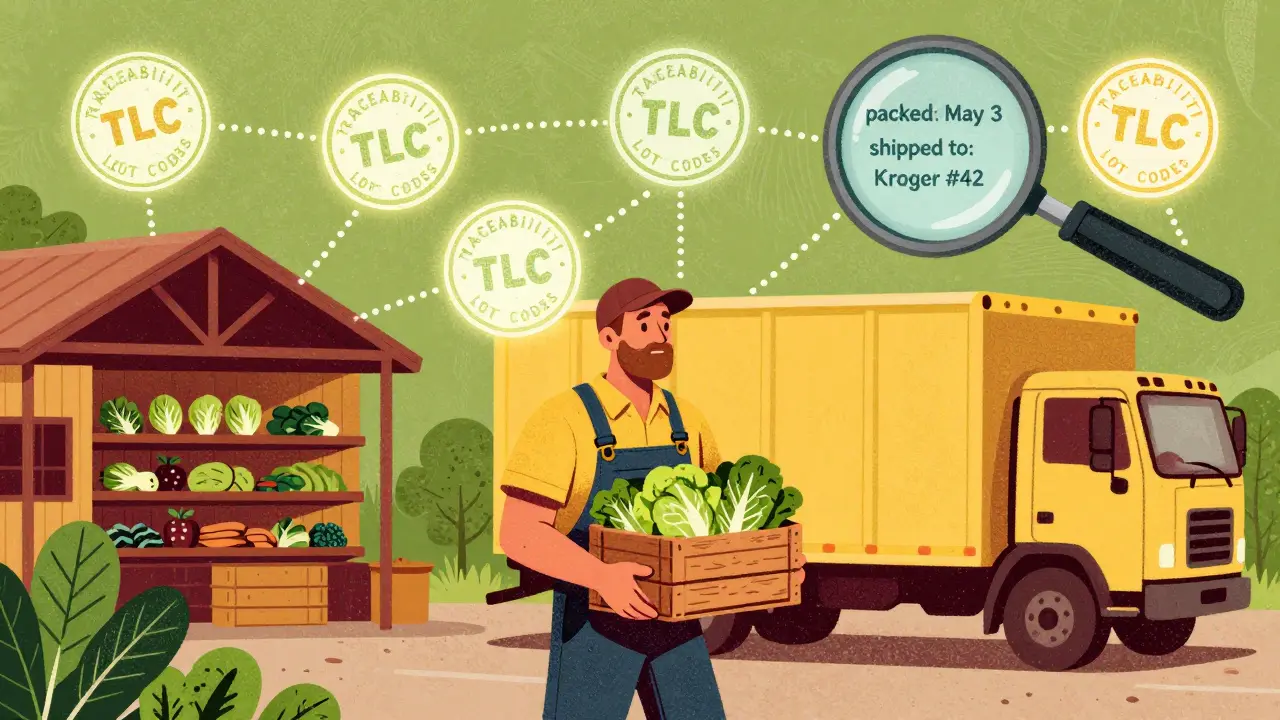
When a foodborne illness outbreak hits, every hour counts. The FDA doesn’t have weeks to track down where contaminated lettuce or eggs came from. That’s where lot number tracking comes in - a system designed to cut response times from weeks to hours. Under the FDA’s Food Traceability Rule, companies handling high-risk foods must use a Traceability Lot Code (TLC) to link every batch from farm to fork. This isn’t just paperwork. It’s a lifeline for public health.
What Is a Traceability Lot Code (TLC)?
A Traceability Lot Code isn’t your typical internal batch number. It’s a unique, standardized identifier assigned at specific points in the supply chain to track food that’s been flagged as high-risk. The FDA defines it as an alphanumeric descriptor that uniquely identifies a traceability lot within a company’s records - and crucially, it must remain consistent as the product moves from one handler to the next. Unlike old-school lot codes that companies used only for their own quality control, TLCs are mandatory for foods on the FDA’s Food Traceability List (FTL). These include leafy greens, tomatoes, onions, fresh-cut fruits and vegetables, soft cheeses, eggs, nut butters, and certain seafood. Together, these foods make up about 15% of the U.S. food supply by volume. The TLC ties directly to seven Key Data Elements (KDEs), like where the food was packed, how much was shipped, and who received it. If the FDA needs to investigate an outbreak, they can ask for these records - and companies have just 24 hours to deliver them electronically.When and Where Lot Codes Are Assigned
The FDA doesn’t let companies assign TLCs whenever they want. There are only three approved moments when a TLC must be created:- When raw agricultural commodities (like lettuce or tomatoes) are first packed at the farm or packing house - except for seafood from fishing vessels.
- When seafood from fishing vessels reaches its first land-based receiver.
- When food is transformed - meaning it’s cooked, chopped, mixed, or repackaged into a new product.
How the FDA Uses TLCs During Outbreaks
Before this system, investigators had to chase down paper records, phone calls, and scattered spreadsheets. One outbreak could take weeks to trace. In 2018, a multistate E. coli outbreak linked to romaine lettuce took over two months to resolve. By then, thousands were sick, and millions of pounds of lettuce were destroyed unnecessarily. Now, when someone gets sick, the FDA pulls the TLC from the patient’s food sample or a retail receipt. They use that code to trace backward through the supply chain. A single code can reveal every facility that touched the product - from the farm that grew it, to the distributor that shipped it, to the grocery store that sold it. The goal? To isolate the source within hours, recall only the affected batches, and prevent more people from getting sick. The FDA estimates this system could reduce foodborne illness outbreaks by 20-30%. That’s tens of thousands of preventable illnesses each year. In pilot programs between 2019 and 2021, traceability speeds improved by over 80%. One test showed a contaminated bag of spinach traced back to its farm in under 48 hours - something that used to take 17 days.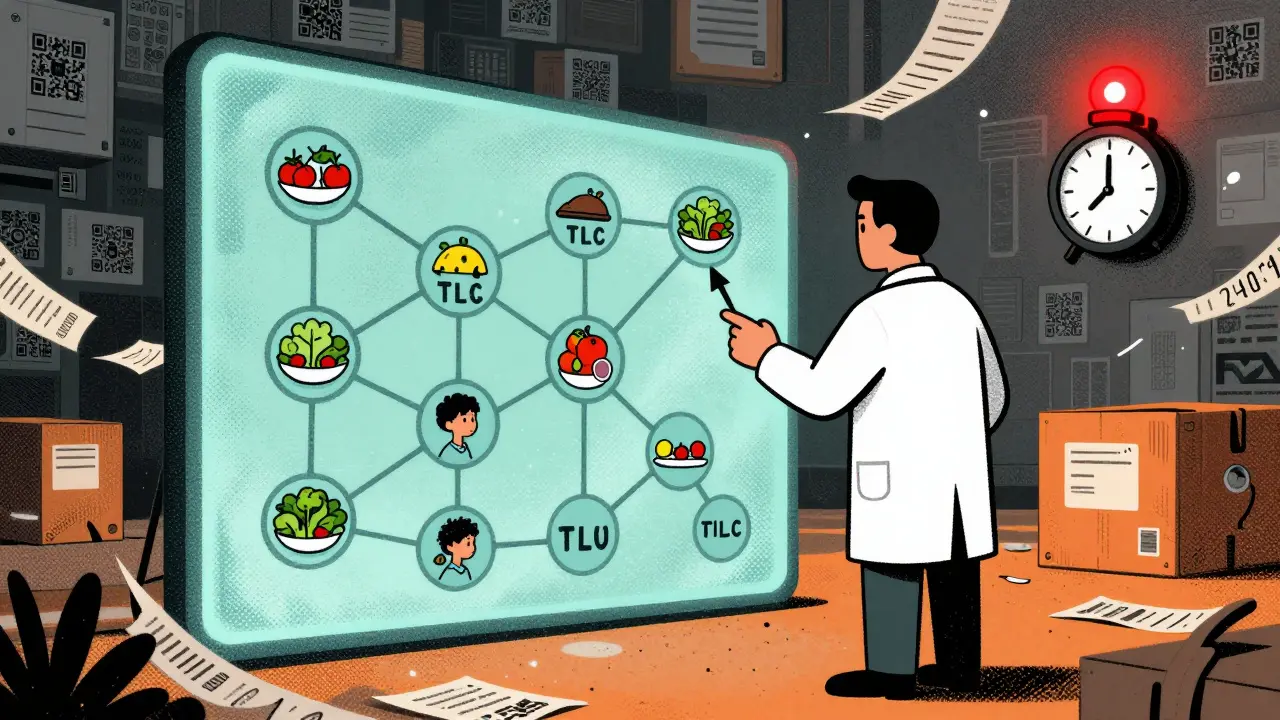
Why This System Is Different From Old Lot Codes
Many companies already used lot codes for internal tracking. But those were often inconsistent. One company might use a Julian date + product code. Another might use a random string. Some didn’t track beyond their own warehouse. The TLC system fixes that by requiring:- Uniform assignment points
- Linkage to seven specific data elements
- Electronic records that can be exported in CSV or similar formats
- Immediate availability to the FDA during investigations
Industry Challenges and Real-World Hurdles
Despite its benefits, the system isn’t easy to implement. A 2023 survey found that 71% of companies struggle to ensure all supply chain partners use TLCs correctly. Small farms and processors face the biggest hurdles. Many still rely on paper logs or outdated software that can’t handle the new requirements. One major complaint? Tandem coding. Companies had to maintain both their old internal lot codes and the new TLC - doubling the work. The FDA responded by clarifying that any existing code can serve as the TLC, as long as it meets the requirements. That helped - but many businesses still spent thousands upgrading systems. Large companies like Walmart and Kroger already use blockchain systems that go beyond the FDA’s rules. But for smaller players, options are limited. About 72% of large firms modified their ERP systems. Smaller ones either bought traceability software (21%) or stuck with manual tracking (7%). The FDA offers free training modules and a Traceability Assistance Program for small businesses, but awareness is still low. A 2023 Government Accountability Office report found only 42% of small and medium businesses knew about the rule.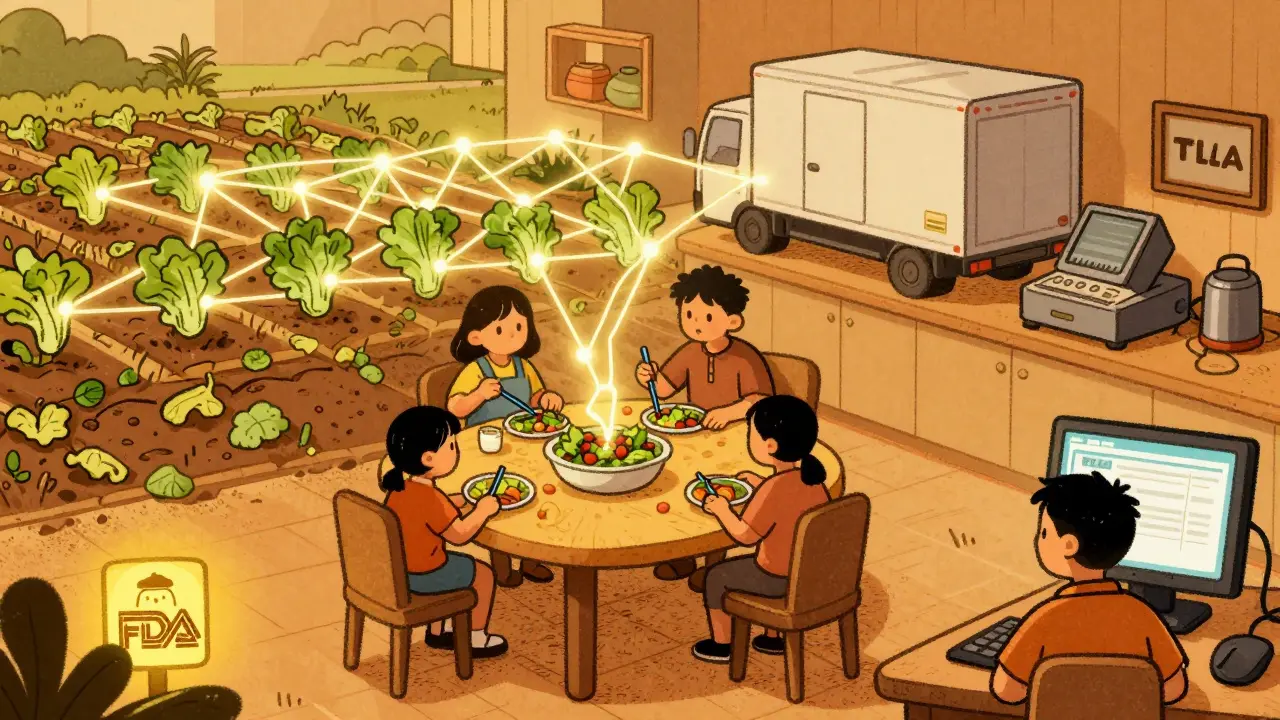


15 comments
rachel bellet
The FDA's Traceability Lot Code system is a monumental leap forward in public health infrastructure. The mandatory linkage to seven Key Data Elements? Non-negotiable. The 24-hour electronic record requirement? Exactly what we needed after decades of fragmented, paper-based chaos. This isn't just compliance-it's a paradigm shift in food safety governance. If you're still using Julian dates or handwritten logs, you're not just behind-you're endangering lives. The data integrity here is non-trivial, and the audit trail? Impeccable. No more guessing. No more delays. Just traceability, standardized, enforced, and actionable. Period.
Pat Dean
Let me get this straight-Americans are now forced to follow some bureaucratic code just to eat a damn salad? Who gave the FDA the right to dictate how small farms label their produce? This is socialist overreach disguised as safety. I’ve never heard of anyone getting sick from lettuce that wasn’t already washed three times. This is just another way for big agribusiness to crush the little guy with red tape.
Jay Clarke
Bro, this is the most important thing the government has done in a decade. Imagine if your phone had a serial number that tracked every repair, every owner, every firmware update-that’s what TLC is for food. We’ve been flying blind for too long. Remember that 2018 romaine outbreak? People were dying because nobody knew where the damn lettuce came from. Now? One code, one trace. It’s like having a GPS for your grocery cart. The FDA didn’t just update a policy-they rewrote the rules of food safety. Respect.
Chuck Dickson
If you’re reading this and you’re a small farmer or local producer-don’t panic. This isn’t about crushing you. It’s about empowering you. You’ve got free training, free tools, and a whole system designed to protect your reputation. A clean TLC means customers trust you. Big retailers are already demanding it. This is your chance to stand out-not get buried. Start small: map your process, pick one code that works, document it. You don’t need blockchain. You just need consistency. And hey-you’re not alone. We’ve got your back.
Robert Cassidy
They say this reduces outbreaks by 20-30%. But what if the real problem is that the FDA’s testing is flawed? What if they’re just chasing ghosts because they’re pressured to show ‘results’? And why are we trusting a federal agency that can’t even track its own budget? This system looks good on paper-but who’s auditing the auditors? I’ve seen how data gets manipulated. This is just another shiny object to distract us from the real issue: corporate consolidation and industrial farming.
Naomi Keyes
Wait-did you know that the FDA’s Traceability Lot Code must be assigned at ONE of THREE specific points?!! Not four! Not five! THREE!! And if you assign it anywhere else? You’re non-compliant!! And you must link it to SEVEN Key Data Elements!! Not six!! Not eight!! SEVEN!! And you must deliver them electronically within 24 HOURS!! Not 25!! Not 30!! 24!! And if you don’t? Fines!! Recalls!! Shutdowns!! So please-stop posting opinions and start reading the Federal Register!!
Dayanara Villafuerte
So basically… the FDA just turned our groceries into blockchain-enabled barcodes 🤯 🥬 🥕 🧀 And honestly? I’m here for it. No more ‘oh no, is my hummus gonna kill me?’ anxiety. I used to scan QR codes for product info-now I’m scanning for safety. It’s like food has a LinkedIn profile. 👌👏 #FoodSafetyWins #TLCForTheWin
Andrew Qu
One thing people miss: this system doesn’t just help the FDA-it helps farmers too. When a contamination happens, you don’t get blamed for the whole crop. Only your lot gets pulled. That’s huge for small producers who can’t afford to lose everything. The key is making sure your code is unique and tied to the right data. If you’re unsure, reach out to your local extension office. They’ve got guides. They’ve got examples. You don’t have to figure this out alone.
kenneth pillet
the fda thing makes sense. i dont get why its so hard for some farms. just use the same code you already have. no need to overcomplicate it. i saw a guy at the farmers market use a sharpie on a sticker. worked fine.
Jodi Harding
They say it’s about safety. But let’s be real-this is about control. Who gets to decide what’s ‘high-risk’? Who gets to decide what data matters? The FDA doesn’t answer to us. And once they have this system fully embedded… what’s next? Mandatory DNA tagging? GPS trackers on eggs? This isn’t traceability. It’s surveillance with a side of spinach.
Danny Gray
Interesting how they call this ‘transformation’ when you chop an onion. So if I dice it, it’s a new lot. But if I just peel it? Same lot. That’s not logic-that’s arbitrary bureaucracy. Why not just track the whole field? Why split hairs over chopping? This system feels like it was designed by someone who’s never held a knife.
Tyler Myers
They say it’s about food safety… but I’ve read the GAO report. Only 42% of small businesses even know about this. Coincidence? Or is this a slow rollout to force compliance through confusion? What if the real goal is to consolidate food production into the hands of big corporations who can afford the software? The FDA doesn’t care about you. They care about their budget line. This isn’t safety. It’s corporate consolidation dressed up as regulation.
Zoe Brooks
Honestly? I’m just glad we’re moving toward something that works. I used to worry about every salad. Now I know there’s a system trying to catch the bad stuff before it hits the shelf. I don’t need to understand all the tech. I just need to know it’s there. And if it helps even one kid avoid E. coli? Worth it. Let’s not overthink it. Safety shouldn’t be a debate. It should be a given.
Kristin Dailey
America leads the world in food safety. This is proof. Other countries are scrambling to copy this. We built it. We enforce it. We protect our people. No other nation has this kind of infrastructure. Stop complaining. Be proud.
Aysha Siera
why do americans trust government so much? in india we know labels are fake. who checks the lot code? who really knows if the data is real? this system looks good but in practice? corruption. paper records are easier to fake than digital ones. the rich will always cheat. the poor will pay.