
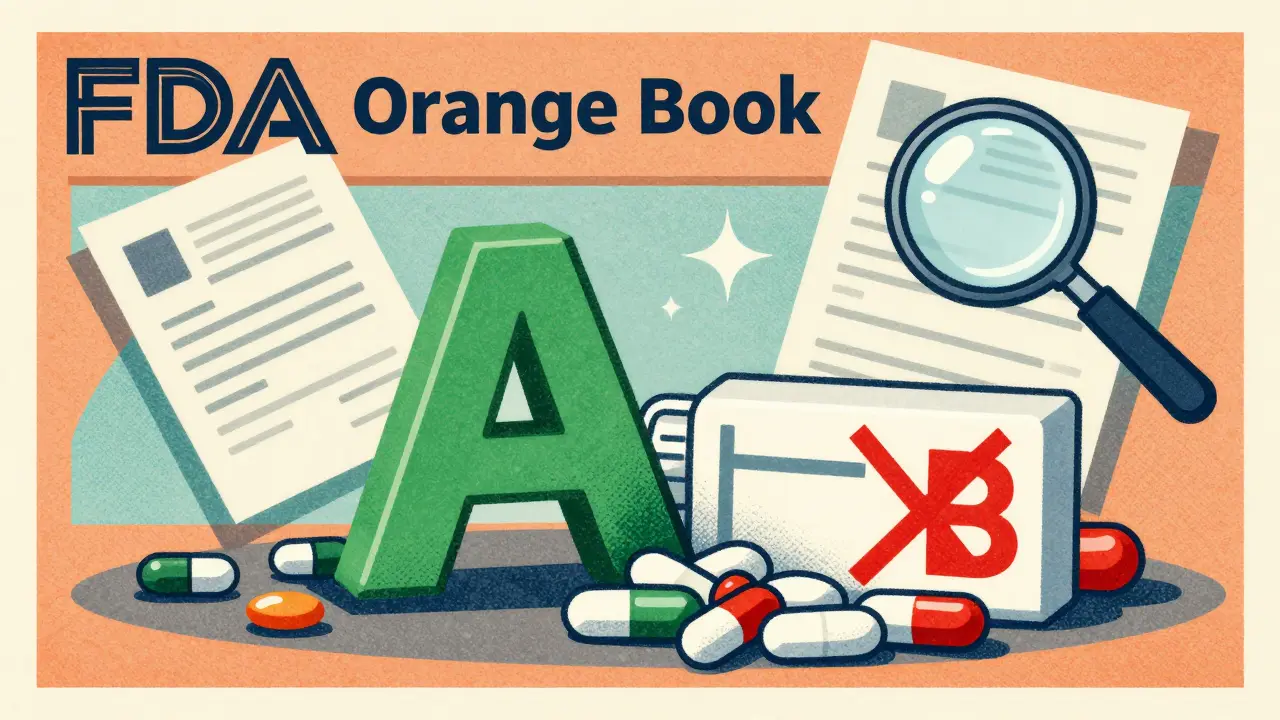
The FDA Orange Book is the single most important document for anyone who needs to know which generic drugs can legally replace brand-name medicines in the U.S. It’s not just a list-it’s the rulebook that tells pharmacists, doctors, insurers, and drug companies exactly which generics are safe to swap in place of expensive brand-name pills. If you’ve ever picked up a generic prescription and wondered why it was allowed to replace the name-brand version, the answer is in the Orange Book.
What the FDA Orange Book Actually Is
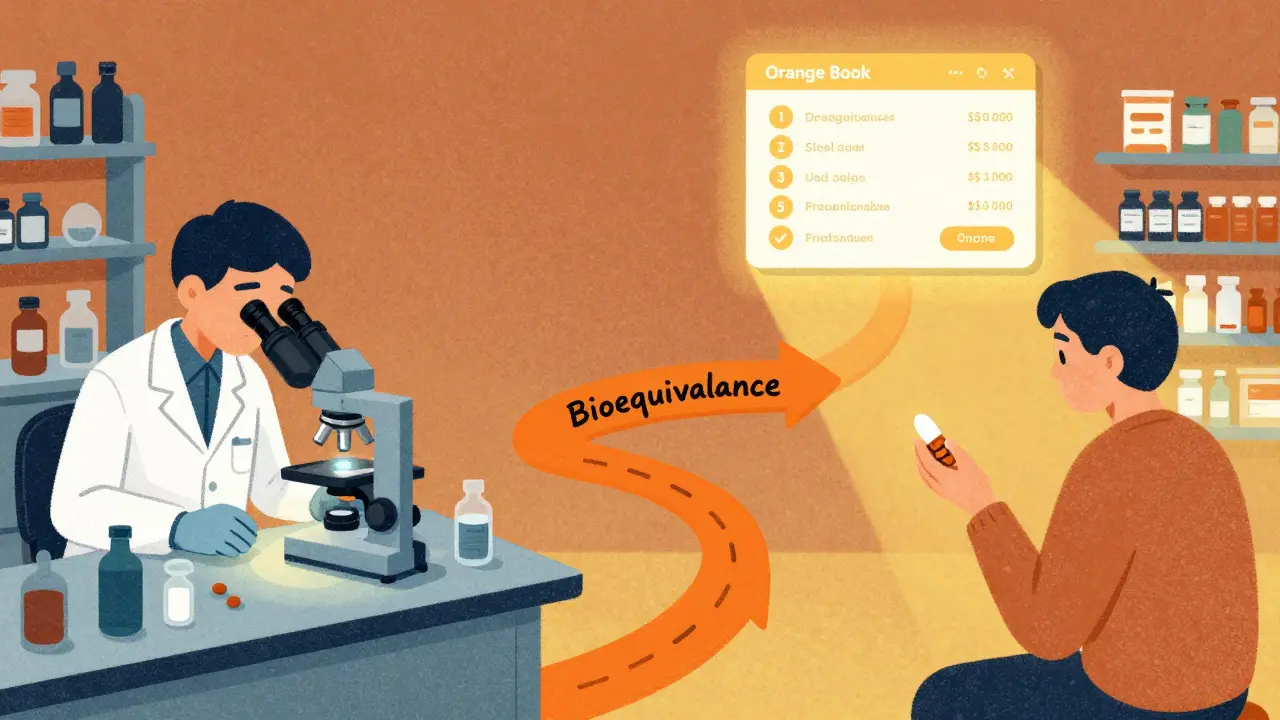
The official name is Approved Drug Products with Therapeutic Equivalence Evaluations. It’s been around since 1984, created as part of the Hatch-Waxman Act to make it easier for generic drugs to enter the market without re-proving safety and effectiveness from scratch. The FDA doesn’t test every generic drug itself. Instead, it relies on a shortcut: if a generic proves it behaves the same way in the body as the original brand-name drug, it gets approved.
That’s where therapeutic equivalence comes in. The Orange Book assigns every approved drug a code-usually an “A” or “B”-that tells you whether it’s interchangeable. An “A” code means the generic is considered bioequivalent and can be substituted without any concern. A “B” code means there’s uncertainty, and the pharmacist might need to check with the prescriber before swapping.
As of late 2023, the Orange Book listed over 16,000 approved drug products. Roughly 90% of all prescriptions filled in the U.S. are for generics, and nearly all of those substitutions are guided by this one document.
How Generic Drugs Get Listed
Generic drugs don’t go through the same long, expensive approval process as brand-name drugs. Instead, they use what’s called an Abbreviated New Drug Application, or ANDA. To get approved, the generic maker must prove two things: their drug has the same active ingredient, strength, dosage form, and route of administration as the original-and it’s absorbed into the body at the same rate and to the same extent.
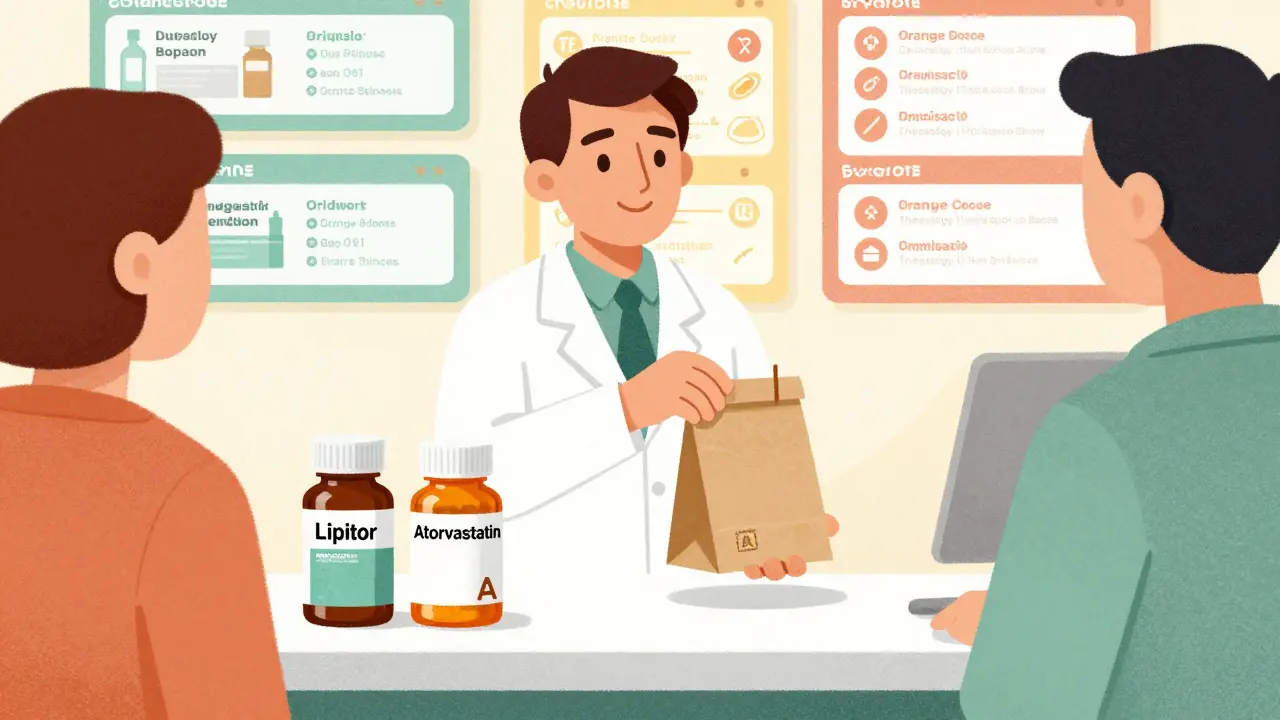
The original brand-name drug is called the Reference Listed Drug, or RLD. In the Orange Book, every generic is linked to its RLD. If you search for a drug like Lipitor (atorvastatin), you’ll see the brand listed as the RLD, followed by dozens of generics-all marked as “No” in the RLD column. Each one has been approved because it matches the RLD’s performance.
The FDA doesn’t test these generics directly. It reviews data submitted by the manufacturer-usually from clinical bioequivalence studies-and approves if the evidence meets the standard. Once approved, the drug appears in the Orange Book the following month. The process is fast: in 2023, the average review time for an ANDA was just 10 months, down from over three years in 2010.
Therapeutic Equivalence Codes: What the Letters Mean
The TE code is the most critical piece of information in the Orange Book for pharmacists. It’s not just a label-it’s a legal signal.
- A codes mean the drug is therapeutically equivalent. These are the ones pharmacists can swap automatically, unless the prescriber writes “dispense as written.”
- B codes mean the drug is not considered equivalent. This could be due to inconsistent absorption, different inactive ingredients, or formulation issues. These generics can’t be substituted without a doctor’s permission.
- BN means the drug has no generic competitors. It’s a single-source product, often because patents or exclusivity are still in effect.
- AB1, AB2, etc., indicate multiple generics that are equivalent to the same RLD. The number just helps distinguish between them.
For example, if you look up metformin, you’ll see dozens of A-coded generics. But if you search for a complex inhaler like Advair, you might see fewer A codes-because matching the delivery system is harder. The Orange Book doesn’t always reflect real-world interchangeability for these products, which is why some pharmacists say they still need to use clinical judgment.
Authorized Generics: The Hidden Option
There’s another kind of generic you won’t find in the Orange Book: the authorized generic. These are brand-name drugs made by the original company but sold under a different label-often at a lower price. For example, the maker of Viagra might sell a generic version of sildenafil under its own name, with no brand logo.
Authorized generics aren’t approved through ANDAs. They’re marketed under the original NDA, so they’re not listed in the Orange Book. Instead, the FDA keeps a separate, quarterly updated list on its website. This list includes the brand name, the manufacturer, and when the authorized generic entered the market.
Why does this matter? Because authorized generics are often the first generics to hit the market after patent expiry-and they’re identical to the brand. Many patients don’t realize they’re getting the exact same pill, just cheaper.
Patents and Exclusivity: The Hidden Barriers
The Orange Book isn’t just about equivalence-it’s also where drug companies list their patents. This is where things get complicated.
When a brand-name company applies for FDA approval, it must list any patents that cover the drug’s chemical structure, formulation, or specific medical uses. These patents are published in the Orange Book. If a generic company files an ANDA and challenges one of those patents, the brand company can sue, triggering a 30-month legal hold on the generic’s approval.
Between 2005 and 2022, the number of patents listed in the Orange Book nearly doubled-from 8,000 to over 14,000. Critics call this “patent evergreening”-where companies file multiple narrow patents to delay competition. Supporters say it protects real innovation.
The FDA doesn’t decide which patents are valid. It just lists what’s submitted. That’s led to legal battles. In 2022, a federal court questioned whether the FDA had the authority to reject certain patents that seemed designed only to block generics. The system is under pressure to change.
How to Use the Electronic Orange Book
The FDA’s Electronic Orange Book is free and easy to use. Here’s how to find what you need:
- Go to the search page and choose “Active Ingredients” or “Proprietary Name.”
- Enter the drug name-like “losartan” or “Synthroid.”
- Look at the results under “Dosage Form; Route.”
- Find the RLD (marked “Yes”) and then see all the generics below it (marked “No”).
- Check the TE code next to each generic.
For combination drugs (like those with two or three active ingredients), you’ll need to search each ingredient separately. Some products, like inhalers or eye drops, are harder to match, and the TE codes may not capture all the nuances.
Pharmacists and pharmacy benefit managers use automated systems that pull data directly from the Orange Book API. That API, launched in 2022, now handles over 2 million queries a month. But 41% of pharmacy systems still need human review because the data isn’t always clear-cut.
Why This Matters to You
If you’re a patient, the Orange Book is why your $200 brand-name pill became a $10 generic. It’s why your insurance company pushes you toward generics. It’s why your pharmacist can legally swap your medication without calling your doctor.
If you’re a prescriber, you need to understand TE codes. If you write a prescription for a drug with a “B” code, you’re telling the pharmacist: don’t substitute. If you don’t know the difference, you might accidentally block a cheaper option.
If you’re a generic drug maker, your entire business depends on accurate Orange Book listings. A misclassified TE code can delay market entry by a year or more. A patent that’s listed incorrectly can trigger lawsuits and block competitors.
The system isn’t perfect. Pharmacists report confusion with complex products. Patients sometimes get different generics from month to month and wonder why the pill looks different. And not all states have the same substitution laws.
But the Orange Book works. It’s the reason the U.S. spends less on prescription drugs than any other developed country, while still approving hundreds of new generics every year. The FDA is working on a “Digital Orange Book” by 2025 that will update in real time and make the data easier to use. Until then, it remains the backbone of America’s generic drug system.
What’s Next for the Orange Book
The FDA is under pressure to clean up outdated or misleading patent listings. In January 2023, it issued new guidance to prevent companies from listing patents that don’t actually cover the drug’s approved use. Commissioner Robert Califf said this was about “removing inappropriate barriers to generic competition.”
At the same time, the agency is testing more detailed equivalence ratings for complex drugs-like inhalers, injectables, and topical creams-where traditional bioequivalence studies don’t always capture real-world performance.
The goal is simple: make sure patients get the right drug, at the right price, without unnecessary delays. The Orange Book won’t disappear. But it’s evolving to keep up with modern medicine.
Is the FDA Orange Book the same as Drugs@FDA?
No. Drugs@FDA is a database that shows all drug applications submitted to the FDA, including those still under review. The Orange Book only includes drugs that have been fully approved and are on the market. A drug might appear in Drugs@FDA with a tentative approval, but it won’t show up in the Orange Book until the approval is final.
Can I trust the therapeutic equivalence codes?
For most drugs, yes. The FDA’s standards for bioequivalence are strict. But for complex products like inhalers, nasal sprays, or topical creams, the codes may not fully reflect real-world differences. Some pharmacists report cases where two A-coded generics behaved differently in patients. Always check with your pharmacist if you notice changes in how a medication works.
Why do some generics look different even if they’re the same?
By law, generic drugs don’t have to look like the brand-name version. The shape, color, or markings can be different because trademarks belong to the original manufacturer. But the active ingredient, strength, and how the body absorbs it must be the same. If you’re concerned, ask your pharmacist for the TE code and confirm it’s an “A” code.
Are all generic drugs cheaper than brand-name drugs?
Almost always, yes. Once multiple generics enter the market, prices drop by 80-90%. But if a drug has no competitors-marked as “BN” in the Orange Book-it can still be expensive. That’s why the FDA encourages fast approval of generics to increase competition.
Do authorized generics show up in the Orange Book?
No. Authorized generics are sold under the original brand’s NDA, not as an ANDA, so they’re not listed in the Orange Book. Instead, the FDA maintains a separate list of authorized generics on its website. These are often the first generics available after a brand’s patent expires.
How often is the Orange Book updated?
The FDA updates the Electronic Orange Book every month. New approvals, patent changes, and discontinued products are added or removed within 30 days of the decision. You can check the “Last Updated” date on the site to see when the data was refreshed.



13 comments
John O'Brien
This Orange Book thing is wild. I got my blood pressure med switched to a generic last month and it felt totally different. My pharmacist said it was an A code, but my heart was racing for two days. Guess the FDA doesn't test how you feel after swallowing it, just the blood levels.
Shit's broken.
Paul Taylor
The Orange Book is the unsung hero of American healthcare it’s what keeps drug prices from exploding into the stratosphere without requiring the government to negotiate prices directly it’s what lets a 72-year-old on fixed income afford their statin instead of choosing between insulin and groceries and yes it’s not perfect but the alternative is a system where every pill costs a mortgage payment and we all know what happens when you let monopolies run healthcare
Desaundrea Morton-Pusey
So the FDA just trusts drug companies to tell the truth about their generics? Lol. And we wonder why people die from bad meds. This whole system is a corporate shell game. They list patents like they’re collecting baseball cards just to delay generics. The FDA’s just a puppet. I bet they get kickbacks.
Murphy Game
They’re not listing all the patents. I’ve seen it. Big Pharma pays off the FDA reviewers. The TE codes? Fake. The ‘A’ codes? Just a marketing trick. I know a guy who works at a compounding pharmacy-he says 30% of the so-called ‘equivalent’ generics cause weird side effects because the fillers are different and the FDA doesn’t care. They just want you to think it’s safe. It’s not.
April Williams
I can’t believe people still trust this. My mom switched to a generic for her thyroid and ended up in the ER. The Orange Book said it was fine. Turns out the generic had a different binder that made her cortisol crash. The FDA didn’t test that. The pharmacist didn’t know. The doctor didn’t care. And now she’s on disability. This isn’t science. It’s capitalism with a white coat.
Harry Henderson
If you’re not using the Orange Book, you’re leaving money on the table. I work in pharmacy and I tell every patient: check the TE code. If it’s AB1 or AB2, you’re getting the same pill for 10% of the price. Stop letting Big Pharma scare you. This isn’t magic-it’s math. Save your cash. Fight the system. The Orange Book is your weapon.
suhail ahmed
In India we call this the ‘copycat medicine’ system but honestly it’s genius. The Orange Book is like a public library for drug equivalence. I’ve seen generics made here that are cheaper than the brand and just as good. The FDA’s system is flawed but it’s the best we got. What matters is access. If you can’t afford your medicine, the Orange Book is your only friend.
Candice Hartley
I just looked up my antidepressant and saw 12 A-coded generics 😮 I had no idea! My pharmacist never explained it. So it’s not just about price-it’s about which one your body tolerates? That’s wild. I’m gonna ask next time. 🙏
astrid cook
I’ve been reading this post for 20 minutes and I still don’t trust any of it. The FDA is a puppet. The Orange Book is a lie. You think they really care if your generic works? They care about profit. Look at the patents. Look at the delays. Look at the authorized generics. It’s all rigged. You’re being played.
Andrew Clausen
The post incorrectly states that the FDA does not test generics. This is inaccurate. The FDA reviews bioequivalence data submitted by manufacturers, which includes clinical studies conducted under FDA-regulated conditions. The agency does not conduct the studies itself, but it rigorously evaluates the methodology, statistical analysis, and results. To claim the FDA ‘doesn’t test’ is a misrepresentation of regulatory science.
Anjula Jyala
The TE codes are based on pharmacokinetic parameters Cmax and AUC with 90% CI within 80-125% per FDA guidance but this doesn't account for pharmacodynamic variability especially in narrow therapeutic index drugs like warfarin or levothyroxine which require therapeutic drug monitoring and yet the Orange Book still assigns AB1 codes without considering clinical outcome data
Kirstin Santiago
I used to be terrified of generics until I learned how the Orange Book works. Now I ask my pharmacist for the TE code every time. It’s not magic, but it’s transparency. And honestly? I’ve saved over $2,000 a year just by switching. The system’s not perfect, but it’s the best thing we’ve got to fight corporate greed.
Don’t fear the generic. Learn the code.
Kathy McDaniel
i just realized my pills look different every month but the name is the same 😅 guess that’s why they’re cheaper? lol