
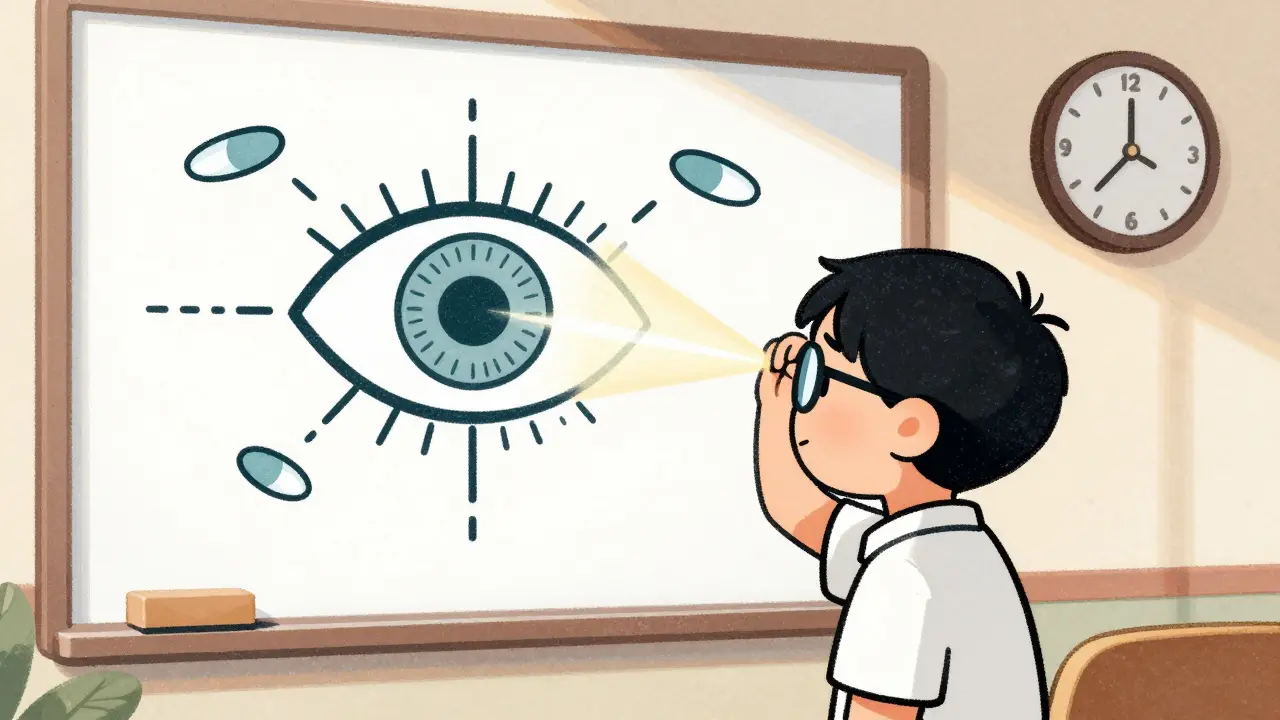
If you’ve ever squinted at the road signs while driving or held your phone farther away to read the text, you’re not alone. Roughly 54% of adults between 40 and 69 have some kind of refractive error - and that number keeps rising. These aren’t diseases. They’re simply optical mistakes in how your eye bends light. The result? Blurry vision. But here’s the good news: we know exactly how to fix them. Whether it’s glasses, contacts, or laser surgery, modern options are more effective and safer than ever.
What Exactly Are Refractive Errors?
Your eye works like a camera. Light enters through the cornea, passes through the lens, and lands on the retina at the back - the part that turns light into signals your brain understands. A refractive error happens when the shape of your eye stops light from landing perfectly on the retina. It’s not broken. It’s just misaligned. There are three main types: myopia (nearsightedness), hyperopia (farsightedness), and astigmatism. Each one messes with light in a different way. And each one has its own correction strategy.Myopia: Why Distant Objects Look Blurry
Myopia means your eye is too long - or your cornea is too curved. Instead of focusing on the retina, light lands in front of it. That’s why distant things like whiteboards, street signs, or TV screens look fuzzy. Kids often start showing signs around age 10, and it usually gets worse until their late teens or early 20s. In East Asia, up to 90% of young adults are myopic. In New Zealand and the U.S., it’s closer to 30-40%. Why the difference? Research points to two big factors: genetics and environment. If both parents are nearsighted, the child’s risk goes up. But spending less time outdoors - especially before age 12 - is a major driver. Sunlight helps regulate eye growth. Kids who play outside for at least two hours a day are less likely to develop severe myopia. Correction is simple: minus (-) lenses. These glasses or contacts spread light out slightly so it hits the retina correctly. For kids with rapidly progressing myopia, doctors now use special overnight contact lenses (Ortho-K) or low-dose atropine eye drops. These don’t cure it, but they can slow progression by up to 80% over two years.Hyperopia: The Hidden Farsightedness
Hyperopia is the opposite. Your eye is too short, or your cornea is too flat. Light focuses behind the retina. You might think this means you see far away clearly - and you do. But here’s the twist: your eyes have to work harder to focus on anything close. That’s why reading a book, texting, or sewing can cause headaches, eye strain, or fatigue - especially after age 40. Many kids are born slightly farsighted. Their eyes are small, and their lenses are flexible. As they grow, their eyes lengthen and the problem often disappears. But if it doesn’t, it can cause lazy eye or crossed eyes in children if left uncorrected. Adults with hyperopia usually need plus (+) lenses. These bend light inward so it lands on the retina. Unlike myopia, hyperopia doesn’t always show up on school vision screenings. That’s why adults who suddenly struggle with reading small print - even if they see distance fine - should get checked. It’s not just aging. It could be uncorrected farsightedness.
Astigmatism: The Irregular Curve Problem
Astigmatism isn’t about eye length. It’s about shape. Instead of being perfectly round like a basketball, your cornea or lens is more like a football. That means light doesn’t focus on one point - it focuses on two or more. The result? Blurry or distorted vision at all distances. You might see double images, glare at night, or feel like you’re looking through water. About 30-60% of people have some level of astigmatism. It’s often present from birth, but mild cases go unnoticed. It can happen alone or with myopia or hyperopia. The tricky part? The correction isn’t just power. It’s angle. Cylinder lenses must be oriented at a specific axis - say, 175 degrees - to work. If the axis is off by even 5 degrees, vision stays blurry. That’s why some people report weeks of discomfort after getting new glasses. It’s not the lenses. It’s the axis. Modern lenses use wavefront mapping to detect even tiny irregularities. That means your prescription can be more precise than ever. Soft toric contact lenses and custom LASIK can now correct astigmatism with high accuracy. But if you’ve had poor results before, don’t assume it’s your fault. Ask for a topography scan. It’s not always included in basic exams.How Correction Methods Compare
You have three main choices: glasses, contacts, and surgery. Each has pros, cons, and trade-offs.- Glasses: Fast, safe, and reversible. No risk of infection. But they can fog up, slip down your nose, or break. People report high satisfaction - 4.2 out of 5 on average. Kids are more likely to wear them if they help pick the frames.
- Contact Lenses: Wider field of view. No frames. But they require daily care. Around 3-4% of wearers develop a serious eye infection called microbial keratitis. Daily disposables are safest. Soft toric lenses now correct astigmatism better than ever. Still, many users report discomfort after 8 hours.
- Refractive Surgery (LASIK, PRK, SMILE): Permanent correction. Most people see clearly the next day. Satisfaction scores hit 4.5 out of 5. But not everyone qualifies. You need a stable prescription for at least a year, corneas thicker than 500 microns, and to be over 18. About 20-40% get dry eyes after surgery. Night glare and halos are common at first. SMILE is newer, causes less dryness than LASIK, and is growing fast - expected to rise 15% yearly through 2028.
Who Should Consider Surgery?
Surgery isn’t for everyone. But if you’re tired of glasses, hate cleaning contacts, or have a job where eyewear is a hazard (think firefighter, athlete, mechanic), it’s worth exploring. You’re a good candidate if:- Your prescription hasn’t changed in 12 months
- Your corneas are thick enough (measured with a pachymeter)
- You’re over 18
- You don’t have autoimmune diseases or uncontrolled diabetes
- You understand the risks: dry eyes, temporary night vision issues, rare vision loss
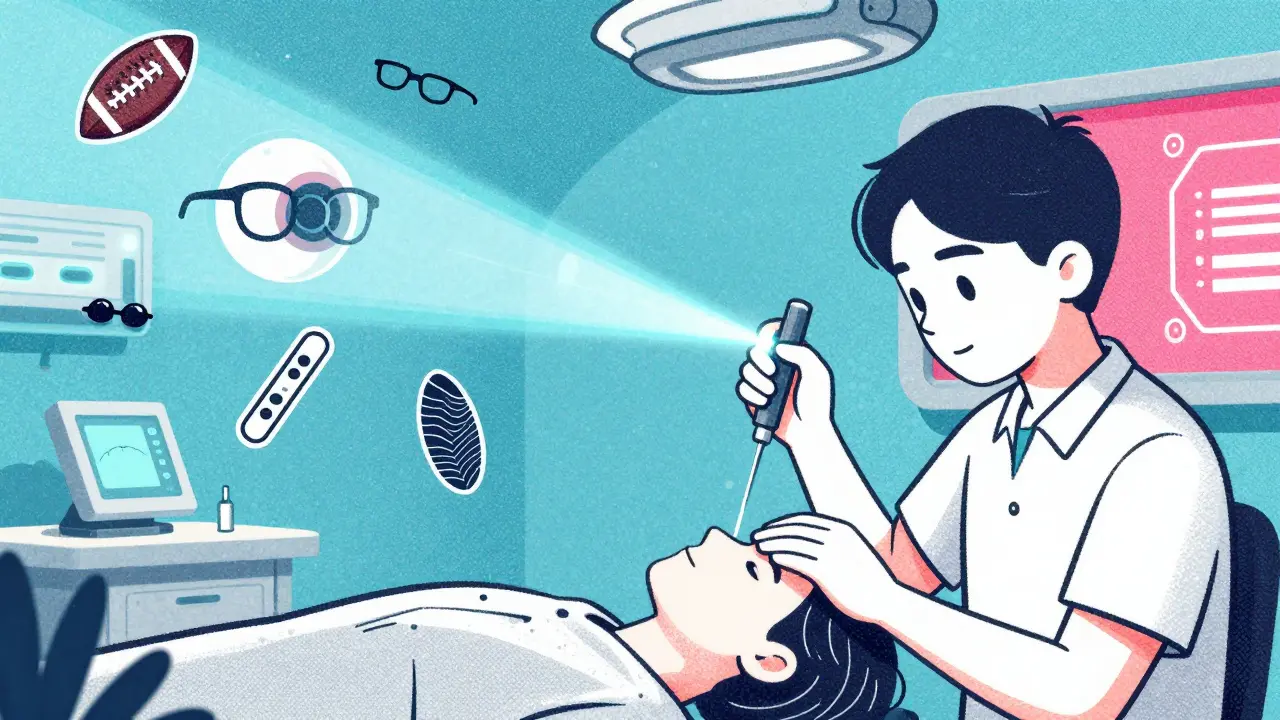
What About Kids?
Children don’t always tell you their vision is blurry. They might sit closer to the TV, rub their eyes often, or avoid reading. School screenings miss up to 25% of cases. If one parent is myopic, get your child checked by age 3. If both are, check at age 2. For kids with progressing myopia, orthokeratology (Ortho-K) lenses worn overnight can slow progression by 36-56%. Low-dose atropine drops (0.01%) are now FDA-approved for this use. Both are non-invasive, reversible, and proven. The goal isn’t just better vision. It’s preventing complications. High myopia (over -6.00 diopters) increases retinal detachment risk by 5-10 times. Early control matters.The Bigger Picture
By 2050, half the world’s population could be myopic. That’s over 5 billion people. The global eyewear market is already worth $140 billion - and growing. But access isn’t equal. In low-income countries, millions live with uncorrected refractive errors. Even in wealthy places like New Zealand, many skip eye exams because they think, “I can still see okay.” The truth? You don’t need perfect vision to function. But you do need clear vision to live well - to drive safely, read comfortably, and avoid chronic eye strain. Regular check-ups every 1-2 years (or annually if you’re over 40 or have a family history) are non-negotiable.What to Do Next
If you’re unsure about your vision:- Book a comprehensive eye exam - not just a quick vision check.
- Ask for a refraction test and corneal topography.
- Discuss your lifestyle: work, hobbies, sports.
- Ask about myopia control if you or your child is under 18.
- Don’t accept a one-size-fits-all prescription. Astigmatism needs precision.
Can refractive errors be cured permanently?
No, they can’t be cured - but they can be corrected permanently with surgery. Glasses and contacts manage the issue. LASIK, PRK, and SMILE reshape the cornea to fix how light enters the eye. After surgery, most people no longer need corrective lenses. But the eye doesn’t change back to a perfect shape; it’s just been adjusted. Natural aging (like presbyopia after 40) can still affect vision later.
Is astigmatism worse than myopia or hyperopia?
Not necessarily. Astigmatism is more complex because it affects both near and far vision at the same time. It also requires precise alignment of the corrective lens (the axis). A small error in axis measurement can make vision feel distorted - like looking through a funhouse mirror. But it’s not more dangerous. Myopia, especially high myopia, carries higher risks of retinal problems. Astigmatism is about precision. Myopia is about progression.
Can children outgrow refractive errors?
Some children outgrow mild hyperopia as their eyes grow longer. But myopia almost never goes away - it usually gets worse until the late teens. Astigmatism is usually stable from childhood onward. The key is early detection. Untreated myopia or astigmatism in kids can lead to amblyopia (lazy eye), which becomes permanent if not corrected before age 8.
Why do my new glasses make everything look curved?
That’s called distortion, and it’s common with high prescriptions - especially for myopia or astigmatism. Strong minus lenses make things look smaller and warped at the edges. It’s not broken. Your brain just needs time to adjust. Most people adapt in 3-7 days. If it lasts longer than two weeks, the prescription may be off. Ask your optometrist to check the lens power, axis, and pupillary distance.
Are contact lenses safe for daily wear?
Yes - if you follow hygiene rules. Daily disposables are safest. Never sleep in them unless they’re FDA-approved for overnight wear. Wash hands before handling. Replace the case every 3 months. About 3-4% of wearers get infections, often from poor cleaning or extended wear. If your eye turns red, painful, or sensitive to light, stop wearing them and see a doctor immediately.
Can I get LASIK if I have astigmatism?
Absolutely. Modern LASIK and SMILE procedures correct astigmatism just as well as myopia and hyperopia. Surgeons use wavefront-guided mapping to create a custom treatment plan for your unique corneal shape. Many patients with astigmatism report better vision after surgery than they ever had with glasses. But you must have enough corneal thickness and a stable prescription for at least a year.
Do I need to wear glasses forever if I’m nearsighted?
No. You can choose to stop wearing them with refractive surgery. But if you don’t have surgery, yes - you’ll likely need glasses or contacts for life. Myopia doesn’t reverse on its own. Even after 50, when presbyopia sets in, you may need two pairs: one for distance and one for reading. Or you can opt for multifocal lenses or monovision LASIK.
What’s the best way to prevent myopia in kids?
Get them outside. Two hours of daylight exposure daily reduces myopia risk by up to 50%. Limit screen time to 2 hours a day. Take breaks every 20 minutes using the 20-20-20 rule: look at something 20 feet away for 20 seconds. If one parent is myopic, schedule an eye exam before age 3. Early intervention with Ortho-K or atropine drops can slow progression dramatically.



12 comments
Angel Tiestos lopez
I used to think glasses were for nerds 🤓 until I got my first pair and realized I could finally see the face of my barista without squinting like a confused owl. Life changed. Also, why does everyone say 'just get LASIK' like it's a TikTok filter? 🤭
Pankaj Singh
This post is full of bs. 54%? Where’s your data? You’re just pushing corporate optometry. My grandma saw fine at 80 without glasses. You’re scaring people to sell lenses.
Robin Williams
Bro. I got my first pair of glasses at 12. Now I’m 34 and I’ve had LASIK twice. The first time? Life-changing. The second? Because I got lazy and stopped wearing my contacts. But here’s the truth - your eyes aren’t broken, they’re just out of sync. And yeah, go outside. Play in the sun. It’s not magic, it’s biology. 🌞
Scottie Baker
I got LASIK last year. Worst decision of my life. Dry eyes so bad I cried in the shower. Now I wear contacts with drops like it’s my job. And don’t even get me started on the glare at night. I can’t drive after dark without feeling like I’m in a damn disco. Who thought this was a good idea?
Anny Kaettano
Let’s talk about myopia progression in kids - this is critical. Ortho-K lenses + 0.01% atropine are game-changers. We’re not just correcting vision; we’re preventing retinal detachment later. The data is solid. Parents, don’t wait until they’re failing school. Get a corneal topography. It’s not optional. It’s preventative neuro-ophthalmology. And yes, it’s worth the cost. Your kid’s future retina will thank you.
Kimberly Mitchell
I don’t understand why people act like this is a medical breakthrough. We’ve had glasses since the 13th century. All this ‘wavefront mapping’ and ‘SMILE’ is just marketing. You’re still just bending light. Stop overcomplicating it.
Angel Molano
Stop lying to parents. Kids don’t outgrow myopia. It gets worse. If you’re not using atropine or Ortho-K by age 10, you’re neglecting your child’s vision.
Vinaypriy Wane
I’ve been wearing toric lenses for 12 years. The axis? Always off. Every. Single. Time. I’ve had three pairs where the optometrist just guessed. I ended up with migraines. Now I demand a topography scan - and I make them show me the printout. If they won’t, I walk out. Your eyes aren’t a suggestion box.
Diana Campos Ortiz
I got my first pair of glasses at 16 and cried because I thought I looked ‘dorky.’ Now I collect frames like they’re art. My favorite? Tortoiseshell cat-eye with gold hinges. Vision isn’t just about clarity - it’s about identity. And yeah, I still use drops for dry eyes after 10 hours on Zoom. We’re all just trying to see the world a little clearer.
Jesse Ibarra
I’ve seen people get LASIK and then go back to scrolling on their phones for 12 hours a day. Like, congrats, you fixed your eyes - now you’re going to destroy them again. You don’t get to opt out of consequences. This isn’t a magic wand. It’s a tool. Use it responsibly or don’t bother.
laura Drever
i got astigmatism and my glasses still make everything look like a funhouse mirror. also why do all the lenses feel like plastic bricks? 🤡
Randall Little
So let me get this straight - we’ve got 5 billion people projected to be myopic by 2050, but we’re still treating this like a personal choice instead of a public health crisis? We don’t have enough optometrists in rural India, and in the U.S., insurance won’t cover kids’ myopia control. This isn’t about lenses. It’s about systemic neglect disguised as innovation.