
The goal of medication dosing adjustments is to balance therapeutic efficacy with safety. It's a precision game where clinicians must account for how a person's body distributes a drug and how quickly their organs can get rid of it. For many, especially those with chronic kidney disease, these adjustments are the only thing preventing severe toxicity.
The Role of Kidney Function in Drug Clearance
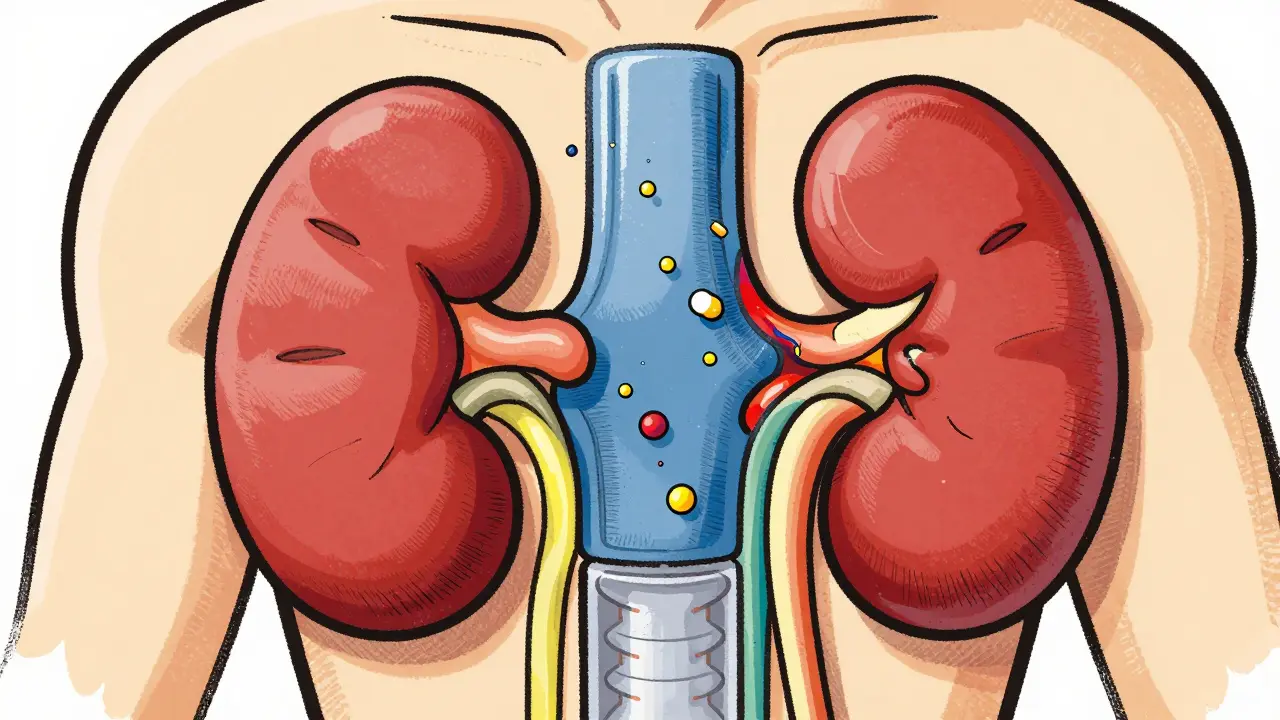
Your kidneys act as the body's filtration system. When they aren't working at 100%, drugs that are primarily cleared by the renal system linger longer. To manage this, doctors use specific metrics to estimate how well the kidneys are performing.
One of the most common tools is Creatinine Clearance (CrCl), which is an estimate of the rate at which the kidneys clear creatinine from the blood. While it's an indirect measure, it's still the gold standard for drug dosing. In fact, roughly 85% of FDA drug labels still base their dosing recommendations on CrCl.
Another key metric is the estimated Glomerular Filtration Rate (eGFR). This is a more modern calculation used primarily for staging Chronic Kidney Disease (CKD). While eGFR is great for knowing what stage of kidney disease a patient has, it can sometimes be misleading when calculating a specific drug dose, especially in people with extreme body weights.
How Age and Weight Change the Math
You can't just look at a lab report; you have to look at the patient. Age and weight drastically change the "volume of distribution"-basically, how much space a drug has to spread out in the body.
For elderly patients, kidney function naturally declines even if they don't have a diagnosed disease. A 65-year-old might have the same serum creatinine levels as a 25-year-old, but their actual filtration capacity is likely much lower. This is why the CKD-EPI equation is often preferred for seniors, as it correlates better with actual measured kidney function than older formulas.
Weight is another tricky variable. In patients with obesity (BMI >30 kg/m²), using actual body weight in a dosing formula can lead to overestimating kidney function, which results in a dose that's too high. To fix this, clinicians use Adjusted Ideal Body Weight (IBW). This prevents the common error of over-dosing a patient just because they have a higher body mass, which doesn't necessarily mean they have more functioning kidney tissue.
| Metric | Primary Use | Best For | Main Limitation |
|---|---|---|---|
| Cockcroft-Gault (CrCl) | Drug Dosing | Obese patients / FDA labels | Less accurate in the very elderly |
| CKD-EPI (eGFR) | CKD Staging | General population / Elderly | Can overestimate GFR in obesity |
Common Dosing Pitfalls and Real-World Risks
Even with these formulas, mistakes happen. A huge challenge in hospitals is the inconsistency between different drug references. One pharmacy manual might suggest one dose for a specific kidney stage, while another suggests something entirely different.
Take Metformin as an example. In patients with an eGFR below 30, this diabetes medication is typically contraindicated because it can lead to a dangerous buildup of lactic acid. Pharmacists often catch "near-misses" where patients remain on full doses long after their kidney function has dropped, putting them at risk of severe complications.
Antibiotics are another high-risk area. Drugs like Vancomycin require tight monitoring. If a dose is adjusted too aggressively based on an inaccurate eGFR, the drug levels can drop too low to fight the infection. If it's not adjusted enough, it can cause further kidney damage, creating a vicious cycle.

Step-by-Step Guide to Renal Dose Adjustment
To avoid these errors, a systematic approach is necessary. Here is the practical workflow used by clinical pharmacists to ensure safety:
- Assess Renal Function: Determine whether to use the Cockcroft-Gault formula (for dosing) or CKD-EPI (for staging).
- Select the Right Weight: Use actual body weight for most, but switch to Adjusted Ideal Body Weight if the patient's BMI is over 30.
- Check the Drug's Profile: Determine how much of the drug is excreted unchanged by the kidneys. If it's mostly metabolized by the liver, renal adjustments may not be needed.
- Apply the Adjustment Formula: Use the ratio of the patient's CrCl compared to a "normal" CrCl to scale the dose or extend the time between doses.
- Monitor and Recalculate: Kidney function can change daily in a hospital setting. Re-checking labs every 24-48 hours is critical for unstable patients.
The Future of Precision Dosing
We are moving away from "one-size-fits-all" equations. The next frontier is AI-driven algorithms that don't just look at creatinine, but also incorporate genetic markers and real-time data.
Imagine a world where a wearable device monitors your glomerular filtration rate in real-time, and your medication dose adjusts automatically via a smart-pump. This would eliminate the 5-7 minute manual calculation process and remove the human error that currently leads to thousands of avoidable healthcare costs every year. Until then, the combination of clinical judgment and a cautious approach to renal formulas remains the best defense against drug toxicity.
Why can't I just use eGFR for everything?
eGFR is excellent for diagnosing the stage of kidney disease, but most drug manufacturers developed their dosing guidelines using Creatinine Clearance (CrCl). Because the math is different, using eGFR for dosing can lead to inaccuracies, especially in patients who are very muscular or obese.
Does every medication need a dose adjustment for kidney failure?
No. Only drugs that are primarily cleared by the kidneys (renally eliminated) need adjustments. Drugs that are processed almost entirely by the liver usually do not require dose changes based on kidney function, though they may still need adjustment for age or liver health.
What is the risk of under-dosing in renal patients?
While toxicity is the main worry, under-dosing is a serious risk, particularly with antibiotics in sepsis patients. If the dose is lowered too much based on a flawed estimate, the infection may not be treated effectively, leading to worse clinical outcomes.
How does obesity affect the calculation?
In obese patients, actual body weight can lead to an overestimation of kidney function. Using Adjusted Ideal Body Weight provides a more realistic picture of the functional kidney mass, ensuring the patient doesn't receive a toxic dose.
What is the safest way to manage medications for a senior with CKD?
The safest approach is a combination of using the CKD-EPI equation for staging, the Cockcroft-Gault for dosing, and regular therapeutic drug monitoring (TDM) to check the actual levels of the drug in the blood.